

Key Points of the Announcement
- The Deal: PETRONAS Carigali is farming out a 20% non-operating interest in the 2011 North Sabah Enhanced Oil Recovery (EOR) Production Sharing Contract (PSC) to SMJ Energy (SMJE).
- The Asset: The contract covers four major offshore fields: Barton, South Furious, SF30, and St Joseph, located in shallow waters off the coast of Sabah.
- Revised Ownership:
- SEA-Hibiscus: 50% (Remains the Operator)
- PETRONAS Carigali: 30% (Reduced from 50%)
- SMJ Energy: 20% (New Entrant)
- Strategic Context: This is the second major upstream acquisition for SMJE (after the Samarang PSC in 2023) and is a direct result of the 2021 Commercial Collaboration Agreement (CCA) between Sabah and PETRONAS.
- Broad Partnership: SMJE’s role now spans the entire value chain, including 25% stakes in PETRONAS Chemicals Fertiliser Sabah and the PFLNG 3 floating LNG facility.
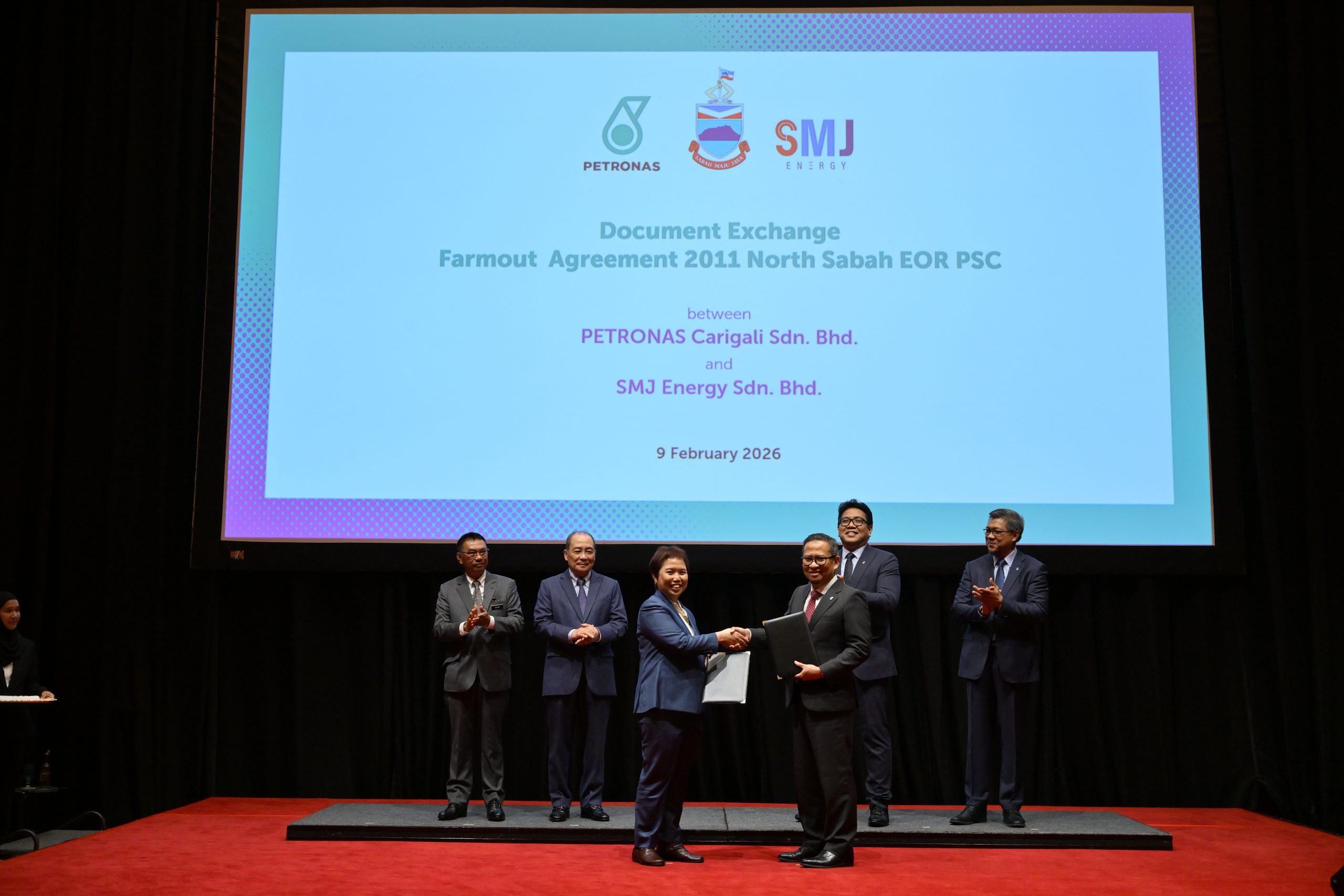
KUALA LUMPUR, Feb 10 (Bernama) — PETRONAS Carigali Sdn. Bhd. (PETRONAS Carigali), a whollyowned subsidiary of PETRONAS, has signed a Farm Out Agreement (FOA) with SMJ Energy Sdn. Bhd. (SMJE), a company wholly-owned by the Sabah State Government for the assignment and transfer of PCSB’s 20 per cent (20%) non-operating participating interest to SMJE in the 2011 North Sabah Enhanced Oil Recovery Production Sharing Contract (2011 NSEOR PSC).
Following the completion of the transaction and subject to the fulfilment of conditions precedent, PETRONAS Carigali’s non-operating participating interest will be revised to 30 per cent (30%), while SMJE will assume a 20 per cent (20%) non-operating participating interest. SEA-Hibiscus Sdn. Bhd. will continue as the operator with a 50 per cent (50%) participating interest.
The agreement was signed by PETRONAS Carigali’s Chief Executive Officer (CEO), Hazli Sham Kassim and SMJE’s CEO, Datuk Dr Dionysia Aloysius Kibat, in the presence of Sabah Chief Minister Datuk Seri Panglima Hj Hajiji Haji Noor and PETRONAS President and Group CEO Tan Sri Tengku Muhammad Taufik.
“This agreement reflects the continued commitment of both PETRONAS Carigali and SMJE to pursue win-win partnerships that accelerate value creation and strengthen Malaysia’s upstream ecosystem. By building on mutual trust, shared objectives and constructive collaboration, the participation of SMJE in the 2011 NSEOR PSC demonstrates how aligned partnerships can unlock sustainable value and advance local capability development in Sabah,” said Hazli Sham during the signing ceremony.
The 2011 NSEOR PSC encompasses the Barton, South Furious, SF30, and St Joseph fields, located in shallow waters off the coast of Sabah, offshore of East Malaysia. In 2023, PETRONAS Carigali and SMJE entered into an FOA for PETRONAS Carigali’s 50 per cent (50%) non-operating participating interest in the Samarang PSC.
Both companies are also partners in Blocks SB403 PSC, SB306A PSC and SB306B PSC. These agreements were entered into to progress the shared ambitions set out in the Commercial Collaboration Agreement (CCA) signed between the Sabah State Government and PETRONAS on 7 December 2021.
The partnership with SMJE extends beyond upstream operations, where SMJE holds a 25 per cent (25%) equity interest in PETRONAS Chemicals Fertiliser Sabah and a 25 per cent (25%) equity interest in PFLNG 3.
PETRONAS remains steadfast in strengthening its partnerships with the State and industry partners, while remaining committed to responsibly and sustainably developing Malaysia’s hydrocarbon resources.
Why It Matters to Vietnam
While this is a Malaysian domestic deal, it serves as a strategic blueprint for Vietnam for two reasons:
- Resource Sovereignty Model: Vietnam’s Petrovietnam (PVN) often manages similar complex offshore fields. Observing how Malaysia balances national interests (PETRONAS) with provincial demands (Sabah/SMJE) provides a case study on how to manage internal regional investments and local content policies.
- Regional Energy Competition: As Sabah ramps up its own “local champion” (SMJE), it becomes a more significant regional player. Vietnamese service providers (PTSC, etc.) may find new opportunities or competition as Sabah-based vendors gain more “say” and technical capability in complex EOR projects.
Why It Matters to ASEAN
- Energy Security: The North Sabah fields use Enhanced Oil Recovery (EOR)—technology that squeezes more life out of maturing fields. This is critical for ASEAN’s energy security as the region tries to slow the decline of legacy oil assets.
- The “Sabah Model” of Federalism: This deal is a significant step toward regional autonomy. In many ASEAN nations, resource-rich regions often clash with central governments. This “win-win” collaboration between PETRONAS and Sabah is being watched as a successful model for resolving regional wealth-sharing disputes.
- Maturation of Local Players: SMJE’s transition from a state-owned vehicle to a serious upstream partner signals the rise of “Tier 2” energy companies in ASEAN, shifting the landscape away from just “National Oil Companies vs. International Oil Companies.”
Editor’s Take
This isn’t just a transfer of shares; it’s a transfer of power. By letting SMJ Energy into the 2011 North Sabah PSC, PETRONAS is effectively giving the state of Sabah a hands-on “classroom” for upstream operations.
For years, the North Sabah fields have been a backbone of East Malaysian production. By involving a state-owned entity as a stakeholder, PETRONAS ensures that “social license to operate” is built into the business model. It turns a potential political friction point into a commercial partnership. Expect SMJE to become even more aggressive in the next Malaysia Bid Round.