

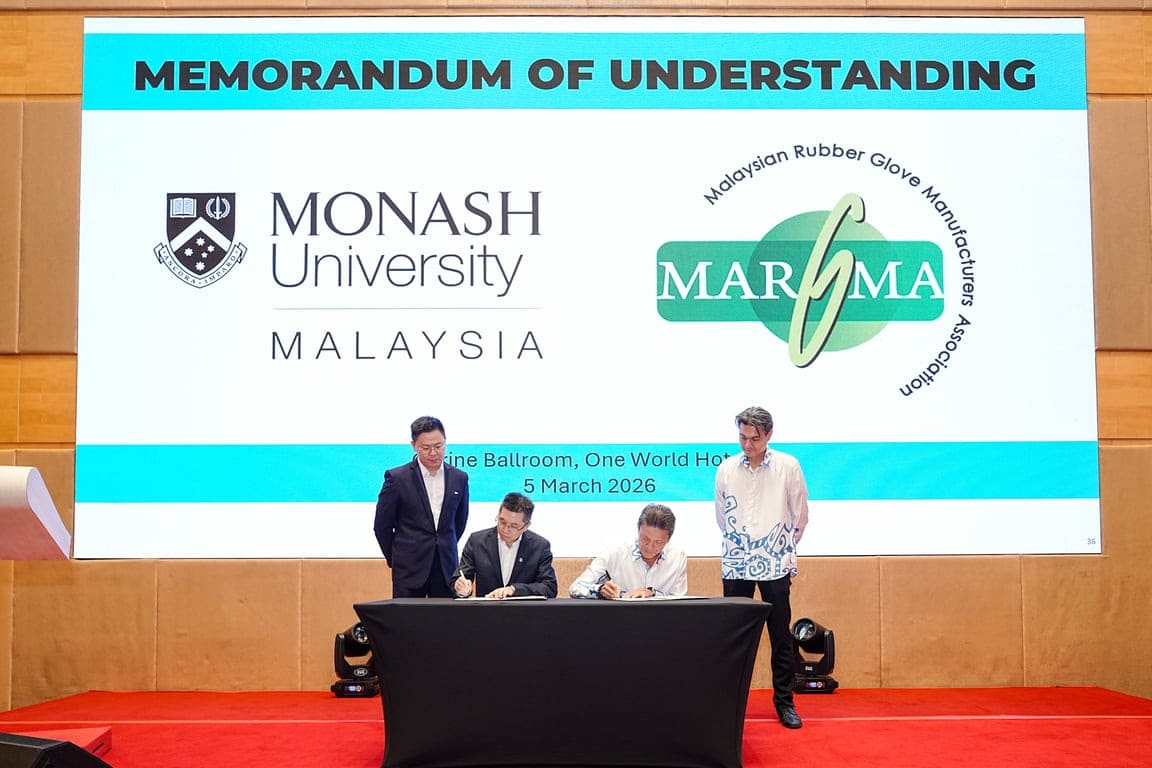
“While Malaysia leads the world in glove production, more than 80% of R&D roles in this sector are currently filled by non-specialists. This initiative is designed to help close that gap and build deeper technical expertise within the industry,” said MARGMA President, Mr Oon Kim Hung.
- The Talent Gap: Despite being the global leader in production, over 80% of R&D roles in Malaysia’s rubber glove sector are currently held by non-specialists.
- The Solution: A strategic MoU to bridge academic research and industrial application, headlined by a new Master’s in Colloids and Latex Technology.
- Curriculum 4.0: The programme moves beyond traditional methods to include Applied AI, Nanotechnology, and Sustainable Manufacturing, ensuring the workforce can handle “Industry 4.0” demands.
- Operational Efficiency: The partnership explicitly targets improved manufacturing outcomes: higher first-pass yields, lower defect rates, and reduced operating costs.
- Economic Footprint: With RM14 billion in export earnings for 2025, the sector remains a cornerstone of Malaysia’s trade, though it faces intensifying regional competition (primarily from China and Thailand).
The Malaysian Rubber Glove Manufacturers Association (MARGMA) and Monash University Malaysia have formalised a strategic partnership through the signing of a Memorandum of Understanding (MoU) aimed at strengthening talent development, research collaboration and innovation within Malaysia’s rubber glove industry.
The collaboration will bridge the gap between academic research and industrial application by developing specialised education programmes, advancing workforce upskilling and establishing a structured talent pipeline to support the industry’s future growth.
As the world’s leading producer and exporter of rubber gloves, Malaysia recorded export earnings of approximately RM14 billion in 2025. With increasing global competition and evolving technological demands, the partnership aims to help the industry move further up the value chain by integrating advanced academic research with practical manufacturing expertise.
“This partnership marks an important step in strengthening collaboration between industry and academia, creating meaningful benefits for both MARGMA members and the university’s students,” said MARGMA President, Mr Oon Kim Hung. “While Malaysia leads the world in glove production, more than 80% of R&D roles in this sector are currently filled by non-specialists. This initiative is designed to help close that gap and build deeper technical expertise within the industry.”
The first major initiative under the MoU will be the co-development of a specialised Master’s degree programme in Colloids and Latex Technology, designed specifically for professionals and engineers working in the rubber glove ecosystem.
Moving beyond traditional “trial-and-error” manufacturing approaches, the programme will equip participants with advanced expertise in colloid science, latex fundamentals, nanotechnology, advanced characterisation techniques, applied artificial intelligence, industrial statistics and sustainable manufacturing practices.
“This partnership represents a significant milestone in aligning academic rigour with the needs of Malaysia’s manufacturing sector,” said President and Pro Vice-Chancellor, Monash University Malaysia, Professor Dato’ Dr Adeeba Kamarulzaman. “By involving MARGMA experts in our academic committees, we ensure that our curriculum remains current, relevant and aligned with industry needs so that graduates are truly industry-ready.”
Beyond education, the MoU focuses on strategic impact and global competitiveness by enabling manufacturers to translate scientific knowledge into practical operational improvements. Key expected outcomes include:
- Higher first-pass yields and lower defect rates
- Reduced operating costs through improved process optimisation
- Stronger in-house R&D capabilities to address increasing regional competition
Under the agreement, both parties will collaborate on several high-impact initiatives designed to strengthen industry-academia integration. These include the development of an industry-led curriculum, with MARGMA experts participating in academic advisory committees to ensure programme relevance and global employability standards.
To support continuous professional development within the industry, the partnership will also introduce co-branded executive training modules and professional workshops aimed at upskilling engineers, technologists and industry professionals.
In addition, a structured talent pipeline will be established through annual intake targets for sponsored candidates from MARGMA member companies. Students will also undergo industrial training and final-year research projects within participating member facilities, providing valuable real-world exposure.
Industry leaders are encouraged to support this initiative through collaboration, sponsorship and talent development pathways.
Together, MARGMA and Monash University Malaysia aim to cultivate a new generation of highly skilled professionals to ensure Malaysia remains the global leader in sustainable, high-technology rubber glove manufacturing.
Editor’s Take:
For decades, Malaysia’s glove industry relied on a “trial-and-error” manufacturing culture that succeeded through sheer scale and low-cost energy. In 2026, that model is no longer defensible. By partnering with a top-tier institution like Monash, MARGMA is finally addressing the “Intellectual Infrastructure” gap.
The focus on Colloids and Latex Technology is highly specific and exactly what is needed to move from producing “commodity” gloves to “specialised” medical and industrial barriers. This isn’t just a training programme; it is a defensive moat. By professionalising R&D, Malaysia is making it harder for regional competitors to replicate its quality and consistency through automation and AI integration.
Why it Matters to ASEAN:
- Regional Standards: As the dominant player, Malaysia’s move to formalise latex education sets the “Gold Standard” for the entire ASEAN rubber belt.
- Value Chain Leadership: While Thailand and Indonesia provide the raw rubber, Malaysia is securing the high-value “Processing and IP” end of the chain. This ensures that the technical “brain” of the global glove industry remains in the Klang Valley.
- Sustainability Benchmark: With Monash’s research capabilities, Malaysia is better positioned to lead the region in biodegradable and nitrile-alternative materials, which are increasingly demanded by EU and US healthcare markets.