

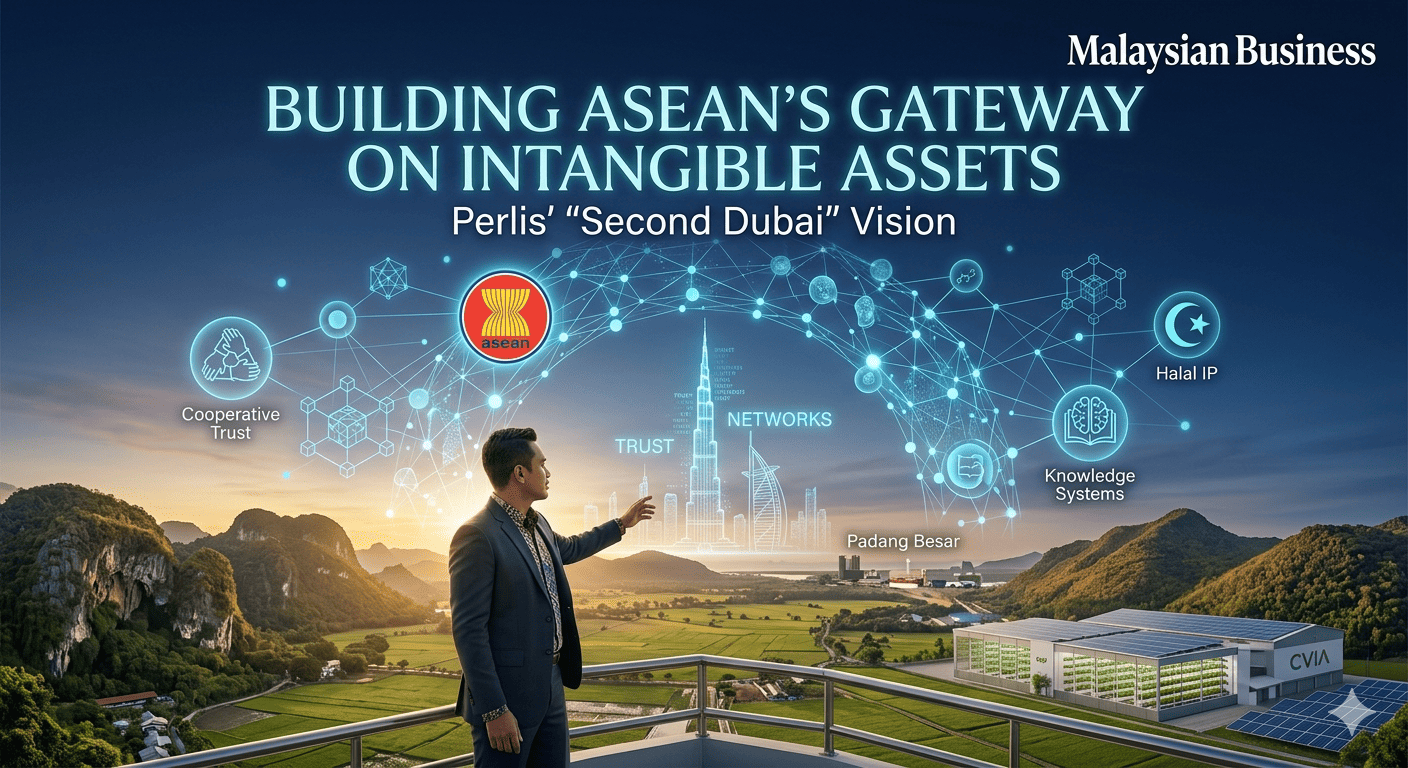
The Raja of Perlis’ recent advocacy for a “non-tangible base” marks a pivotal evolution in the nation’s regional economic strategy. Rather than engaging in the capital-intensive pursuit of physical megaprojects like skyscrapers and deep-water ports, Malaysia’s smallest state is executing a strategic pivot. Perlis is setting its sights on intangible capital, specifically, cross-border trust, cooperative networks, and digital innovation, to establish itself as the northern high-velocity gateway into the ASEAN corridor.
Understanding the Non-Tangible Base
Economists Jonathan Haskel and Stian Westlake define intangible assets as “capital without physical form.” These assets include proprietary software, data analytics, corporate trust, and networks. In the modern global economy, intangibles scale far more rapidly than physical assets. They generate high-yield domestic spillovers and embed long-term trust across borders.
Core Intangible Pillars for Perlis' Strategy:
┌──────────────────────────────────────────┬──────────────────────────────────────────┐
│ Cooperative Trust Networks               │ Leveraging high liquidity from entities   │
│                                          │ like ANGKASA for cross-border SME scaling │
├──────────────────────────────────────────┼──────────────────────────────────────────┤
│ Knowledge and Innovation Systems         │ High-yield R&D, advanced agritech IP,    │
│                                          │ and cross-border digital platforms       │
├──────────────────────────────────────────┼──────────────────────────────────────────┤
│ Brand and Reputation Equity              │ Halal supply-chain security, regional    │
│                                          │ eco-tourism, and trade credibility       │
└──────────────────────────────────────────┴──────────────────────────────────────────┘
New Factoids & Emerging Strategic Initiatives
To contextualise this economic shift for the Malaysian Business reader, we must evaluate the physical developments being repositioned under this intangible framework:
- Agritech Intellectual Property at CVIA: The Chuping Valley Industrial Area (CVIA) is transitioning from a traditional real estate play into a high-value intellectual property (IP) hub. By focusing on indoor vertical farming patents and smart climate adaptation technologies, Perlis aims to export agricultural solutions directly to Thailand and Vietnam.
- The Halal Certification Network Effect: Capitalising on Malaysia’s internationally recognised Department of Islamic Development Malaysia (JAKIM) standards, Perlis is positioning its local operations as the premier regional advisory for cross-border halal validation. This creates a high-margin services industry that requires no heavy manufacturing footprints.
- The Unmanned Edge: In alignment with regional advancements, such as the HKSTP-TechX public safety and low-altitude economy alliance, Perlis is exploring the use of AI-driven drones for border trade logistics and precision agriculture.
Who Wins? Opportunities for Business and Investors
For Malaysian Businesses: Domestic Scaling via Cooperative Networks
Malaysian small and medium enterprises (SMEs) can bypass traditional capital constraints by plugging directly into ANGKASA’s massive local network (7.3 million members, RM186.7 billion in assets). Through cross-border initiatives at the Padang Besar terminal, local firms can export to southern Thailand via cooperative supply chains that lower the initial “Complexity Tax” of global market entry.
For Institutional Investors: High-ROE Innovation Arbitrage
Private equity and institutional funds can invest directly in Perlis’ agritech and clean energy innovations. Because these ventures are intangible-heavy, their capital expenditure needs are much lower than traditional infrastructure investments. This mirrors the high returns seen in other sectors, such as CIMB’s Forward30 strategy yielding an 11.3% ROE.
For International Businesses: The Regional Test-Bed
International firms targeting the ASEAN market can use Perlis as a low-cost, high-trust testing ground. Using the state’s proximity to Thailand, multinational firms can pilot cross-border digital payment systems, automated customs protocols, and advanced logistics AI. This complements MIMOS’ global Go-To-Market strategy by establishing a real-world testing sandbox for foreign and domestic technologies alike.
Dubai vs. Perlis
| Economic Dimension | Dubai (Middle East Gateway) | Perlis (ASEAN Gateway Vision) |
| Asset Foundation | Tangible (Aviation, maritime ports, luxury real estate). | Intangible (Cooperative trust networks, agritech IP). |
| Market Target | Global trade, international finance. | Regional cross-border SMEs, ASEAN cooperatives. |
| Growth Engines | Sovereign wealth, free economic zones. | Northern Corridor (NCER) integrations, diaspora branding. |
| Core Vulnerability | Exposure to real estate cycles and international tourism. | Risks of policy fragmentation, slow digital literacy uptake. |
The Perlis Intangible Gateway
The Non-Tangible Architecture of the Northern Frontier
┌─────────────────────────────────────────────────────────────────────────────────────┐
│ 1. THE ASEAN TRADE CORRIDOR            │ 2. THE COOPERATIVE TURNOVER PULL           │
│ ● Metric: RM3.0 Trillion+ Total Trade  │ ● Metric: RM186.7 Billion Asset Base       │
│ ● Context: 2025 regional data          │ ● Context: Driven by 16,468 cooperatives   │
│ ● Intangible Asset: Regional cross-    │   and 7.3 million active members           │
│   border supply chain connectivity     │ ● Intangible Asset: Institutional trust    │
├────────────────────────────────────────┼────────────────────────────────────────────┤
│ 3. BORDER TRADE MOMENTUM               │ 4. THE NCER VALUE MULTIPLIER               │
│ ● Metric: Padang Besar and Bukit Kayu  │ ● Metric: 2,482-Acre CVIA Hub              │
│   Hitam cross-border hubs              │ ● Context: Spearheading advanced services  │
│ ● Context: Direct access to Southern   │   and high-value modern agritech           │
│   Thailand consumer markets            │ ● Intangible Asset: Halal & green IP       │
│ ● Intangible Asset: Logistics networks │   and smart manufacturing frameworks       │
└────────────────────────────────────────┴────────────────────────────────────────────┘
Editor’s Take: The ROI of Intangible Infrastructure
For the Malaysian Business reader, Perlis’ “Second Dubai” vision is not a pipe dream; it is an exercise in resource optimization. While PETRONAS renews long-term energy contracts to ensure economic stability, and the nation targets RM426.7 billion in approved investments, Perlis is showing how to do more with less.
By taking capital from traditional resources and pouring it into high-value intellectual property, agritech innovations, and cross-border trust networks, Perlis is offering a sustainable alternative to the heavy-industry development model. The challenge now lies purely in execution: turning the state’s strategic location and cooperative networks into a high-yielding engine for regional growth.