

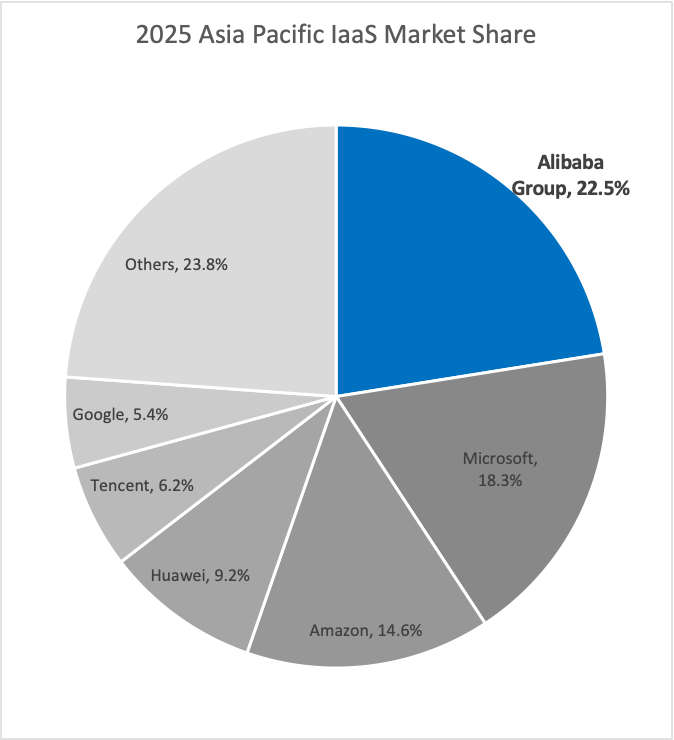
As the global economy navigates a cooling growth cycle, the digital backbone of the region is heating up. According to the latest Gartner® report released this month, Alibaba Cloud has widened its lead as the largest Infrastructure-as-a-Service (IaaS) provider in Asia Pacific. The company’s regional market share climbed to 22.5% in 2025, up from 20.8% the previous year, signaling a decisive shift toward AI-native infrastructure.
The growth comes at a pivotal time for Malaysia, where Alibaba Cloud maintains its position as the No. 2 cloud provider. The surge is being driven by a fundamental transition in how businesses utilize technology—moving away from traditional cloud storage toward “Agentic Architecture,” where AI doesn’t just suggest answers but actively executes multi-step business workflows.
The Rise of the “AI-Native” Backbone
Globally, the IaaS market added a staggering $45 billion in revenue in 2025, a 24.3% growth rate that outperformed previous years. Gartner’s findings suggest that AI-native workloads have become the dominant source of net-new demand. Alibaba Cloud has captured a significant portion of this momentum, with its global market share rising to 7.7%.
Nowhere is this acceleration more visible than in Singapore, where Alibaba achieved a milestone as the only major global provider to record triple-digit year-on-year growth. This performance propelled the firm to third place in the city-state’s highly competitive market. Similarly, in Indonesia, the company ascended to the No. 2 spot, underscoring a broad regional preference for infrastructure that can handle the “higher utilization intensity” required by persistent AI runtimes.
From Assistant to Executor
The cornerstone of this success lies in what Alibaba Cloud CTO Dr. Li Feifei describes as an “agent-native” strategy. While many firms are still debating AI frameworks, regional enterprises are already deploying “Agentic AI” systems that can autonomously coordinate tasks such as document editing, spreadsheet updates, and complex research.
“The numbers show that customers in this region are making real choices, and they’re choosing Alibaba Cloud,” said Dr. Li. “That commitment and trust are the result of years of building capacity ahead of demand.”
With 78 data centers across Asia, Alibaba is leveraging “data gravity” to meet increasing regulatory and sovereign requirements. This allows the provider to act as a “unifying layer” for businesses that need to move data and orchestrate workloads across fragmented regional markets without sacrificing security or local compliance.
Navigating a Changing Landscape
The Gartner report notes that while global hyperscalers continue to dominate, the addressable market is expanding through industry-aligned and sovereign offerings. This trend is particularly relevant for Malaysia’s digital economy, which is increasingly focused on high-security sectors and regional trade connectivity.
As AI continues to transition from a conversational tool to an autonomous business executor, Alibaba Cloud’s proactive investment in AI-optimized infrastructure appears to have positioned it as the primary gateway for the next era of Asian enterprise intelligence.
Editor’s Take: The “Choice” is Performance
For the Malaysian Business reader, the message from Dr. Li Feifei (Alibaba Cloud CTO) is clear: “A lot of companies talk about AI… what the numbers show is that customers are making real choices.” In a world facing a 3.1% growth squeeze, Alibaba’s ability to build “capacity ahead of demand” is the ultimate competitive advantage. For Malaysian enterprises, the focus must now shift from simply “moving to the cloud” to leveraging Agentic Architecture to drive real-world productivity.