

Dr. Kavintheran Thambiratnam, Shamsher Singh Gill
About the authors
Asst. Prof. Ts. Dr. Kavintheran Thambiratnam is a senior academic and researcher at the Department of Physics, International Islamic University Malaysia (IIUM). Specializing in photonics and optical fiber technology, he holds a Ph.D. from the University of Malaya and has authored over 100 ISI-indexed publications focusing on fiber lasers and optical sensing. Alongside Shamsher Singh Gill of Malaysian Business, Dr. Kavintheran synthesizes technical rigor with editorial innovation. Together, they deliver evidence-based analysis and strategic foresight on Malaysia’s economic landscape, providing critical guidance for policymakers and corporate leadership.
The Macroeconomic Shock and the AI Infrastructure Boom
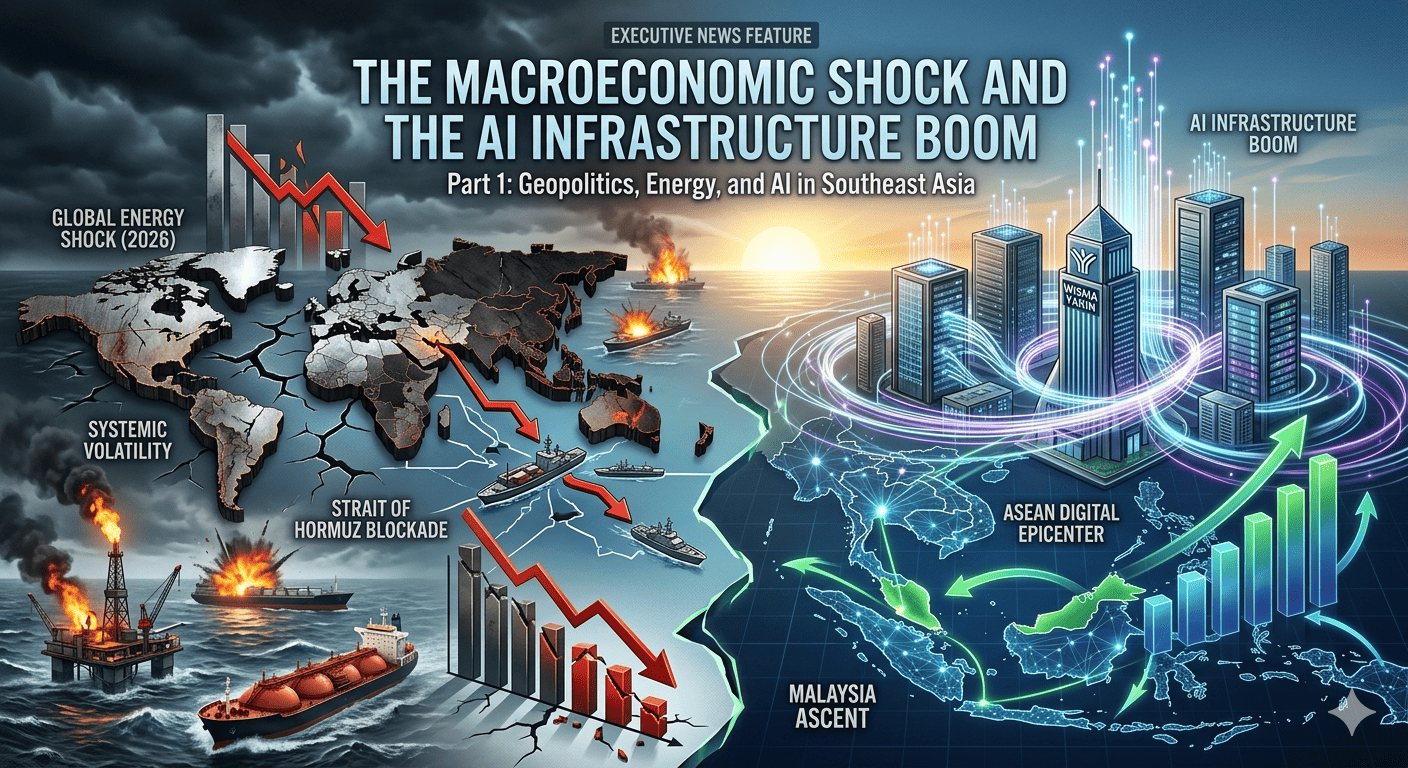
This is Part 1 of our three-part series exploring the critical intersection of geopolitics, energy, and artificial intelligence in Southeast Asia. The global landscape in early 2026 is facing unprecedented challenges, marked by systemic energy shocks stemming from the Middle East conflict and an aggressive technological decoupling between the United States and China. Amidst this turbulence, the ASEAN region, particularly Malaysia, has emerged as a focal point for a massive AI datacenter boom, drawing billions in foreign direct investment. We examine the macroeconomic forces driving this historic infrastructure expansion, the severe vulnerabilities exposed by the global energy crisis, and what the escalating computational density of AI means for Malaysia’s ascent as a regional digital epicenter.
The global macroeconomic and technological landscape in the first quarter of 2026 presents an unprecedented convergence of systemic crises and transformative opportunities. The rapid proliferation of artificial intelligence (AI), characterized by exponential increases in computational demand, generative model training, and algorithmic complexity, has catalyzed a historic expansion of datacenter infrastructure worldwide.1 Simultaneously, the geopolitical equilibrium has been severely fractured by the outbreak of military conflict in the Middle East involving the United States, Israel, and Iran. This conflict has effectively severed critical energy supply arteries, disrupted the global trade of essential industrial commodities, and introduced extreme volatility into wholesale energy markets.3 Concurrently, the strategic technological decoupling between the United States and China has evolved into a complex matrix of export controls, tariffs, and localized supply chain realignments, forcing technology conglomerates to rapidly restructure their global footprints.5
Within this turbulent environment, the Association of Southeast Asian Nations (ASEAN) and Malaysia in particular has emerged as a focal point for global technology investments. Drawn by historically favorable energy costs, strategic geographic positioning, and a concerted push toward digital transformation, international hyperscalers and regional colocation providers have initiated a datacenter boom across the Malay Peninsula.1 However, the foundational economic and logistical assumptions underpinning this investment thesis are currently being tested by exogenous shocks.
This comprehensive write-up provides an exhaustive examination of the structural challenges facing datacenter operations and AI development in the ASEAN region. By analyzing the cascading effects of the 2026 energy shock, the restructuring of electricity tariffs, the vulnerabilities within the semiconductor supply chain, the necessity for advanced thermal management systems, and the evolving regional regulatory frameworks, this analysis delineates the strategic imperatives required to navigate the current geopolitical and technological epoch.
The Global Energy Shock and Macroeconomic Restructuring
The military operations and subsequent retaliatory strikes that escalated in late February 2026 have triggered the most severe disruption to global energy markets since the oil crises of the 1970s and the systemic shocks of 2022, fundamentally altering the calculus for energy-intensive industries such as digital infrastructure.3 The focal point of this economic tremor is the Strait of Hormuz, a maritime chokepoint measuring merely 29 nautical miles at its narrowest point.10 Under normal operational conditions, this narrow waterway facilitates the transit of approximately 20 million barrels per day (mbpd) of crude oil and petroleum products, alongside 112 billion cubic meters of liquefied natural gas (LNG).10
The effective closure of this critical artery, driven by Iranian threats to commercial shipping and the physical dangers of the conflict zone, has instantaneously removed nearly 20 percent of total global oil supplies and approximately one-fifth of the world’s LNG trade from the open market.3 The immediate consequence of this supply contraction has been a violent recalibration of energy commodity pricing.
The Asymmetric Vulnerability of Asian Energy Markets
The immediate impact of the Persian Gulf blockade has been wildly asymmetrical, with the Asian continent bearing the brunt of the supply shock. Historically, approximately 80 percent of the oil exported through the Strait of Hormuz has been destined for Asian economies, rendering the region uniquely exposed to Middle Eastern geopolitical volatility.3 As tanker traffic is halted, and alternative transit routes prove either militarily risky or logistically insufficient, energy importers in the East have been forced into a frantic recalibration of their supply chains.3 Attempted bypasses, such as the Saudi East-West pipeline to the port of Yanbu on the Red Sea, expose shipments to missile threats, while navigating the Bab el-Mandeb Strait presents equal logistical perils.3
The pricing dynamics resulting from this structural deficit have been stark. Benchmark United States crude prices surged rapidly from pre-war levels in the low-to-mid $60 per barrel range to hover near $95 to $100 per barrel.4 Federal Reserve Bank macroeconomic modeling suggests that West Texas Intermediate (WTI) could average $98 per barrel in the second quarter of 2026, and could climb as high as $132 per barrel if the disruption extends throughout the year.3 Concurrently, international LNG prices experienced an immediate and punitive spike of over 50 percent.4
For the ASEAN+3 region, which sources over a third of its oil and gas directly from the Middle East, this translates to severe and immediate macroeconomic headwinds.9 Economic models project that if oil prices sustain an elevated floor of around $90 per barrel for the remainder of 2026, regional inflation could rise by an additional 0.7 percentage points, while simultaneously shaving 0.2 percentage points off broader regional GDP growth.9 Several Southeast Asian nations entered this crisis with precariously thin strategic energy buffers, severely limiting their capacity to absorb the shock without passing costs onto industrial consumers.
| ASEAN Nation | Estimated Strategic Energy Reserves (As of Early 2026) | Regional Energy Import Dependency | Source |
| Vietnam | Less than 20 days | Highly constrained, limited buffer | 12 |
| Indonesia | Approximately 20 days | Net importer of oil, exposed to crude pricing | 12 |
| Philippines | Approximately 2 months | Relies on imports for over 60% of fuel needs | 12 |
| Thailand | Approximately 2 months | Relies on imports for over 60% of fuel needs | 12 |
| Malaysia | Approximately 2 months | Exporter of crude, but exposed to global pricing | 12 |
The crisis has definitively dispelled the notion of localized energy independence in a globally integrated commodity market. Because the cost of crude oil and LNG dictates the baseline of global energy pricing, a localized disruption in the Middle East inevitably results in a ubiquitous spike in wholesale energy and electricity costs worldwide.4 This systemic vulnerability highlights the underlying fragility of fossil-fuel-reliant economic architectures, particularly for industries like data processing that require uninterrupted, massive baseload power.
The Strategic Shift Toward Renewable Energy Resiliency
Unlike the historical oil shocks of the late 20th century, the 2026 crisis intersects with a period where renewable energy generation has achieved unprecedented cost competitiveness and scale. In 2024, data indicated that more than 90 percent of new renewable power projects globally were cheaper to deploy and operate than fossil-fuel alternatives.11 Consequently, the geopolitical turmoil in the Middle East is acting as an aggressive catalyst, shifting the transition toward renewable energy from a long-term environmental and sustainability goal to an immediate, urgent requirement for sovereign economic and operational security.9 Nations and corporations with higher integrations of renewable power are proving far more insulated from the current inflationary spikes, as renewables rely on domestic resources such as solar irradiance and wind, completely bypassing the volatile maritime chokepoints of imported fuels.11 For the datacenter industry, this macroeconomic reality mandates an accelerated pivot away from grid-supplied fossil fuels.
The ASEAN Datacenter Boom and the AI Density Challenge
Prior to the full onset of the 2026 energy crisis, the ASEAN region had firmly established itself as the fastest-growing frontier for global digital infrastructure. Driven by the proliferation of cloud computing, edge networks, and the immense computational requirements of generative AI, datacenter capacity in the Asia-Pacific region is projected to double to approximately 30 GW by the 2027/2028 timeframe.2
The geographic distribution of this explosive growth, however, has been highly uneven. Singapore, historically the region’s premier digital hub and ranking as the world’s fifth-largest datacenter market with 1 GW of operational capacity as of early 2025, encountered severe structural constraints.1 Limitations regarding land availability and strict moratoriums related to grid power capacity and carbon emissions forced hyperscalers to look elsewhere.1 This saturation precipitated a massive overflow of capital and infrastructure development into neighboring jurisdictions, most notably Malaysia, Indonesia, and Thailand.1
Malaysia’s Ascent as the Regional Digital Epicenter
Malaysia capitalized aggressively on this regional spillover by leveraging its relatively lower land and energy costs, its immediate geographic proximity to Singapore (particularly in the southern state of Johor), and highly accommodating federal government policies aimed at achieving a 35 percent digital economy contribution to the national GDP by 2030.1 The years 2024 and 2025 witnessed a historic, unprecedented influx of foreign direct investment from top-tier global technology conglomerates seeking to build the foundation of the Asian AI ecosystem.
| Hyperscaler / Corporate Entity | Total Investment Commitment | Investment Horizon / Status | Core Focus Areas | Source |
| Amazon Web Services (AWS) | US$6.2 Billion (RM29.2 Billion) | Long-term commitment to 2038 | AWS Asia Pacific (Malaysia) Region, Cloud Infrastructure | 7 |
| Microsoft | US$2.2 Billion (RM10.5 Billion) | Four-year deployment (2024-2028) | Cloud Region (Malaysia West), AI Infrastructure, Skilling | 7 |
| US$2.0 Billion (RM9.4 Billion) | Announced 2024 | First Google Data Center and Cloud Region, AI Literacy | 7 | |
| YTL Utilities / Nvidia | US$4.3 Billion | Announced 2024 | AI Infrastructure Development and Supercomputing | 13 |
| ByteDance (via Aolani Cloud) | US$2.5 Billion | Underway in 2026 | 36,000 Blackwell GPU Cluster for AI Model Training | 17 |
The aggregate scale of these investments, totaling nearly US$17 billion from American hyperscalers alone, fundamentally alters Malaysia’s infrastructure landscape.7 By early 2025, Malaysia had accumulated the largest datacenter pipeline currently under development in Southeast Asia, totaling an estimated 2.4 GW of future capacity.18 The Johor region, acting as a direct pressure release valve for Singaporean demand, became the fastest-growing hub in the region, developing 4.5 times its previously operational capacity in a matter of months.18
The Escalating Computational Density of Artificial Intelligence
The qualitative nature of these newly constructed datacenters drastically compounds the quantitative expansion. Traditional cloud computing and enterprise colocation facilities were designed primarily for conventional central processing unit (CPU) workloads. Conversely, AI development, large language model (LLM) training, and complex inferencing rely on massive, interconnected clusters of graphics processing units (GPUs). These specialized processors operate at substantially higher thermal and power densities than their CPU counterparts.19
The industry metrics illustrate a staggering upward trajectory in energy requirements. The average per-rack power density in datacenter environments has surged from a manageable 8 kilowatts (kW) in 2021 to 12 kW by the end of 2023, with baseline projections indicating a rise to 30 kW by 2027 merely to keep pace with standard AI development.18 However, frontier AI training models demand far more robust infrastructure. Facilities supporting advanced LLM training, such as those utilized for ChatGPT architectures, can require over 80 kW of power per server rack.18 Furthermore, the deployment of cutting-edge hardware, such as Nvidia’s highly anticipated GB200 chip paired with specialized server hardware, can push aggregate power consumption to a phenomenal 120 kW per rack.18
This unprecedented density paradigm translates directly to astronomical aggregate power consumption at the facility and grid levels. According to the International Energy Agency (IEA), a typical hyperscale AI datacenter currently consumes as much baseline power as 100,000 residential households, while the largest campuses under construction are designed to consume twenty times that amount.20 Among the top six datacenter hotspots in the ASEAN region, Malaysia is forecasted to experience the absolute steepest acceleration in industrial power demand. Electricity consumption by Malaysian datacenters is projected to increase sevenfold, surging from a modest 8.5 Terawatt-hours (TWh) in 2024 to an estimated 68 TWh by 2030.1 Looking further ahead, structural estimates by research firm BMI project that datacenter power consumption in Malaysia could exceed 5,000 MW by 2035.21 This would account for a staggering 40 percent of Peninsular Malaysia’s current total power capacity, transforming what was once a comfortable surplus energy environment into a critically constrained, highly stressed electrical ecosystem.20
Reference:
- ASEAN’s data centres electricity demand keeps growing – From AI to emissions: Aligning ASEAN’s digital growth with energy transition goals | Ember, accessed March 23, 2026, https://ember-energy.org/latest-insights/from-ai-to-emissions-aligning-asean-digital-growth-with-energy-transition/setting-the-scene/
- The Asian perspective on the data centre landscape | White & Case LLP, accessed March 23, 2026, https://www.whitecase.com/insight-alert/asian-perspective-data-centre-landscape
- What the closure of the Strait of Hormuz means for the global …, accessed March 23, 2026, https://www.dallasfed.org/research/economics/2026/0320
- Energy and the Iran War: What We’re Watching, accessed March 23, 2026, https://www.resources.org/common-resources/energy-and-the-iran-war-what-were-watching/
- US chip export controls have cooled down | East Asia Forum, accessed March 23, 2026, https://eastasiaforum.org/2026/03/11/us-chip-export-controls-have-cooled-down/
- Trump Opens H200 Exports to China with 25% Surcharge | Introl Blog, accessed March 23, 2026, https://introl.com/blog/trump-h200-export-china-policy-reversal-december-2025
- Malaysia’s tech sector powered up with unprecedented investments …, accessed March 23, 2026, https://www.mida.gov.my/mida-news/malaysias-tech-sector-powered-up-with-unprecedented-investments-in-2024/
- Economic impact of the 2026 Iran war – Wikipedia, accessed March 23, 2026, https://en.wikipedia.org/wiki/Economic_impact_of_the_2026_Iran_war
- Shock and Resilience: ASEAN+3 and the Conflict in the Middle East, accessed March 23, 2026, https://amro-asia.org/shock-and-resilience-asean3-and-the-conflict-in-the-middle-east
- The Middle East conflict begins to cast a shadow on the global economy, accessed March 23, 2026, https://www.deloitte.com/us/en/insights/topics/economy/iran-middle-east-conflict-impacts-global-economy.html
- Energy Fallout From Iran War Signals a Global Wake-Up Call For Renewable Energy, accessed March 23, 2026, https://broadbandbreakfast.com/energy-fallout-from-iran-war-signals-a-global-wake-up-call-for-renewable-energy/
- How the War With Iran Is Impacting Economies in Asia – TIME, accessed March 23, 2026, https://time.com/article/2026/03/16/us-israel-iran-war-trump-asia-economy-oil-energy-inflation-recession/
- Google to Invest US$2 Billion in Malaysia’s Data Center and Cloud Market – ASEAN Briefing, accessed March 23, 2026, https://www.aseanbriefing.com/doing-business-guide/malaysia/sector-insights/google-to-invest-us-2-billion-in-malaysia-s-data-center-and-cloud-market
- Microsoft announces US$2.2 billion investment to fuel Malaysia’s cloud and AI transformation, accessed March 23, 2026, https://news.microsoft.com/apac/2024/05/02/microsoft-announces-us2-2-billion-investment-to-fuel-malaysias-cloud-and-ai-transformation/
- Microsoft’s upcoming cloud region to unlock new economic opportunities for Malaysia – Source Asia, accessed March 23, 2026, https://news.microsoft.com/source/asia/features/microsofts-upcoming-cloud-region-to-unlock-new-economic-opportunities-for-malaysia/
- Advancing Malaysia Together: Google Announces US$2 Billion Investment in Malaysia, Including First Google Data Center and Google Cloud Region – Google Cloud Press Corner, accessed March 23, 2026, https://www.googlecloudpresscorner.com/2024-05-30-Advancing-Malaysia-Together-Google-Announces-US-2-Billion-Investment-in-Malaysia,-Including-First-Google-Data-Center-and-Google-Cloud-Region
- ByteDance Acquires Nvidia Blackwell GPUs in Malaysia to Expand AI Infrastructure – TECHi, accessed March 23, 2026, https://www.techi.com/bytedance-nvidia-blackwell-gpus-malaysia-ai-infrastructure/
- The Rise of Data Centres, Artificial Intelligence, and ASEAN’s Decarbonisation Goal, accessed March 23, 2026, https://accept.aseanenergy.org/the-rise-of-data-centres-artificial-intelligence-and-aseans-decarbonisation-goal
- Liquid cooling options for data centers – Vertiv, accessed March 23, 2026, https://www.vertiv.com/en-us/solutions/learn-about/liquid-cooling-options-for-data-centers/
- Data Centres, Energy Demand and Sustainability: Can Malaysia Strike the Right Balance?, accessed March 23, 2026, https://fulcrum.sg/data-centres-energy-demand-and-sustainability-can-malaysia-strike-the-right-balance/