

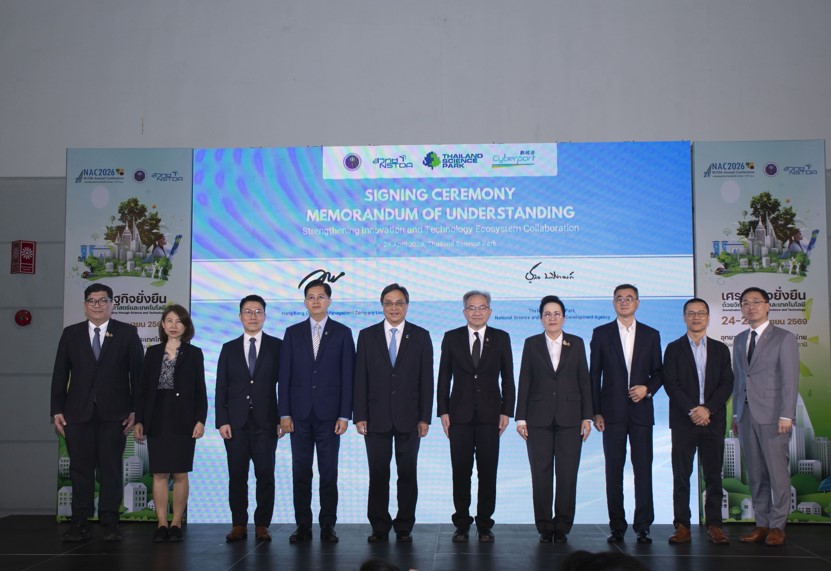
In a move to unify the ASEAN and Greater Bay Area (GBA) tech corridors, Cyberport Hong Kong has signed a strategic Memorandum of Understanding (MoU) with Thailand’s National Science and Technology Development Agency (NSTDA).
The partnership, signed through the Thailand Science Park (TSP), aims to dismantle the geographical barriers for startups by creating a reciprocal “soft-landing” gateway between two of Asia’s most vibrant digital hubs.
Bridging the Execution Gap
While many regional alliances focus on high-level dialogue, this MoU targets Practical Mechanisms to move startups from ideation to commercialisation. The collaboration focuses on:
- Reciprocal Market Access: Facilitating Thai startups’ entry into the GBA and Hong Kong markets, while giving Hong Kong firms a stronghold in Thailand and the broader ASEAN region.
- Deep-Tech Validation: Leveraging TSP’s “TSP Scale X Landing Programme” to fast-track international firms through pilot projects and proof-of-concept (PoC) initiatives with real industry demand.
- Sector Focus: Primary efforts will target the AI+ era, including artificial intelligence, smart city solutions, and advanced digital technologies.
The Power of Two Ecosystems
The synergy combines the strengths of two massive research and incubation engines:
| Feature | Cyberport (Hong Kong) | Thailand Science Park (NSTDA) |
| Identity | HK’s Digital Tech Hub & AI Accelerator | Thailand’s first and largest Science & Tech Park |
| Community | 2,300+ companies, including 9 unicorns | 120+ tech companies & 5 national research centres |
| Core Engine | Largest AI Supercomputing Centre in HK | Regional R&D hub with advanced testing infra |
| Key Win | Hosted Nano Coating Tech (Thai Deep-Tech) | Base for 40% international technology firms |
Editor’s Take: The “AI+ Corridor”
For the Malaysian Business reader, this MoU is a significant signal that the regional tech landscape is moving away from fragmented hubs toward a unified ASEAN Alliances model. We have recently seen NEXEA and MyInnovationX launch ASEAN’s first AI matchmaker, and Glem.ai enter the MDEC FOX programme.
Now, with Hong Kong acting as a “super-connector” for Thai innovators to access the Chinese Mainland, the competition for “Sovereign Intelligence” is heating up. Malaysia must leverage its own strategic assets, like the JS-SEZ, to ensure it remains a primary destination in this cross-border flow of high-value innovation. In a global economy growing at 3.1%, the “gateway” cities that can reduce market-entry friction the fastest will be the ones that capture the next generation of Asian unicorns.