

Technological Adaptation and Regional Resilience (Part 3 of 3)
Asst. Prof. Ts. Dr. Kavintheran Thambiratnam is a senior academic and researcher at the Department of Physics, International Islamic University Malaysia (IIUM). Specializing in photonics and optical fiber technology, he holds a Ph.D. from the University of Malaya and has authored over 100 ISI-indexed publications focusing on fiber lasers and optical sensing. Alongside Shamsher Singh Gill of Malaysian Business, Dr. Kavintheran synthesizes technical rigor with editorial innovation. Together, they deliver evidence-based analysis and strategic foresight on Malaysia’s economic landscape, providing critical guidance for policymakers and corporate leadership.
In Parts 1 and Part 2, we examined the macroeconomic shocks, surging energy costs, and fragile semiconductor supply chains reshaping Malaysia’s datacenter sector. This final installment focuses on the technological adaptations and regional governance frameworks required to sustain ASEAN’s digital economy amid volatility.
Advanced Thermal Management: The Shift to Liquid Cooling
The combination of soaring electricity tariffs, sustainability mandates, and the extreme thermal density of next-generation silicon (e.g., GB200 racks drawing 120 kW) has rendered traditional air cooling architectures obsolete. Reliance on CRAHs and CRACs is no longer viable for dense AI workloads.¹⁹
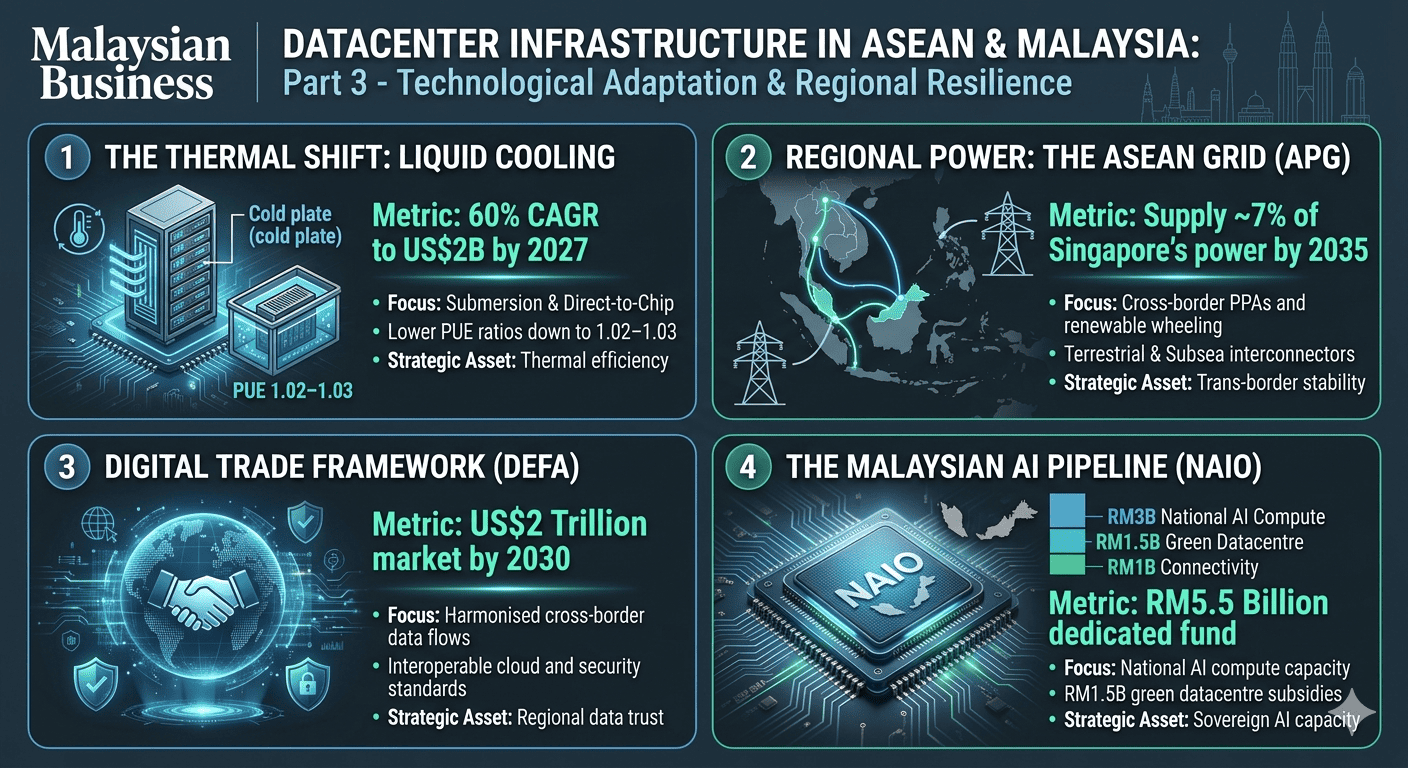
By 2026, liquid cooling has transitioned from niche HPC deployments to the backbone of hyperscale datacenter infrastructure.³⁷ The global liquid cooling market is expanding at a 60% CAGR, projected to reach US$2 billion by 2027.¹⁹
Cooling Architectures
- Direct-to-Chip (Cold Plate) Cooling: With ~43% market share, this method circulates coolant directly across CPU/GPU dies via microfluidic channels, capturing heat at its origin.³⁷
- Immersion Cooling: The fastest-growing segment, immersion cooling submerges entire servers in dielectric fluids, eliminating fans and chillers. It delivers up to 80% higher efficiency and achieves PUE ratios as low as 1.02–1.03.³⁶ ³⁸
Thermal Intelligence
Liquid cooling is not just mechanical, it integrates sensor arrays monitoring flow, pressure, temperature, and coolant chemistry.³⁷ These feed into AI-driven DCIM and AIOps platforms, enabling predictive maintenance and dynamic workload migration to avoid thermal hotspots.³⁷
CAPEX Economics
The transition requires reinforced flooring, advanced plumbing, and chemical management systems, driving massive upfront CAPEX.² Tenant portability is reduced, as fluid-filled racks are difficult to relocate.² Financing volumes reflect this shift: Asian datacenter loans surged nearly 50% year-on-year to US$11 billion.²
Regional Governance: Building Multilateral Resilience
No single nation can mitigate systemic shocks alone. ASEAN is accelerating integration of energy and digital frameworks to ensure resilience.
ASEAN Power Grid (APG)
The APG, long delayed, is now moving from concept to reality.³⁹ With ASEAN electricity demand projected to double by 2050, regional interconnection is essential to balance renewables and ensure 99.999% reliability.⁴⁰
The Enhanced MoU ratified in late 2025 established legal frameworks for terrestrial and subsea interconnectors, enabling large-scale cross-border PPAs.⁴¹ Malaysia now plays a dual role—both wheeling partner and direct supplier—exporting surplus renewable and gas-fired power, primarily to Singapore.²¹ By 2035, Malaysia could supply ~7% of Singapore’s baseline demand.²¹ This interconnectedness reduces vulnerability to localized shocks and allows datacenters in Malaysia to draw green electrons from Laos or Thailand.⁴⁰
ASEAN Digital Economy Framework Agreement (DEFA)
Set for conclusion in 2026, DEFA is the world’s first region-wide trade agreement focused on digital governance.⁴³ It underpins ASEAN’s projected US$2 trillion digital economy by 2030.⁴⁴
DEFA introduces binding commitments on:
- Secure cross-border data flows
- Cybersecurity resilience standards
- Source code protection
- Cloud interoperability standards⁴³
By reducing fragmentation, DEFA lowers compliance burdens and enables seamless AI model training across borders.⁴⁵
Malaysia’s National AI Office (NAIO)
Malaysia has centralized its AI strategy under the NAIO, incubated by MyDigital Corporation.⁵⁰ Its mandate includes the AI Technology Action Plan 2026–2030 and the AI Adoption Regulatory Framework.⁵⁰
Key funding commitments:
- RM3 billion for national AI compute infrastructure
- RM1.5 billion for datacenter enhancements
- RM800 million for 5G integration
- RM200 million for AI cybersecurity⁵³
These investments aim to contribute RM60 billion to GDP by 2030.⁵⁴ Regionally, Malaysia secured the secretariat role for the ASEAN AI Safety Network at ADGMIN 2026, anchoring AI safeguard mechanisms in Kuala Lumpur.⁴⁶
Strategic Imperatives
ASEAN’s datacenter sector faces a trilemma:
- Computational scale – demand for advanced GPUs and AI clusters.
- Supply chain fragility – geopolitical risks to energy and semiconductors.
- Grid stability & sustainability – balancing fossil surcharges with renewable integration.
Operators must decouple OPEX from hydrocarbon markets via schemes like CRESS, invest in BESS for reliability, and adopt liquid cooling to manage thermal loads. Simultaneously, compliance with U.S. export controls and proactive governance under the Strategic Trade Act are essential to avoid secondary sanctions.
Ultimately, resilience depends on multilateral cohesion: APG for energy, DEFA for digital trade, and NAIO for AI governance. Datacenters must evolve into intelligent, liquid-cooled, renewable-powered nodes embedded in a secure, regionally integrated grid. Only by mastering energy procurement, advanced thermal engineering, and geopolitical compliance can ASEAN sustain its trajectory as a global AI powerhouse.
The list of cited works and references can be found in Part 1 and 2.