

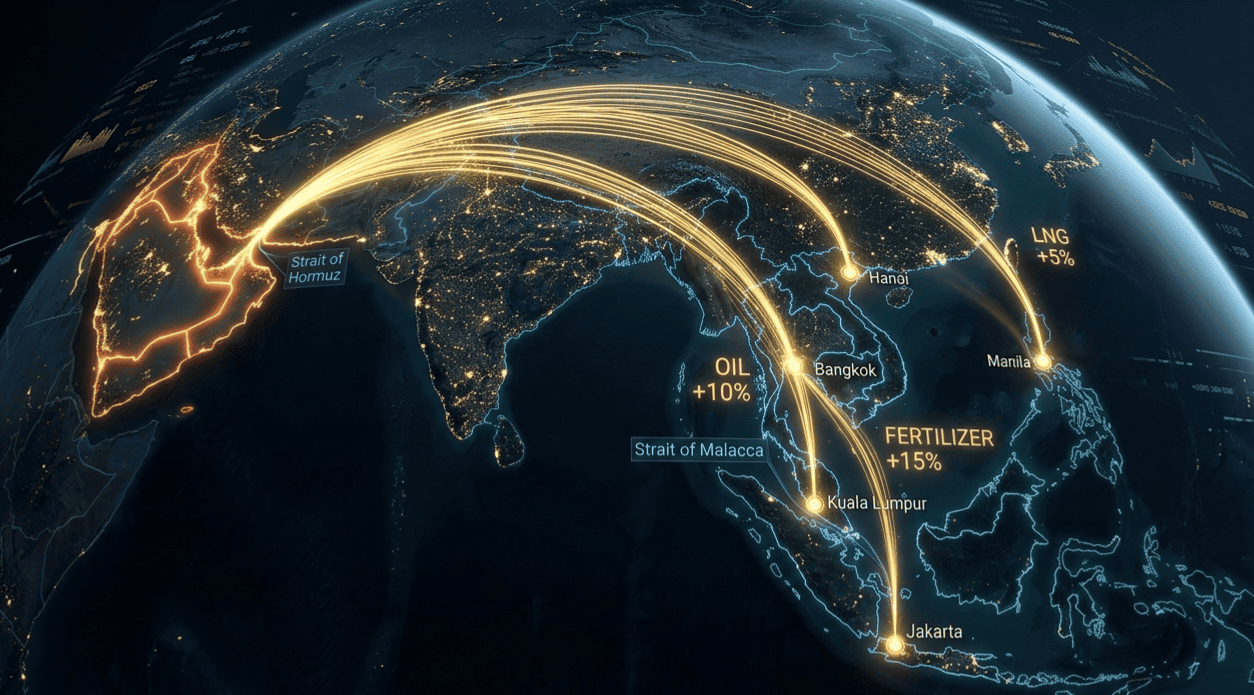
The International Monetary Fund (IMF) recently issued a stark warning: the escalating conflict in the Middle East is no longer a regional crisis, but a “global, yet asymmetric” economic shock. For the ASEAN bloc—a region defined by its export-led growth and energy sensitivity—the fallout is reshaping the 2026 outlook. As the IMF puts it in their latest analysis, “all roads lead to higher prices and slower growth.”
The Energy Divide
The most immediate impact is the “asymmetric” energy shock. For net energy importers like Thailand and the Philippines, the surge in Brent crude—driven by the largest disruption to the global oil market in history—acts as an immediate tax on domestic income. This threatens to reignite inflation just as it was beginning to stabilize. Conversely, while Malaysia and Indonesia may see temporary fiscal windfalls from higher oil and gas revenues, these gains are precarious. If the conflict sustains a high “risk premium,” the resulting global slowdown could dampen demand for their other exports, neutralizing any energy-export advantage.
The “Jugular” of Trade
The IMF describes the Strait of Hormuz as the “world’s jugular.” With 25% to 30% of global oil and 20% of LNG normally passing through this narrow waterway, any closure is a direct hit to ASEAN’s industrial backbone. The region is particularly vulnerable to the spike in fertilizer costs. Agricultural powerhouses like Vietnam face a “socio-political problem” as rising input costs threaten crop yields and drive up food prices—a critical issue where food accounts for a large share of household spending.
Financial Pressure and Policy Dilemmas
Beyond physical goods, the “flight to safety” in global markets is tightening financial conditions. A strengthening U.S. Dollar puts downward pressure on the Rupiah and Ringgit, complicating the mandate for regional central banks. If energy and food prices remain elevated, central banks may be forced to keep interest rates higher for longer, potentially stifling the domestic recovery ASEAN worked so hard to build.
While the duration of the conflict remains the “great unknown,” the blueprint for ASEAN is clear. The IMF’s analysis serves as a reminder that in a hyper-connected economy, a shock in the Middle East is a shock to the manufacturing floors of Hanoi and the trade hubs of Singapore alike. Resilience will be the region’s most valuable commodity for the remainder of 2026.