

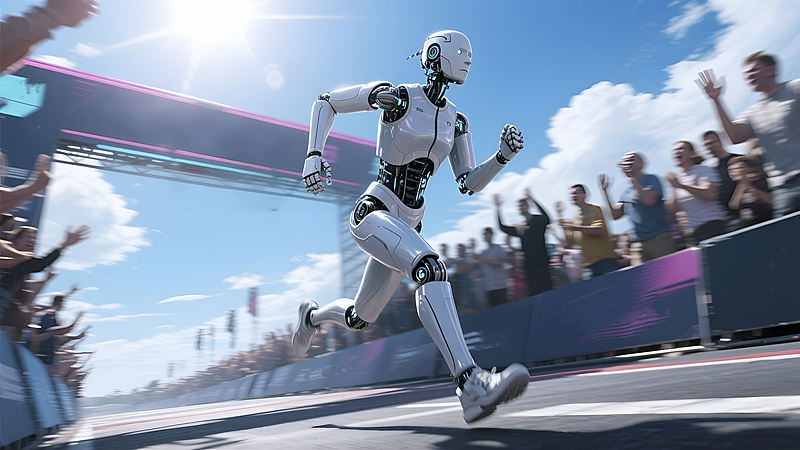
In a historic leap for robotics, the Beijing Economic-Technological Development Area (BDA), or Beijing E-Town, has successfully completed a “combat-ready” test run for the 2026 Humanoid Robot Half-Marathon. Conducted under the cover of night from April 11 to 12, the drill saw over 70 teams—including four international entries—testing their autonomous and remote-controlled robots on the actual 21.0975-kilometer course.
Scheduled for its official kick-off on April 19, this event marks the world’s first humanoid robot marathon brand and is operating at a scale nearly five times larger than the previous year.
A Masterclass in Stress-Testing
The night trials were designed to simulate every “all-element” scenario of a live race, ensuring that the transition from laboratory to the open road is seamless.
Key Test Scenarios:
- Autonomous Navigation: For the first time, large-scale autonomous navigation is being applied, challenging the robots’ perception and decision-making in complex urban environments.
- Endurance & Energy: The half-marathon distance serves as an extreme stress test for long-range battery life and energy management.
- Dynamic Stability: High-speed running and sharp turns require millisecond-level posture correction to prevent falls as the center of gravity shifts.
The New Rules of the Game
The 2026 event introduces systematic upgrades to its regulations to ensure a “fair and orderly” competition.
| Regulation Pillar | What’s New for 2026 | Strategic Impact |
| Human Intervention | Stricter rules on manual assistance. | Pushes the development of true autonomous decision-making. |
| Gait & Balance | Standardised scoring for posture and gait. | Incentivises more “human-like” and stable movement profiles. |
| Logistics Support | Managed battery swapping and resupply zones. | Simulates real-world maintenance for industrial robot fleets. |
| Emergency Containment | Rapid-response security and medical services. | Ensures track safety during high-speed robot failures. |
Editor’s Take: Approaching “Elite Human” Speeds
More than just a sporting novelty; it is a live benchmark for industrial mobility. With some teams predicting that their robots may approach the times of elite human athletes, we are witnessing the closing gap between biological and mechanical performance. As these robots successfully navigate the “full-process” of an urban marathon, the case for their deployment in high-stakes logistics and urban services becomes undeniably stronger.