

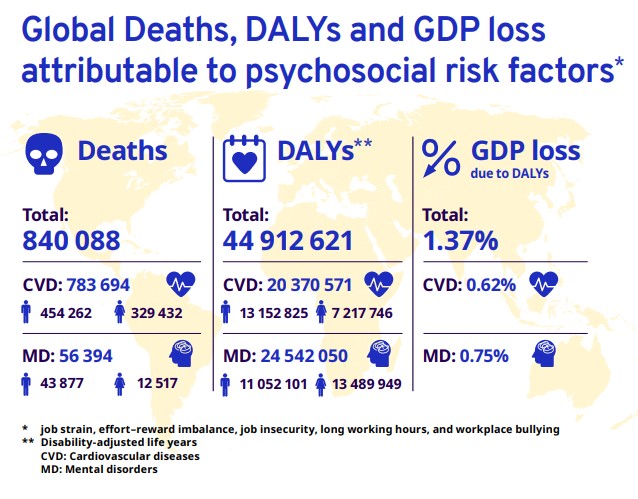
A groundbreaking report from the International Labour Organization (ILO) has identified a hidden epidemic in the global workforce. More than 840,000 people die annually due to health conditions linked to “psychosocial risks”, a category of workplace stress defined by poorly managed work, job insecurity, and workplace harassment.
The report, titled The psychosocial working environment: Global developments and pathways for action, reveals that these risks are no longer just an “HR issue” but a primary driver of cardiovascular disease and mental health disorders, including suicide. Globally, the economic fallout is staggering, resulting in a loss of 1.37% of global GDP annually due to productivity drops and healthcare costs.
The Three Layers of Risk
The ILO identifies that psychosocial harm isn’t caused by a single event, but by a combination of factors across three levels of the working environment:
- The Job Design: High demands paired with low control, or “passive jobs” where workers lack autonomy.
- Organization & Management: Lack of role clarity, excessive workloads, and poor supervision.
- Workplace Policy: Inadequate procedures to prevent bullying, harassment, and the “technostress” stemming from digital monitoring.
The AI Paradox: Flexibility vs. Surveillance
The report highlights that while digitalization and Artificial Intelligence (AI) offer opportunities for flexibility, they also introduce new stressors. Algorithmic management and 24/7 digital connectivity can lead to “ghost work burnout,” where employees feel like replaceable cogs in a machine they cannot control. Conversely, poorly designed digital roles can lead to “skill atrophy” and deep boredom, which are as detrimental to well-being as excessive demands.
Editor’s Take: The Productivity Iceberg
For the Malaysian Business reader, the ILO’s findings are a loud wake-up call. We often celebrate our RM789.85 billion trade records and our status as a semiconductor hub, but this data reveals the “Iceberg of Productivity Loss.” Unchecked mental stress expressed as decreased creativity and decision-making exhaustion is a silent drain on our national competitiveness.
Crucially, Malaysia is already ahead of the curve. As of February 2026, the Ministry of Human Resources expanded the Occupational Safety and Health Guide to mandate psychosocial risk assessments for flexible work arrangements. For a nation targeting 4.7% GDP growth, protecting the “psychosocial safety” of our workers is no longer a moral luxury—it is a strategic necessity to ensure our RM18 billion FDI into zones like the JS-SEZ actually results in sustainable, long-term performance.