

While email remains the undisputed “workhorse” of digital marketing, a significant portion of its value is being lost to technical friction. According to the newly released Sinch Mailgun Email Impact Report 2026, organizations are leaving nearly a fifth of their potential ROI on the table due to poor deliverability.
The report, which analyzed over 400 billion emails and surveyed 1,200 global senders, reveals a stark reality: despite 78% of businesses calling email “critical to success,” nearly 18% of all emails fail to land in the recipient’s inbox.
THE “LOST REVENUE” PARADOX
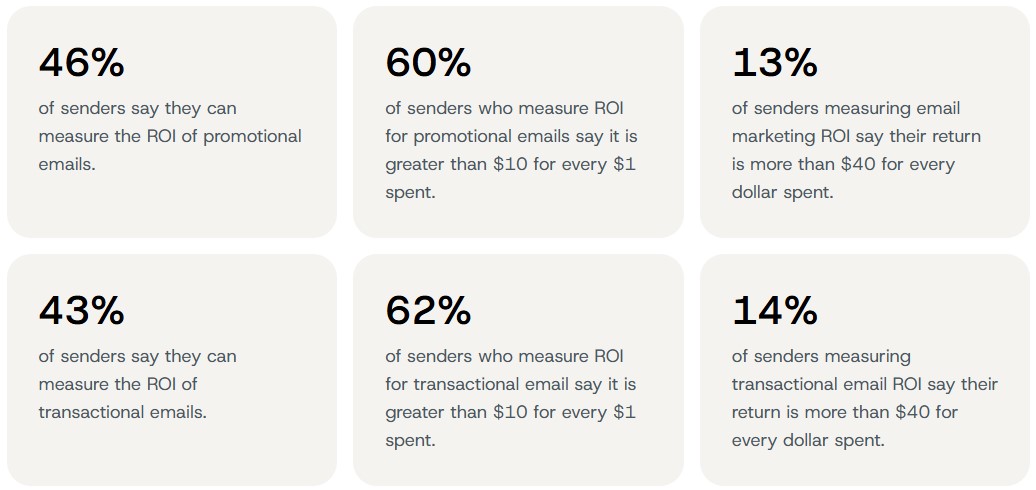
For businesses measuring performance, the returns are staggering. 60% of companies report an ROI of at least 10:1, and more than one in ten see returns as high as 40:1. However, fewer than half of organizations can confidently measure this ROI, leading to a “measurement gap” where budgets are allocated without clear evidence of impact.
In the competitive APAC landscape, this gap is especially costly. “Fixing deliverability is one of the fastest ways to unlock more value from existing spend,” notes Ginger Kidd, VP of Marketing at Sinch APAC. Marketers in cost-conscious markets like Australia simply cannot afford for 20% of their communication to vanish into spam filters.
How do you measure email ROI?
If you’re among the 57% of senders who aren’t measuring email RO, or aren’t sure how, here’s the basic formula:

(Total revenue from email – Total cost of email) / Email costs] x 100 = Email ROI

So, let’s say you’re calculating ROI for a month in which you attribute $200,000 in revenue to the email channel. And you estimate your monthly email expenditures to be around $10,000.

That’s an ROI of 1,900%, which means you made $19 for every $1 your organization spent on email that month. These results would put a sender near the middle of what our survey revealed.
BEYOND CONTENT: AI’S UNTAPPED POTENTIAL
The report identifies a massive disconnect in how teams use Artificial Intelligence. While 41% of teams have adopted AI for content generation (writing copy and subject lines), the “high-impact” applications remain underutilized:
- Content Generation (41%): Widespread, but only improves speed, not necessarily placement.
- Decision-Led AI (Underutilized): Sophisticated teams are using AI to predict subscriber disengagement, optimize send times, and protect sender reputation.
- Performance Uplift: Organizations applying AI to segmentation and deliverability are significantly more likely to report year-over-year performance gains.
SECTORAL BENCHMARKS: The Performance Hierarchy
Not all industries are created equal when it comes to the “inbox battle.” The report highlights a tiered performance landscape based on send type and audience intent:
| Industry | Delivery Rate | Primary Driver |
| Air Freight & Logistics | 99.25% | High-utility transactional sends (tracking/shipping). |
| Financial Services | 91% (Placement) | Driven by high trust and critical notifications. |
| eCommerce & Retail | 89% (Placement) | Face higher bounce rates and unsubscribe pressure. |
| Media & Publishing | 95.95% (Delivery) | Broad promotional audiences put downward pressure on metrics. |
Editor’s Take: The “Measurement Debt” Crisis
For the Malaysian Business reader, the Sinch Mailgun report highlights a dangerous trend: Measurement Debt. We are currently seeing RM789.85 billion in Q1 trade, but if our digital communication is failing at an 18% rate, our export-driven growth is effectively running with a “clogged pipe.”
As we move toward “Sovereign Intelligence” and a more AI-integrated economy, the focus must shift from volume to placement. Using AI to churn out more copy is a 2024 strategy; using AI to ensure that a critical trade document or a luxury retail offer actually hits the primary inbox is the 2026 mandate. In an era of 3.1% global growth, you cannot afford to have 20% of your customer reach blocked by your own technical infrastructure.