

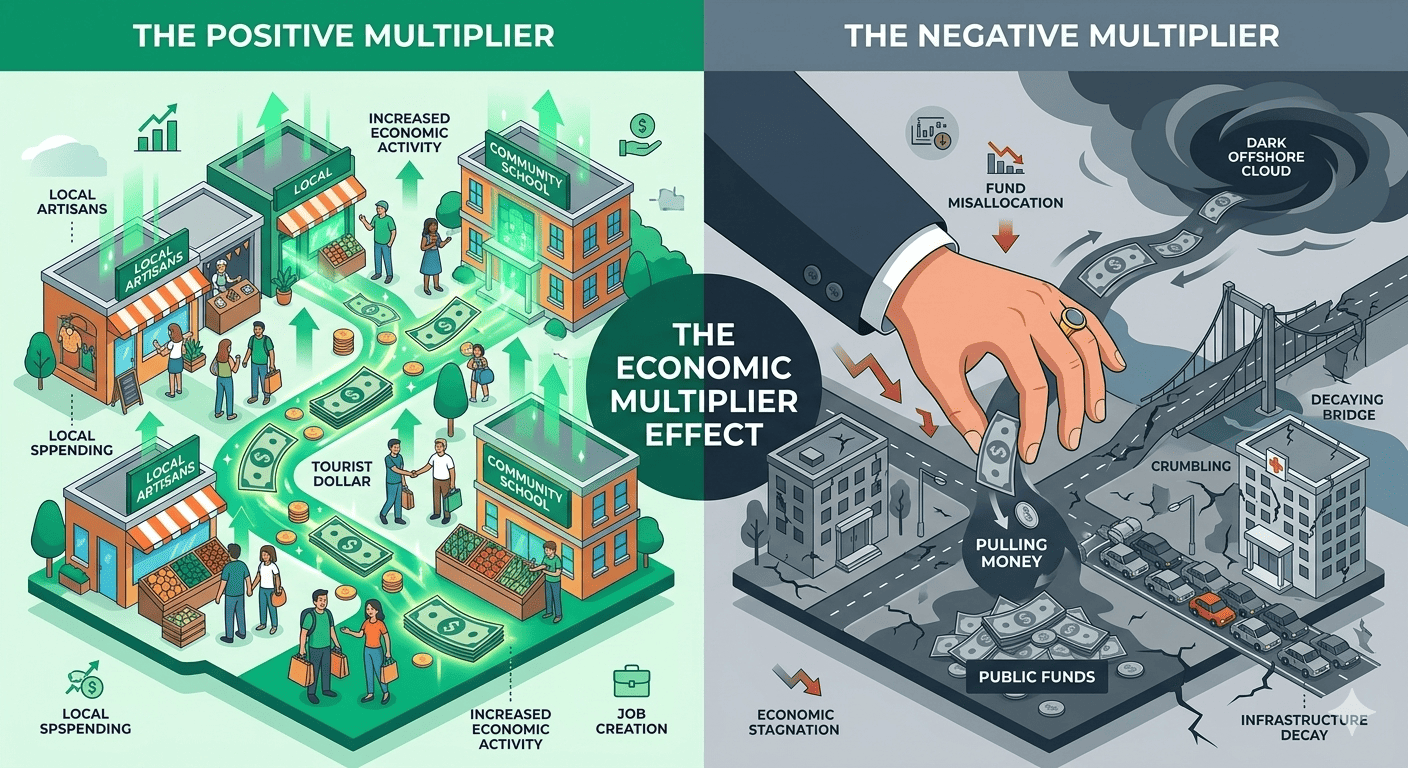
The recent Rain Rave event in Bukit Bintang has sparked a heated debate regarding economic reporting. While official reports suggest the three-day festival garnered a staggering RM270 million, skeptics have been quick to challenge the figure. To understand how a single weekend event can claim such high economic impact, we must look through the lens of the Multiplier Effect.
Now, What is this Multiplier Effect?
Don’t worry, there is no mathematics involved in this article. In economics, the multiplier effect refers to the proportional amount of increase in final income that results from an injection of spending. Essentially, it is the idea that RM1 spent by a tourist does not just stop at the cash register but it “circulates” through the local economy multiple times.
The Invisible Force: Why Many Miss the Multiplier
Despite its importance, the multiplier effect is often misunderstood because it is invisible to the naked eye. Most people only see the Direct Injection of the physical RM50 note handed to a street food vendor. They do not see the Indirect Impact when that vendor buys local poultry, nor the Induced Impact when the poultry farmer pays his workers’ wages.
| Component | Definition |
| Initial Injection | The direct spending by event organisers and attendees (hotels, tickets, food). |
| Indirect Impact | Spending by businesses to support the event (hotels buying more linen, restaurants buying more local produce). |
| Induced Impact | Spending by employees who earn wages from the event (a waiter spending their overtime pay at a local grocery store). |
| The Leakage | Money that leaves the local economy (buying imported goods or profits sent to foreign headquarters). |
Why the RM270 Million figure?
When authorities quote RM270 million, they are likely using a high multiplier coefficient. If the direct spending was RM90 million and they applied a multiplier of 3.0, the “total economic impact” reaches RM270 million. Critics often call “bullshit” because these coefficients can be inflated or fail to account for “leakages” where the money leaves the country.
The Reality Check: Hotels and Airbnbs
Reports from the Bukit Bintang precinct during the Rain Rave indicate a significant surge in demand, though “fully booked” is often a hyperbolic term used in marketing.
- Occupancy Surges: Mid-range hotels and boutique stays within a 1km radius of the event reported occupancy rates exceeding 90%.
- Airbnb Premiums: Short-term rentals saw a “surge pricing” effect, with some units in the Golden Triangle listing for 40% higher than standard May rates.
- The Displacement Factor: While event-goers filled rooms, some regular business travellers avoided the area due to noise and traffic, meaning the net gain is often slightly lower than the total room count suggests.
However, this effect works both ways. Just as spending has a positive multiplier, leakage and corruption have a devastating negative multiplier.
The ‘Negative Multiplier’ of Corruption
Consider a scenario where funds are diverted from public coffers meant for the poor. When RM1 million is stolen through a bribe or kickback, the loss to the economy is not just that RM1 million.
- The Opportunity Cost: That money, if spent correctly, would have provided healthcare or education, allowing citizens to enter the workforce i.e. a Social Multiplier.
- The Stagnation Effect: Stolen money often leaves the country for offshore accounts (Total Leakage). It stops circulating.
- The Result: By removing RM1 million from the public system, the economy might actually lose RM3 million to RM4 million in potential growth. Corruption doesn’t just take money; it extinguishes future capital velocity.
Beyond the Ringgit: The Intangible Multiplier (Yes, there is more…)
Economic impact is not solely defined by liquid cash. Using both the Rain Rave and the long-standing Sarawak Rainforest World Music Festival (RWMF) as benchmarks, we see a “Social Multiplier” at work:
- Micro-Business Activation: Events like these act as a mechanical necessity for local vendors. A satay seller in Bukit Bintang or a handicraft maker in Santubong gains more than just sales; they gain market validation and brand exposure to international audiences.
- Regional Awareness: The RWMF has successfully rebranded Sarawak from a “remote jungle” to a “global ethno-music hub.” This intangible asset lowers the cost of future tourism marketing making it a Marketing Multiplier.
- Community Pride & Resilience: Local communities involved in these festivals develop specialised skills in hospitality and logistics. This elevates the local talent pool, contributing to the “rounded skill profile” the ILO recently identified as a strategic priority for future-proofing workforces.
Editor’s Take: The Math of Optimis
For the Malaysian Business reader, the RM270 million figure should be viewed as a “Potential Gross Impact” rather than a net profit. The multiplier effect is a valid economic tool, but its accuracy depends on the transparency of the coefficient. As we track Malaysia’s goal to become a high-value Business Events hub, as seen with MyCEB Association Day 2026, we must demand for data that accounts for leakages. The true value of the Rain Rave isn’t just in the hotel receipts; it’s in the Capital Velocity created when that money stays within the Malaysian ecosystem.