

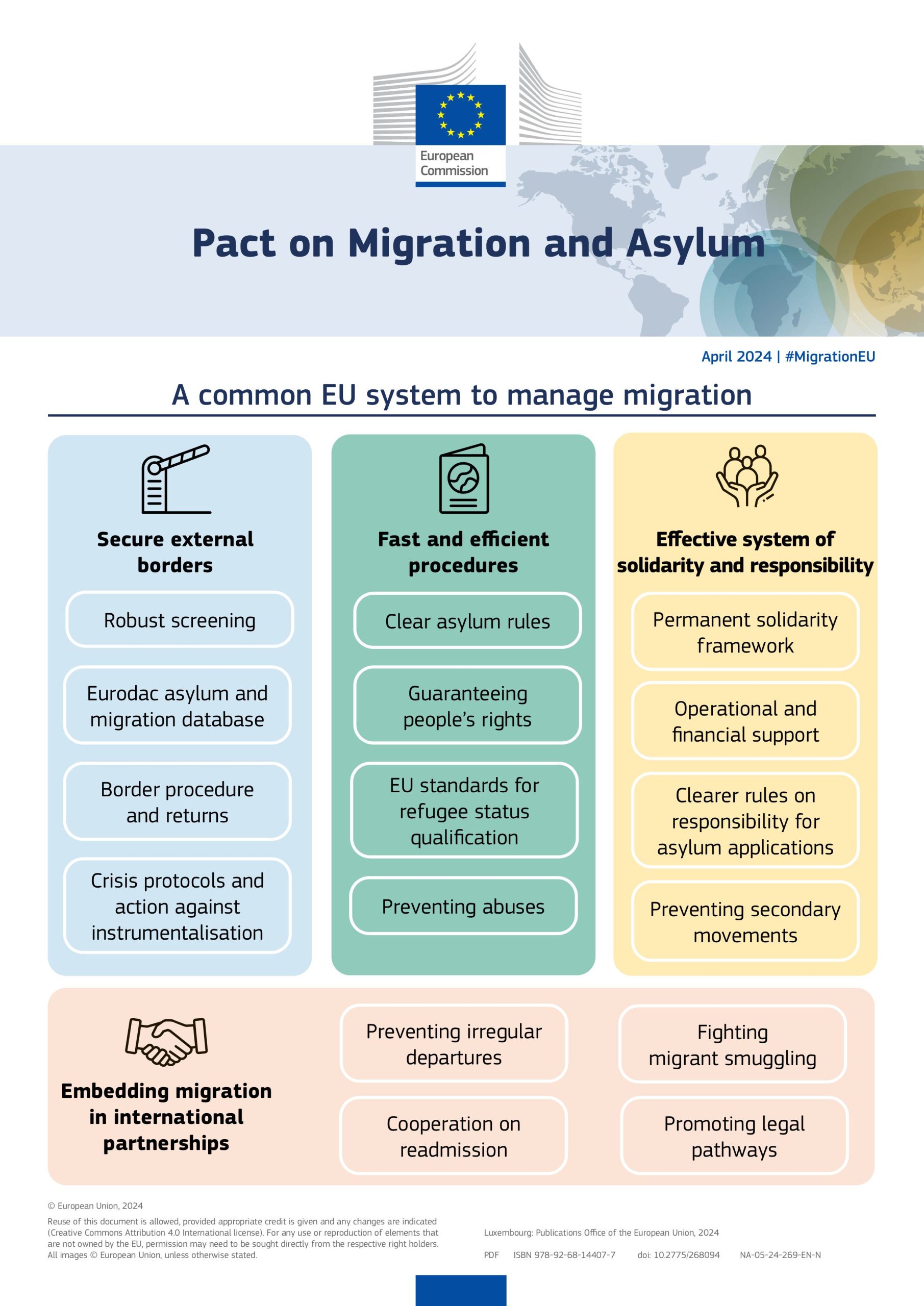
The European Union’s New Pact on Migration and Asylum has entered its active implementation phase, transforming decades of theoretical debate into a transnational operational reality. Central to this new framework is the formalised “Safe Third Country” (STC) mechanism, which allows the 27-nation bloc to deport asylum seekers to non-EU nations deemed to possess adequate protection standards.
While European policymakers view this as a mechanical necessity to secure the bloc’s borders and standardise asylum procedures, the move is generating significant scrutiny within ASEAN and the broader Global South, where leaders and analysts are calculating the long-term impact on regional stability and economic growth.
EU Perspective: Modernising the 1951 Convention
The European Commission argues that the Pact, ratified in late 2025, is a necessary evolution of the 1951 Refugee Convention, a document designed for a post-WWII European landscape, not the modern era of mass, hybrid migration.
| EU Strategic Objective | Rationale for the Pact |
| Sovereign Border Control | Standardising asylum screening to prevent “asylum shopping” within the Schengen Zone. |
| Operational Efficiency | Decoupling the processing of claims from European soil to reduce the strain on frontline states like Italy and Greece. |
| Regional Balance | Implementing a “Mandatory Solidarity” mechanism to distribute the bureaucratic and financial load of hosting among all member states. |
Commissioners have consistently maintained that the current system is unsustainable. The Pact, they argue, provides a legal and humane framework to manage migration while upholding non-refoulement principles through partners deemed safe, ultimately protecting the integrity of the international asylum system.
The STC Critique: Shifting Responsibility, Impacting Development
Conversely, a broad coalition of human rights organisations, academic institutions, and Global South governments argue that the STC mechanism is an exercise in strategic outsourcing.
- The Burden-Shift: Critics, including Amnesty International and the European Council on Refugees and Exiles (ECRE), contend that the policy shifts the legal, social, and economic burden of hosting refugees onto developing nations. These states often possess fragile social infrastructures and are ill-equipped to manage sudden population influxes.
- A “Glass Ceiling” on Growth: Developmental economists point to a potential “Impact Factor” on emerging “Rising Stars” like Vietnam or Bangladesh (which is currently listed as a safe return destination). When a developing economy must prioritise immediate humanitarian crisis management, resources are inevitably diverted from high-yield, long-term investments in areas such as digital infrastructure (5G) and advanced services.
- The Problem of ‘Negative Multipliers’: As highlighted by our recent analysis of the Rain Rave event, the positive multiplier of initial spending can be eclipsed by long-term structural strain. Analysts argue that for every RM1 of EU aid received by an STC partner, the true long-term economic cost can be several factors higher, impacting local housing markets, healthcare access, and wage structures.
The Remittance Paradox: Malaysia’s Unique Strain
Malaysia occupies a unique and precarious position in this global migration nexus. Data from Bank Negara Malaysia shows that migrant workers remitted a substantial RM32.6 billion abroad in 2024.
| Labour Source Country | Remittance Value (2024) | Strategic Impact |
| Indonesia | RM10.9 Billion | Primary ASEAN labour partner; key geopolitical ally. |
| Bangladesh | RM6.2 Billion | Currently designated “Safe” by the EU; risk of increased influx. |
| Nepal | RM5.9 Billion | Highly dependent on these flows, which represent ~23% of their GDP. |
This highlights a fundamental structural issue: while international aid provided to a host country circulates locally, stimulating sectors like retail and F&B, it represents a high-velocity, low-retention expenditure. Conversely, remittances act as a sustained wealth transfer that strengthens the economy of the origin country (e.g., Bangladesh), while Malaysia, the host nation, must absorb the hidden infrastructural and social costs of hosting that workforce.
Editor’s Take: The Strategic Impact of ‘Safe Third Country’ Designations
For the Malaysian business community, the EU’s expansion of the “Safe Third Country” (STC) mechanism introduces a new layer of complexity to ASEAN-EU relations. While Brussels frames these agreements as essential for regional stability and migration management, the long-term economic implications for host nations remain a subject of intense debate among policymakers.
The central tension lies in the trade-off between immediate fiscal incentives and structural economic goals. Critics of the STC framework point to a potential “divergence of focus”: where emerging markets are encouraged to prioritize detention and processing infrastructure over the technology transfers and trade equity necessary for high-income transitions.
For ASEAN, the challenge is twofold:
- Fiscal Transparency: Assessing whether EU financial aid packages adequately cover the “hidden costs” of migration management, including impacts on local healthcare, housing, and wage growth.
- Diplomatic Cohesion: Determining whether to engage in bilateral STC negotiations or to pursue a multilateral framework that ensures migration management does not come at the expense of regional “Rising Star” growth trajectories.