

Strategic Takeaways
- The Phased Rollout Schedule: The NIF’s manufacturing protocols became fully operational on March 1, 2026, completely replacing the old PIA 1986 application tracks. The framework is scheduled to expand into the services sector during Q2 2026 under specialized guidelines.
- The 15 Priority Industrial Areas: The framework targets 15 strategic manufacturing subsectors, focusing heavily on Electrical and Electronics (E&E), Chemicals, Pharmaceuticals, Medical Devices, Aerospace, and Advanced Machinery & Equipment (M&E).
- The Tiered Incentive Architecture: Approved projects are assigned explicit performance tracks. The specific level and duration of tax relief are directly linked to a company’s ongoing compliance, verified through detailed Annual Compliance Reports.
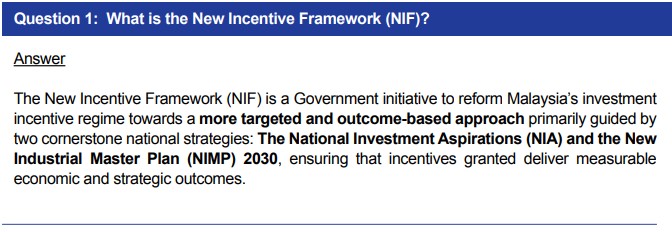
To provide direct operational context for the RM92.8 billion in approved investments recorded in Q1 2026, the Malaysian Investment Development Authority (MIDA) has completed the phased rollout of its New Incentive Framework (NIF) for the manufacturing sector.
Officially active for all new submissions since March 1, 2026, the NIF replaces the forty-year-old activity-based systems of the Promotion of Investments Act 1986 (PIA 1986).
The regulatory overhaul introduces a tiered, performance-driven system designed to secure economic substance and protect corporate structures within a Global Minimum Tax (GMT) environment.
The policy shift directly addresses a critical challenge for multinational corporations navigating regional re-shoring: the decline of traditional tax holidays under OECD Pillar Two compliance rules.
By removing standard statutory “promoted lists” and routing applications through the digital InvestMalaysia Portal, MIDA has replaced simple sector-based qualification with a strict scoring matrix.
Under this framework, corporate tax relief is no longer granted simply for establishing physical operations.
Instead, it functions as a flexible financial multiplier that scales alongside verified milestones in automation, human capital development, and local component sourcing.
| Key Operational Dimension | The Legacy Framework (PIA 1986) | The New Incentive Framework (NIF) |
| Evaluation Base | Static Promoted Activity Lists Incentives automatically triggered by broad sector classification, regardless of local economic value. | Dynamic Outcome-Based Metrics Entitlement tied directly to performance across the six core pillars of the National Investment Aspirations (NIA) Scorecard. |
| Incentive Architecture | Flat Profit-Based Tax Holidays Vulnerable to top-up taxes under the OECD Pillar Two Global Minimum Tax (GMT) rules. | Tiered Performance Tracks Tax structures separated into operational tiers based on verified spending, wage minimums, and local supply chain integration. |
| Compliance Mandate | Upfront Gatekeeping Only Lax tracking after initial award, allowing operations to slowly drift into basic assembly loops. | Continuous Lifecycle Monitoring Ongoing verification via mandatory Annual Compliance Reports to protect active incentive tiers. |
Dissecting the Evaluation Architecture: The NIA Scorecard Protocol
To qualify for incentives under the new guidelines, projects must meet strict operational pre-qualifiers before undergoing review via the NIA Scorecard. This digital evaluation engine measures investment quality across six strategic pillars:
- 1. Increasing Economic Complexity: Rewarding projects that introduce front-end engineering processes such as advanced wafer-level packaging and MOCVD deposition—to move beyond basic back-end assembly.
- 2. Creating High-Value Jobs: Requiring strict salary and staffing structures, with an emphasis on technical positions offering monthly salaries above RM5,000 to improve local engineering capabilities.
- 3. Extending Domestic Linkages: Incentivizing foreign firms to integrate with domestic vendors and use local supply chains, shifting away from isolated raw material sourcing.
- 4. Cluster & Sustainability Alignment: Grading projects on their industrial integration, greenhouse gas reduction targets, and the adoption of energy-efficient, automated circular-manufacturing practices.
Editor’s Take: Safeguarding Corporate Margins via Productivity Realism
From the strict perspective of fiscal policy and Productivity Realism, the launch of the NIF highlights an essential rule for modern corporate expansion: long-term tax optimization and margin preservation belong entirely to enterprises that align their operational workflows with verified local value generation. For too long, multinational firms have treated tax incentives as static financial adjustments, ignoring how changing global minimum tax rules can dilute old-style tax holidays if they lack real economic substance.
True corporate leadership requires treating investment incentives as dynamic performance contracts.
By using the NIA Scorecard to reward automation and technical job creation, local authorities are showing how to build a competitive manufacturing landscape without relying on race-to-the-bottom tax incentives.
This model of performance-driven support serves as an excellent guide for regional corporate leaders as they scale operations to navigate shifting international trade laws and strict compliance benchmarks.