

Strategic Takeaways
- The Built-to-Suit Expansion Tranche: The footprint includes 30,000 square meters of specialized space currently in active operation, supported by a further 130,000 square meters of committed, built-to-suit developments across Malaysia and Thailand scheduled to go live over the next two years.
- The Rapid Market Realignment: The expansion directly captures a high-growth sector, as the global data center logistics market scales from USD 23 billion in 2025 to USD 35 billion by 2030, driven by rapid cloud migration and heavy enterprise AI deployment cycles.
- The Integrated Global Network: Led by a dedicated global task force, the APAC expansion builds on DHL’s recent rollout of 7 million square feet of data center logistics space across 10 dedicated sites in North America, allowing hyperscalers to utilize a unified global supply framework.
To provide direct operational context for the massive digital expansion sweeping the region, DHL Supply Chain has finalized a major expansion of its data center logistics capabilities across the Asia-Pacific (APAC) corridor.
The strategy introduces more than 160,000 square meters of dedicated, high-security warehousing space across key digital centers.
The move addresses an immediate operational roadblock for hyperscalers and data center operators racing to meet compressed build schedules: the friction of assembling, testing, and installing high-value server arrays within active, chaotic construction zones.
The investment highlights the core rule of Productivity Realism within premium technology supply chains: as hardware density grows, real speed to market is won by shifting complex assembly work out of chaotic building zones and into controlled logistics environments. Driven by a massive wave of AI investment, the APAC data center market is projected to attract USD 800 billion in capital by 2030, overtaking the United States as the world’s largest digital infrastructure market.
By upgrading its workforce with advanced technical skills, DHL is stepping past basic corporate moving services.
Instead, the provider functions as a core operational partner, capable of building out fully wired server racks and running functional tests before delivering components directly to active data center hubs.
Dissecting the Staging Architecture: Shifting the Burden of Technical Integration
Under the updated deployment framework, DHL splits its specialized support into two distinct operational layers, designed to optimize asset velocity:
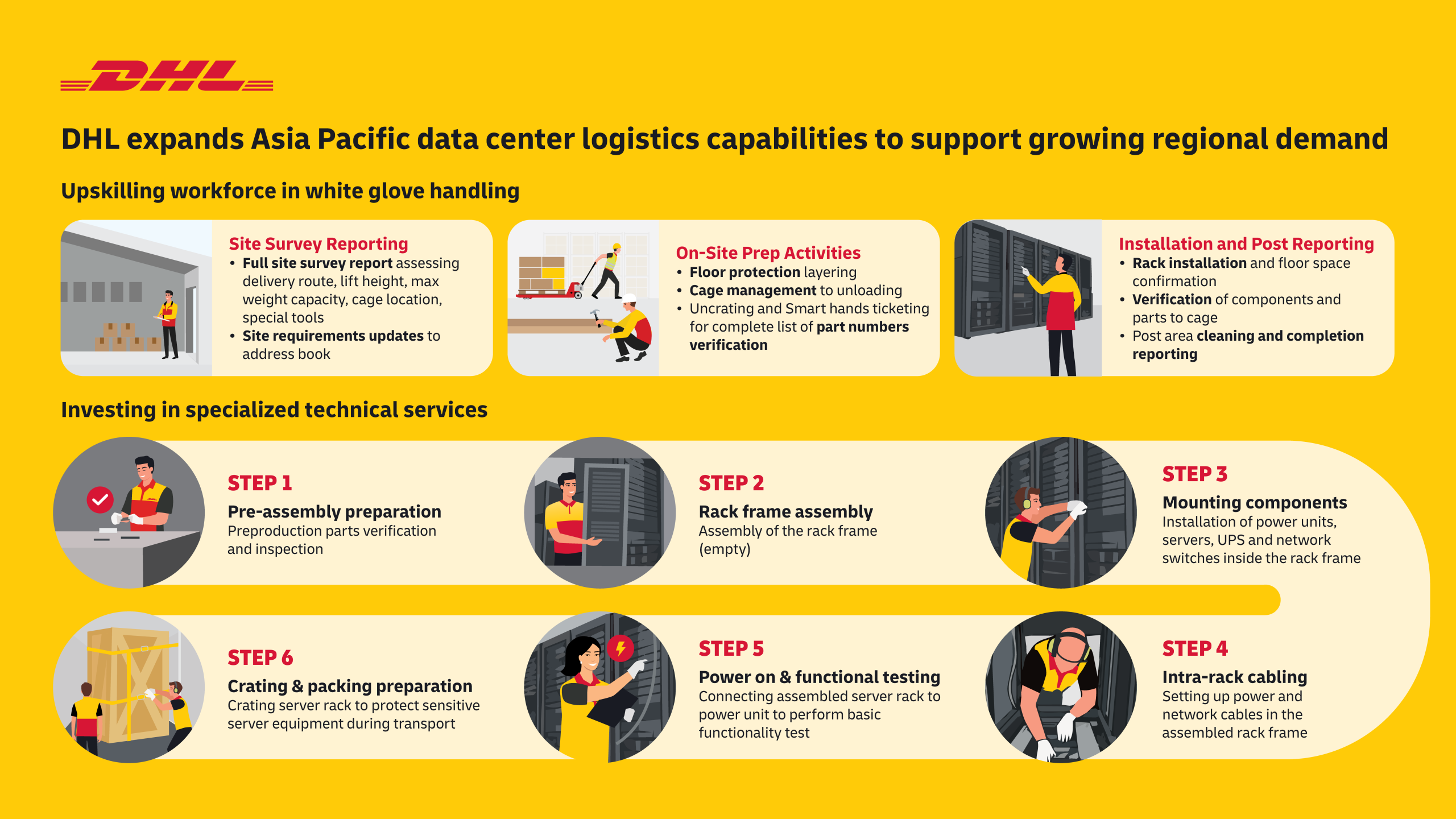
1. Off-Site Technical Engineering Services: To reduce congestion on active build sites, specialized logistics teams handle initial hardware integration within purpose-built, high-security hubs. Technicians carry out server rack frame assembly, mount sensitive components, manage intricate intra-rack cabling, perform functional testing, and apply secure protective packaging to shield components during final transit.
2. Advanced On-Site White-Glove Handling: Moving past basic delivery drivers, dedicated teams manage the final setup process under strict environmental controls. This comprehensive sequence covers pre-delivery route assessments, building site survey reports, installing floor protection, managing secure server cages, verifying part numbers, placing individual racks, and providing final post-installation area cleaning.
Editor’s Take: Safeguarding Digital Infrastructure Margins via Productivity Realism
From the strict view of infrastructure economics and Productivity Realism, DHL’s massive investment in built-to-suit technical facilities emphasizes an essential rule for modern technology expansion: long-term project delivery and execution certainty belong entirely to operators that systematically eliminate manual assembly friction from live building sites. For too long, digital infrastructure developers have treated logistics as a simple transport cost, overlooking how component damage, missing serial numbers, and uncoordinated delivery times can disrupt multi-billion dollar construction timelines.
True tech leadership requires treating the supply chain as an active component of engineering setup.
By building specialized off-site assembly skills and using dedicated tech hubs to streamline deployment, logistics leaders are showing how to scale computing power quickly without sacrificing data safety or construction schedules.
This smart operational focus provides an excellent guide for regional managers as they coordinate complex international supply lines to meet demanding project deadlines.