

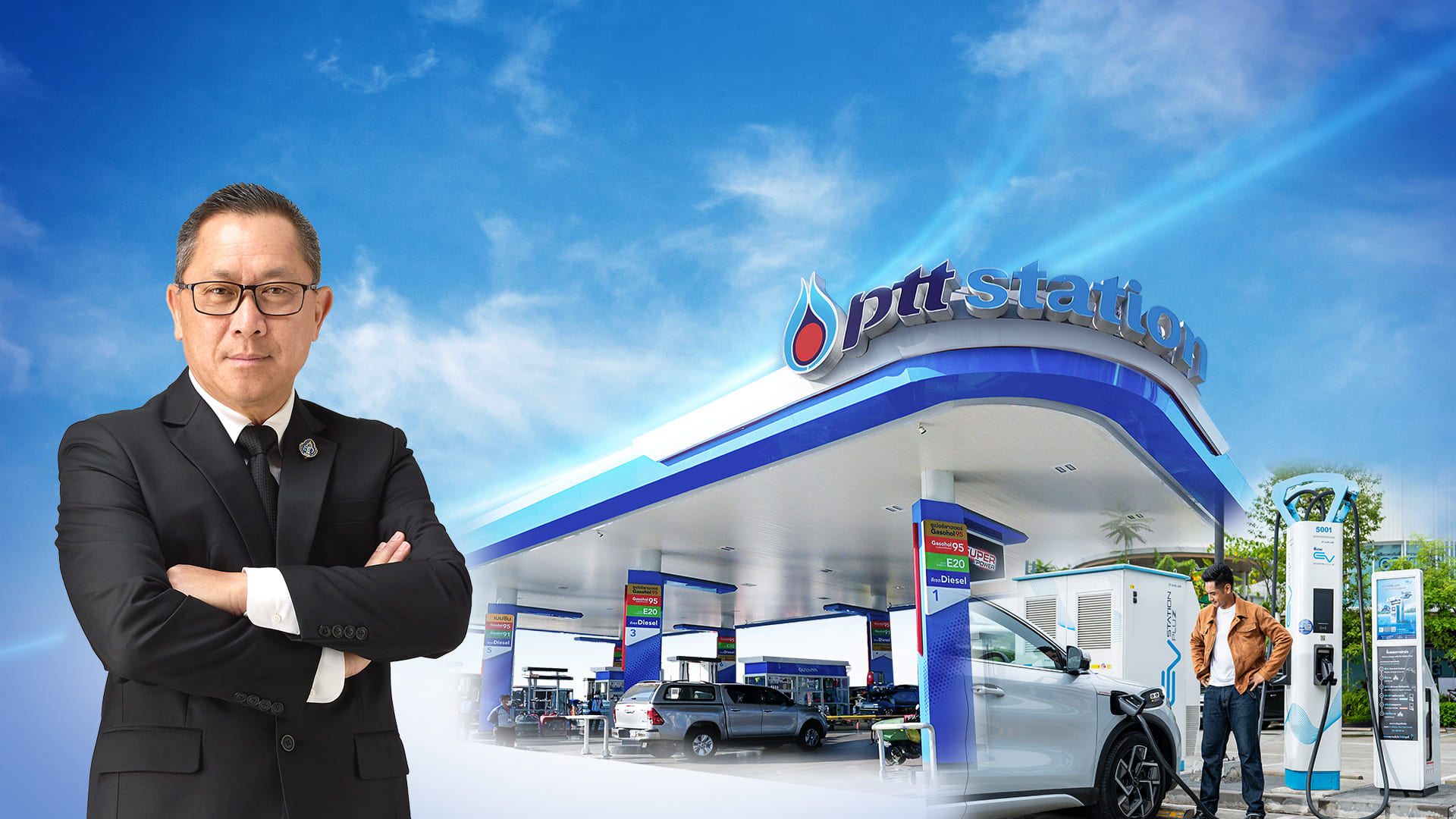
Thailand’s PTT Oil and Retail Business (OR) is executing a surgical departure from the high-volume, low-margin world of traditional fuel. Despite a 9.0% decline in total revenue, OR’s 2025 net profit surged by 47.8% to 11,304 million baht (~RM1.5 billion), signaling that its transition into an integrated lifestyle and digital ecosystem is already paying dividends.
The Group has now committed 58,000 million baht (~RM7.7 billion) to a high-conviction, five-year investment plan (2026–2030). This roadmap is designed to transform its 2,000+ service stations into a scalable regional platform, moving beyond Thailand into the broader ASEAN corridor—including a deepening focus on the Malaysia-Thailand Joint Development Area (MTJDA).
The Alpha Cycle: From Petrol to “PluZ” and Pillows
OR is leveraging its massive physical footprint to create a market moat that pure-play energy retailers cannot easily replicate:
- The EV Value-Unlock: The EV Station PluZ network is being integrated into existing stations as EV uptake accelerates. This isn’t just about charging; it’s about capturing the “dwell time” of the affluent, early-adopter segment.
- The Hospitality Hedge: In a major strategic play, OR announced a joint venture with Centara Hotels to develop budget hotels directly at PTT Stations. By offering 70–80 rooms per site, OR is evolving its network from daily convenience to overnight hospitality.
- The Digital Yield Premium: With 9.3 million blueplus+ members, OR is using granular behavioral data to drive cross-selling across its food, beverage (Café Amazon), and wellness lines.
COMPETITOR ANALYSIS: The Petronas “Superstore” Response
As OR eyes regional expansion, it faces a formidable counter-offensive from Malaysia’s Petronas, which is following a parallel but distinct “Energy Superstore” trajectory.
| Feature | Thailand’s OR (PTT) | Malaysia’s Petronas (PetDag/Gentari) |
| Non-Fuel Core | Café Amazon (4,600+ outlets); dominant regional coffee player. | Kedai Mesra & Café Mesra; >RM1 billion in non-fuel sales for 4 straight years. |
| EV Strategy | EV Station PluZ; focus on “Lifestyle Integration” and dwell-time retail. | Gentari; targets 9,000 public chargers by 2026 across Malaysia, India, and Thailand. |
| Lifestyle Play | Hospitality (Centara JV); budget hotels at stations. | “Integrated Customer Hubs”; focus on SME partnerships and digital-first retail via Setel. |
| Digital Moat | blueplus+ (9.3m members); deep focus on behavioral data for cross-border scale. | Setel & Mesra Rewards; seamless payment ecosystem and high-frequency engagement. |
The Strategic Leverage: While OR is betting heavily on the hospitality and coffee “Lifestyle” hook to keep people at stations, Petronas is leveraging Gentari to dominate the infrastructure and green mobility layer of the ASEAN corridor. The battleground for 2026 will be who can move faster to “own” the consumer’s time while their vehicle is plugged in.
The North-South Charging Corridor
To illustrate the competitive density, we have generated an infrastructure map (Figure 1) detailing the North-South Expressway (NSE) connectivity. This map below provides a breakdown of the current Gentari vs. OR positioning in the race to link the two nations.
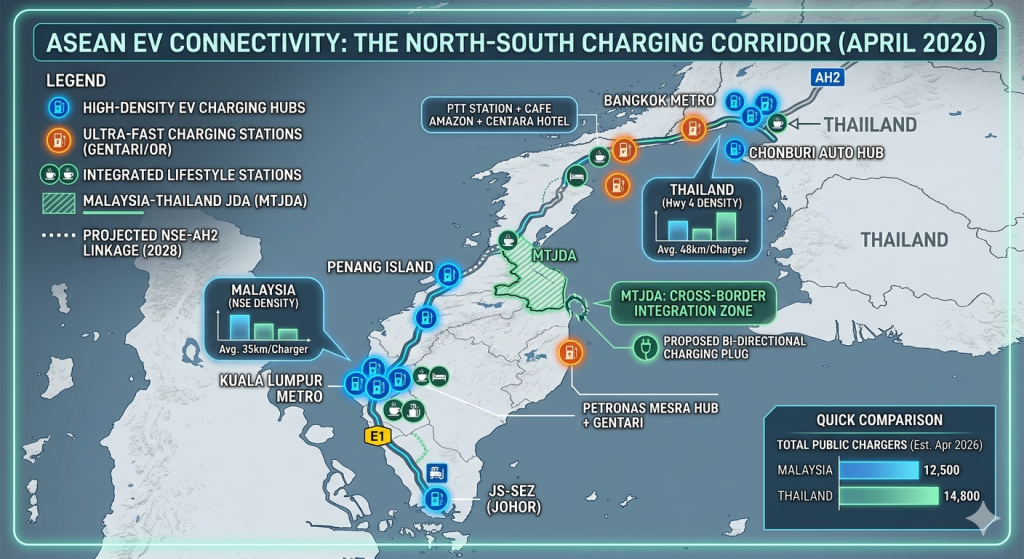
The Malaysia NSE Density call-out shows an average of 35km between chargers, highlighting Petronas’ aggressive Gentari rollout along the primary transit vein. In contrast, the Thailand Highway 4 Density shows a wider 48km gap on their side, but makes up for this with a higher concentration of Integrated Lifestyle Stations (the glower coffee and bed icons), reinforcing OR’s belief that superior non-fuel amenities will attract more frequent, longer-duration stops. The map also clearly identifies the high-density High-Density Hubs in Kuala Lumpur, Penang, and JS-SEZ (Johor), emphasizing where the majority of standard public charging demand remains.
The MTJDA: The Cross-Border Kill Zone
The most critical feature is the Malaysia-Thailand Joint Development Area (MTJDA), labeled on the map as the “Cross-Border Integration Zone.”
- The Opportunity: A dotted green line shows the “Proposed NSE-AH2 Linkage (2028).” This zone is being prioritized by both PTT and Petronas for shared ultra-fast charging infrastructure to facilitate seamless EV trucking and tourism.
- The Future Moat: The map highlights the proposed Bi-Directional Charging Plug, suggesting that the future of this corridor lies not just in charging vehicles, but in Vehicle-to-Grid (V2G) energy trading between the two grids to manage peak-hour demand in this industrial-intensive area.