

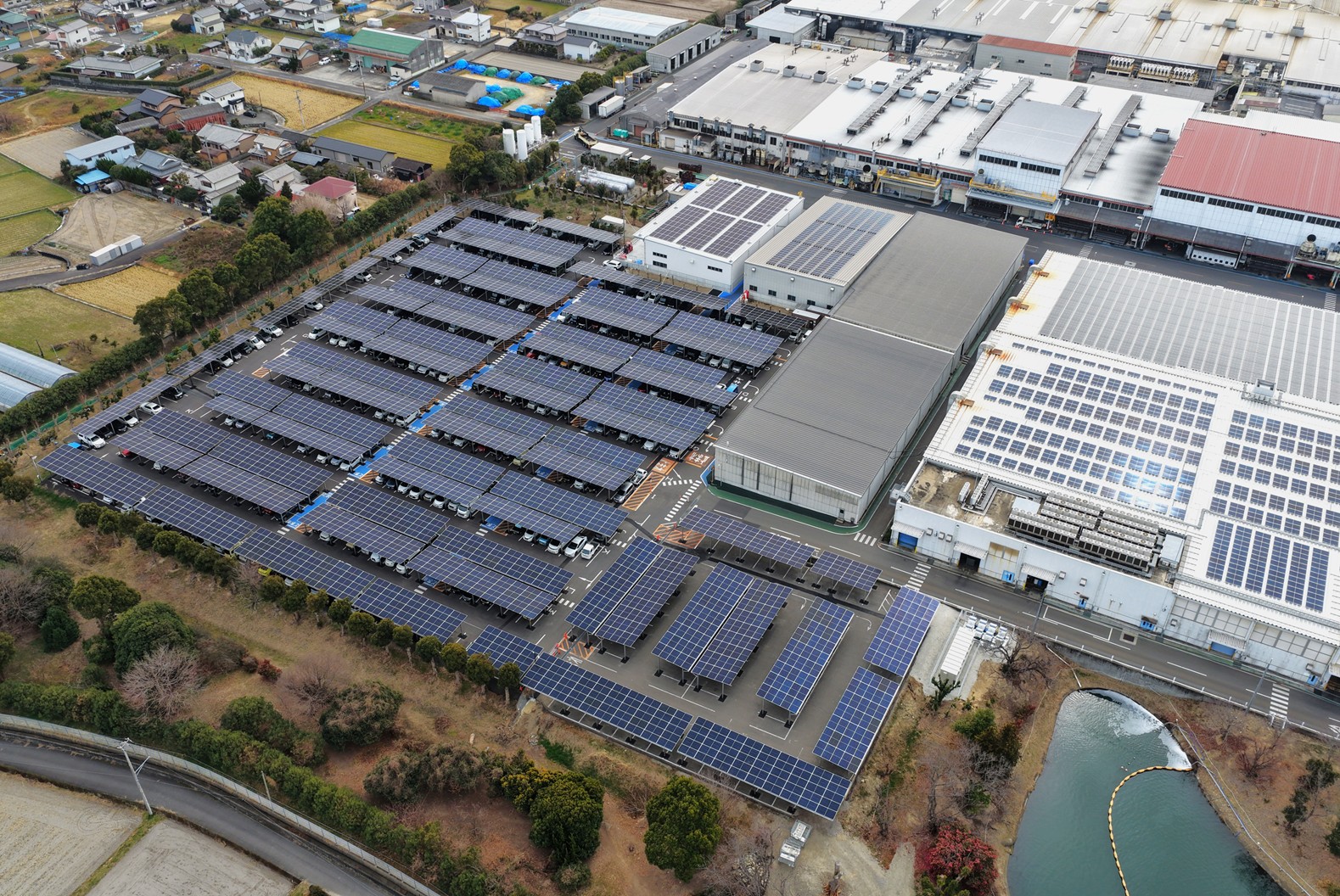
As the conflict in the Persian Gulf disrupts the Strait of Hormuz—the artery for nearly 25% of the world’s sea-borne oil—Japan’s manufacturing giants are racing to insulate themselves from “import inflation”. JTEKT Corporation, a backbone supplier to the Toyota Group, has just commissioned a 2 MWp solar carport at its Kagawa plant, marking a decisive shift from global grid dependence to on-site energy security.
The project, delivered under a 20-year Power Purchase Agreement (PPA) with Peak Energy, is expected to slash electricity costs by 40% compared to grid prices. For a sector where margins are currently being eroded by $100+ oil, this isn’t just a green initiative—it is a defensive financial play.
The Alpha: Solving the “Land-Locked” Energy Crisis
Japan’s industrial zones are notoriously land-constrained, making large-scale solar farms nearly impossible. JTEKT’s solution was to look at its own tarmac:
- Dual-Use Infrastructure: By covering 640 parking spaces, JTEKT turned “dead space” into a power plant capable of generating 2,500 MWh annually—enough to remove roughly 230 cars’ worth of emissions.
- The PPA Advantage: Under the 20-year deal, Peak Energy financed and installed the system, allowing JTEKT to secure fixed-price power without the heavy upfront cost of construction.
- Operational Resilience: The installation took only five months and was sequenced around active plant operations, proving that renewable pivots don’t have to mean factory downtime.
THE TOYOTA MANDATE: Decarbonising the Bill of Materials
JTEKT’s move is a direct response to the 8th Toyota Environmental Action Plan, which kicked off this month (April 2026). Toyota has issued a “CO2 Zero Challenge” to its entire supply chain, requesting all business partners to achieve carbon neutrality in their operations.
| Target | JTEKT’s Commitment | Strategic Move |
| Carbon Reduction | 60% reduction by 2030 (vs. 2013 levels). | Integrating solar carports with existing rooftop solar and inverter-controlled hydraulic systems. |
| Energy Mix | 60% renewable energy introduction rate. | Diversifying via on-site carports and off-site “physical” and “virtual” PPAs. |
| Group Goal | Carbon neutrality for own production by 2035. | Using “Smart Manufacturing” to cut operational waste by 20% while scaling renewable generation. |
Editor’s Take: The Replicable Model for Malaysia
JTEKT’s model offers a clear roadmap and as Malaysia moves toward targeted electricity subsidies and faces similar land constraints in industrial hubs like Bayan Lepas or Pasir Gudang, the solar carport is the logical next step. It protects the bottom line from global oil volatility while meeting the increasingly strict “Green Procurement” rules of major MNCs like Toyota.