

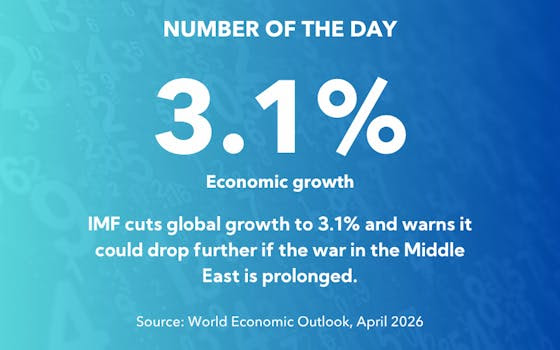
The International Monetary Fund (IMF) has officially downgraded its global economic growth forecast to 3.1% for 2026. This adjustment, revealed in the April 2026 World Economic Outlook, signals a cooling global economy as geopolitical tensions exert increasing pressure on trade and energy stability.
1. The “Prolonged War” Warning
The primary driver behind this downward revision is the continuing instability in the Middle East. The IMF has explicitly warned that the 3.1% figure is not a floor; growth could drop further if the conflict is prolonged, potentially triggering fresh inflationary spikes and supply chain disruptions.
2. The Regional Impact
For open, trade-dependent economies like Malaysia, this global slowdown presents a dual challenge:
- Export Demand: A dip in global growth to 3.1% typically correlates with softened demand for electrical and electronic (E&E) products and commodities.
- Investment Sentiment: As noted in the Kearney 2026 FDI Confidence Index, 36% of global executives now cite geopolitical tension as their top concern, making the “Resilience Premium” of stable markets more valuable than ever.
Editor’s Take:
Navigating the 3.1% Reality
The IMF’s latest number is a stark reminder that the “post-pandemic recovery” has shifted into a “geopolitical endurance” phase. For the Malaysian Business reader, the message is clear: while the 3.1% global average remains positive, the volatility in the Middle East acts as a massive “risk multiplier”. Success in this fiscal year will depend on a company’s ability to de-risk supply chains and pivot toward the high-growth corridors of the APAC region, which currently remains the world’s most attractive investment destination despite the global gloom.