

Key Takeaways
- Shifting Up the Value Chain: Malaysia is moving beyond legacy back-end assembly and testing by launching SemiconStart Malaysia, a national incubation initiative focused entirely on high-margin front-end sectors like Integrated Circuit (IC) design and advanced packaging.
- Strategic Global Venture Pairing: Orchestrated by the Malaysian Technology Development Corporation (MTDC) and Silicon Catalyst UK, the programme provides selected startups with up to RM1 million in funding alongside a structured 260-day design-to-market development pipeline.
- Inaugural Cohort Deployed: Ten pioneering domestic semiconductor ventures, including SkyeChip and SMD Compound, have been inducted into the first cohort to catalyse national technology sovereignty and build local intellectual property (IP).
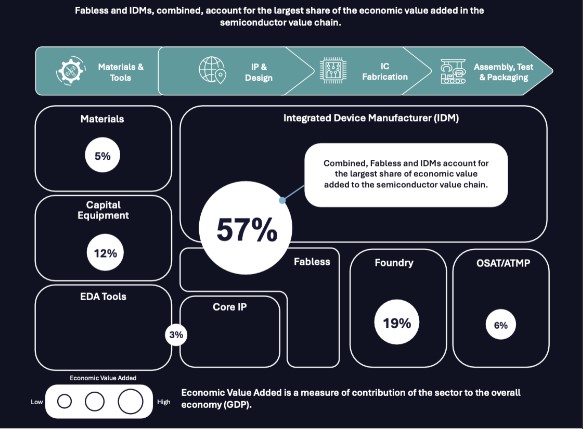
For the past fifty years, Malaysia’s role in the global semiconductor ecosystem has been dependable but heavily concentrated in one sector. The nation handles roughly 13% of global back-end assembly, testing, and packaging. While this has established Penang and Kulim as vital manufacturing hubs, the highest profit margins, and the underlying intellectual property, have remained anchored in Western and East Asian economies.
To bridge this structural gap, the government has launched SemiconStart Malaysia. Originally announced under Budget 2026, this dedicated venture-building incubator is designed to pivot the nation’s industrial ecosystem toward front-end design, advanced materials, and proprietary technology creation.
As the global semiconductor market approaches a projected US$1 trillion milestone, this initiative intends to ensure local firms capture a larger share of that value, moving up from low-margin manufacturing to high-yield intellectual property ownership.
Overcoming the Deep-Tech Capital Barrier
Building a semiconductor company is notoriously difficult compared to standard software ventures. Hardware startups face high prototyping costs, lengthy development cycles, and multi-million ringgit mask-set fees required simply to print a first-generation test chip.
SemiconStart Malaysia addresses these challenges directly through a partnership between MTDC and Silicon Catalyst UK, a specialist global accelerator focused exclusively on hardware startups. The incubator provides local founders with an integrated ecosystem that functions as a structural bridge to the global market.
The Incubation Matrix: Framework, Support, and Core Specialisations
| Operational Dimension | Programme Specifications & Delivery Mechanisms | Target Advanced Sub-Sectors |
| Duration & Pathway | 260-day structured commercialisation and engineering runway | Integrated Circuit (IC) Design & Core IP |
| Direct Capital Injection | Up to RM1 million per company in seed incubation support | Photonics, Optics, & Radio-Frequency Systems |
| Ecosystem Access | In-kind access to Electronic Design Automation (EDA) tools, prototyping shuttles, and foundry fabrication networks | Advanced Materials, MEMS, Sensors, and Quantum Technologies |
The Inaugural Vanguard: Ten Local Pioneers
The success of the initiative depends entirely on the capability of its active participants. The inaugural cohort features ten domestic and Malaysia-based deep-tech ventures. These entities are moving away from traditional contract manufacturing to focus on high-value niches:
- IC Design & Logic Architecture: SkyeChip Semi, GreatAsic Technology, Silicon X, and FirstChip.
- Advanced Packaging & Foundries: FusionAP and SMD Compound.
- Deep-Tech Systems & Materials: nanoSkunkWorkX, Aphelia, Channel Microsystems, and Kirana Semikonduktor.
By anchoring these firms within a unified framework, the Ministry of Science, Technology and Innovation (MOSTI) aims to create strong linkages between technological capability, entrepreneurial ambition, and international investment networks.
Editor’s Take: The Strategic Why
The Macro View: SemiconStart Malaysia marks an important transition from state strategy to actual implementation. For years, regional economic analysts have warned that Malaysia risks being trapped in a middle-tech squeeze. Emerging regional competitors are leveraging lower labor costs for basic factory assembly, while advanced nations dominate the high-value software and design layers.
By offering capital alongside direct access to foundries and EDA design software through Silicon Catalyst UK, this initiative removes the steep upfront costs that typically stifle local engineering talent.
The true measure of success will not be the amount of seed capital distributed, but whether these ten inaugural companies can successfully tape-out their designs and secure international venture capital. If even two or three of these firms scale into globally competitive providers, Malaysia will have successfully evolved from a global factory floor into an influential deep-tech design hub.