

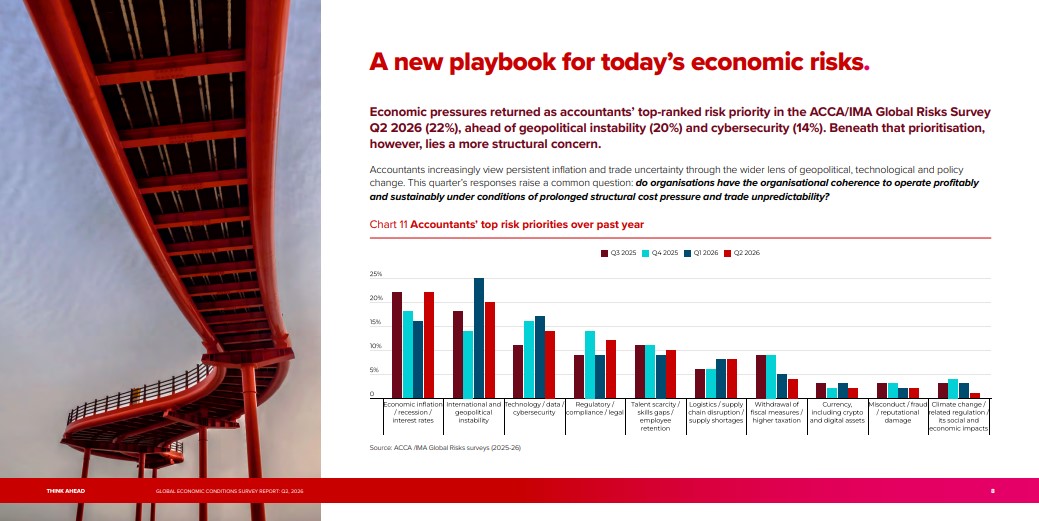
- Surging Operational Overhead: According to the latest ACCA and IMA Global Economic Conditions Survey (GECS), more than 75% of global accountants and 83% of CFOs reported rising operating costs in Q2 2026—nearing record highs driven by Middle East geopolitical disruption and supply chain friction.
- Emerging Growth Friction: Despite a slight rebound in baseline confidence, declining global indicators for new orders, capital expenditure, and hiring suggest global economic expansion is slowing under persistent inflation and monetary tightening.
- Malaysian Outperformance: In contrast to global headwinds, Malaysia’s domestic economy expanded by 5.8% in Q2 2026, with headline inflation cooling to 1.9% in June—anchored by strong domestic consumption, robust manufacturing, and RM54.7 billion in targeted government subsidies.
The second quarter of 2026 has delivered a sharp divergence between global corporate sentiment and Malaysia’s domestic resilience. Findings from the latest joint survey by the Association of Chartered Certified Accountants (ACCA) and the Institute of Management Accountants (IMA) reveal that global finance leaders are struggling under near-peak operating costs, primarily fueled by rising commodity prices and logistics bottlenecks tied to ongoing Middle Eastern tensions.
While global chief financial officers report mounting anxiety over margins and cost pass-through risks to consumers, Malaysia continues to act as a relative regional bright spot. Strong economic fundamentals, coupled with federal intervention to absorb energy and food price spikes, have insulated the domestic market from the broader stagflationary pressures impacting Western and regional peers.
| Economic Indicator / Metric | Global Enterprise Landscape (Q2 2026) | Malaysia Domestic Reality (Q2 2026) |
| CFOs Reporting Cost Increases | 83% (Near-record peak) | Moderate impact; insulated by federal subsidies |
| Primary Business Risk | Economic pressures (22%) & Geopolitics (20%) | Supply chain costs for SMEs & import sectors |
| Q2 GDP Growth Realisation | Softening globally; weak new orders & CapEx | 5.8% YoY Expansion (Robust domestic demand) |
| Headline Inflation Status | Persistent global elevated rates | Moderated to 1.9% in June 2026 |
| Fiscal Buffer Deployed | Tightening central bank policies | RM54.7 billion in subsidies & assistance |
What it means for Malaysia
- Short-Term Cushion via Subsidies: The Malaysian government’s RM54.7 billion allocation for subsidies, incentives, and direct assistance has successfully anchored retail energy prices and basic essentials. This fiscal intervention prevented domestic inflation from mirroring the global surge, allowing consumer spending and private consumption to drive the strong 5.8% Q2 growth rate.
- SME Margin Compression: Despite macro resilience, import-dependent micro, small, and medium enterprises (MSMEs) face ongoing margin compression. Rising global freight charges, fluctuating raw material prices, and elevated input costs mean local businesses must prioritise cash flow management, inventory efficiency, and pricing flexibility to weather protracted international volatility.
What it means for ASEAN
- Supply Chain Safe-Haven Appeal: As global CFOs encounter mounting geopolitical and logistics friction elsewhere, ASEAN’s relative macroeconomic stability positions it as an attractive destination for foreign direct investment (FDI). Malaysia’s strong manufacturing, E&E, and mining performance in Q2 underscores the region’s role as an operational anchor for international trade.
- Monetary Policy Divergence: While central banks across major developed markets face the threat of renewed rate hikes if businesses pass rising costs onto end consumers, Southeast Asian economies with contained inflation—like Malaysia—enjoy greater monetary policy space. This provides a stable environment for regional cross-border investment and capital deployment.
Editor’s Take
Malaysia’s strong Q2 performance is a testament to effective fiscal hedging, but domestic insulation cannot be treated as a permanent shield. With 83% of global CFOs feeling the squeeze of rising costs, international supply chain pressures will eventually leak into local operating environments. The government’s RM54.7 billion subsidy spending provides necessary breathing room, but long-term resilience requires Malaysian firms to move beyond passive cost absorption. Enterprise leaders must aggressively leverage AI, optimize supply chains, and build operational agility before global cost pass-through erosion chips away at domestic consumer confidence.
To examine the complete global dataset, methodology, and regional survey metrics, access the full report via the ACCA & IMA Global Economic Conditions Survey (GECS) Q2 2026 Report.