

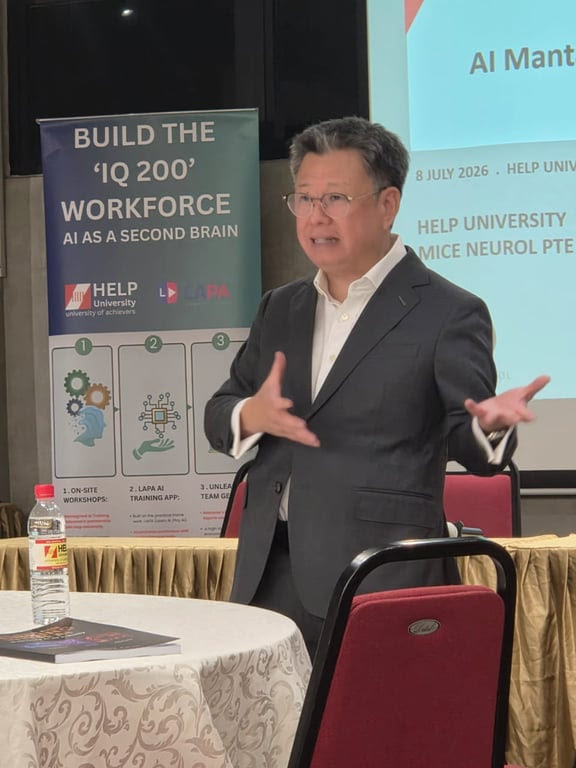
- Gamified Gamut for Corporate AI: Edutech startup LAPA Labs and HELP University are converting an academic pilot into two flagship corporate AI training initiatives powered by a learning engine adapted from competitive esports.
- Dual-Track Operational & Executive Upskilling: The partnership introduces LAPA Day, a hands-on employee immersion workshop yielding working prototypes, and a C-suite initiative led by LAPA co-founder Dr. Kenny Goh and Prof. Philip Charles Zerrillo targeting organizational cognitive transformation.
- HRD Corp Claimable & Fully Accessible: Built around adaptive project-based modules (LAPA App), capability diagnostics (LAPA Assess), and live challenges (LAPA Arena), the HRD Corp-claimable programs focus on human-centric judgment alongside technological adoption.
As enterprise artificial intelligence tools proliferate across Southeast Asia, Malaysian organizations are facing a critical gap between purchasing AI software and driving actual workforce adoption. To address this challenge, Kuala Lumpur-based HELP University has deepened its partnership with AI edutech startup LAPA Labs via a newly signed Memorandum of Understanding (MOU) to establish a full corporate AI capability platform.
Transitioning from initial classroom pilots to enterprise-wide capability building, the initiative launches two distinct tracks: LAPA Day, a one-day immersive workshop where employees solve high-stakes business challenges to build functioning prototypes, and an executive program designed specifically for CEOs and business leaders. Grounded in HELP University’s academic expertise and LAPA’s gamified methodology, the programs aim to elevate internal problem-solving, strategic decision-making, and human leadership in AI-integrated workplaces.
| Program Track | Target Audience | Core Deliverable / Methodology | Strategic Objective |
| LAPA Day | Operational teams & employees | Gamified workshop, live competition via LAPA Arena, working prototype build | Experiential upskilling, instant feedback, and practical workflow automation |
| CEO AI Leadership | C-Suite & senior executives | Strategic mandate co-delivered by Dr. Kenny Goh & Prof. Philip Charles Zerrillo | Re-architecting organizational cognition, human-AI decision frameworks, and innovation strategy |
| LAPA Learning Engine | Entire enterprise workforce | Three-tier stack: LAPA App (lessons), LAPA Assess (diagnostics), LAPA Arena (competitions) | Continuous capability tracking and HRD Corp-claimable skills development |
What it means for Malaysia
- Closing the National AI Implementation Gap: While Malaysian enterprises express near-unanimous intent to invest in AI infrastructure, many struggle with workforce adoption and internal skills deficits. By offering HRD Corp-claimable programs that yield tangible prototypes rather than static certifications, the HELP-LAPA alliance provides a scalable mechanism for local businesses to meet national upskilling agendas under the Malaysia Higher Education Blueprint and 13th Malaysia Plan.
- Merging Academic Rigor with Tech Gamification: HELP University’s status as a Premier Digital Tech Institution combined with LAPA’s esports-derived learning architecture demonstrates a viable model for industry-academic collaboration. This framework helps bridge the historical divide between theoretical university research and commercial business requirements.
What it means for ASEAN
- A Human-Centric Blueprint for Regional AI Literacy: As organizations across Southeast Asia rapidly deploy generative AI and automated systems, maintaining human oversight, ethical judgment, and strategic intuition remains a regional challenge. The methodology articulated in Dr. Kenny Goh’s Whole Brain Thinking with AI offers a regional framework for balancing rapid technological deployment with human agency.
- Elevating Gamified Learning Standards in Enterprise EdTech: The translation of competitive esports mechanics, such as instant feedback, visible progression, and live arena stakes, into corporate learning sets a modern precedent for Asian EdTech startups looking to displace passive, slide-based corporate training models.
Editor’s Take
Buying AI licenses is easy; building an organization that knows how to deploy them strategically is where most digital transformations fail. HELP University CEO Dr. Goh Chee Leong’s metaphor of AI as a Formula One car sitting in a garage highlights the exact friction point facing Malaysian executives today. The HELP-LAPA partnership stands out because it abandons passive lectures in favor of high-energy, experiential execution. For Malaysian business leaders, learning to drive AI requires cultivating human instinct alongside algorithm output—ensuring tech investment yields measurable business value.