

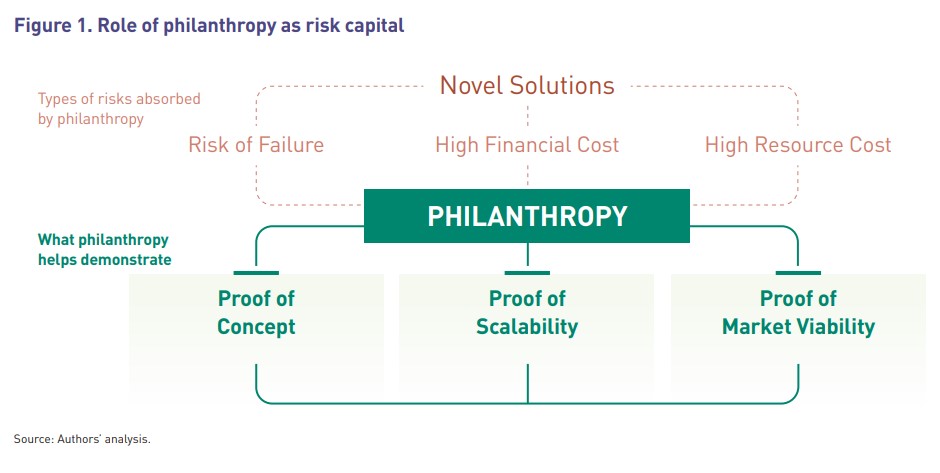
At a time when traditional overseas development assistance is shrinking and global macro volatility is rising, a major research report released today at the sixth Philanthropy Asia Summit argues that philanthropy must discard its defensive mindset. The study reveals that when structured as “Risk Capital,” private philanthropic funds are uniquely positioned to underwrite the early-stage, deep-tech innovations that commercial markets cannot price and governments cannot politically risk backing.
The landmark report, titled “Philanthropy as Risk Capital in Asia: Bridging Innovation to Impact,” was authored by the Centre for Asian Philanthropy and Society (CAPS) and commissioned by the Temasek-backed Philanthropy Asia Alliance (PAA).
Analyzing data and field operations across 13 Asian economies between October 2025 and January 2026, the study demonstrates how patient, conviction-driven private capital has built the regulatory evidence required to de-risk untested solutions. Collectively, the initial cohorts examined have already scaled to reach 210 million people across the region.
The Capital Sequencing Model: Shifting from Charity to Proof-of-Concept
The CAPS-PAA report details how prominent Asian family offices and foundations are shifting away from traditional check-writing. Instead, they are functioning as early-stage incubators, moving through strategic stages to transition social innovations from initial testing to systemic institutional adoption.
| Innovation Stage | Active Instrument | Primary Strategic Vector | Case Study Example |
| Stage 1: Proof of Concept | Patient, long-term conviction grants. | Absorbing 100% of early-stage scientific or operational risk. | The Tahija Foundation (Indonesia): Deployed US$17 million over 10 years for Wolbachia-based dengue control; achieved a 77% reduction in transmission. |
| Stage 2: Operational Scale | Concessional debt, equity, and ecosystem bridges. | Securing access to local government bodies to clear regulatory hurdles. | Vanke Foundation (China): Funded INSPRO’s insect-based bioconversion organic waste tech, facilitating district-level pilot deployments. |
| Stage 3: National Integration | Public sector adoption & policy absorption. | Aligning the mature solution with national economic and development plans. | Tata Trusts (India): Provided early-stage backing and ecosystem support to digital platform Haqdarshak, aligning it with the ‘Digital India’ welfare delivery system. |
The Strategic Insights: Trust, Instruments, and Policy Architecture
The report identifies three core operational mechanics that allow Asian philanthropists to deploy high-risk capital effectively:
- Conviction-Driven Horizon: The most durable, high-impact capital injections originate from ultra-high-net-worth (UHNW) families driven by direct regional experience. These funders commit capital across decade-long horizons, insulating innovators from the short-term quarterly return pressures of traditional venture capital.
- Instrument Agility: Advanced foundations are expanding their toolkits beyond standard grants. They are actively utilizing concessional debt and revenue-sharing equity structures to create self-sustaining financing loops. However, the report notes that outdated regional regulatory frameworks continue to limit wider cross-border adoption.
- Proximity as an Asset: For these funders, proximity to the communities they serve and structural alignment with local government agendas are just as valuable as financial capital. Founders leverage the foundation’s political and corporate credibility to navigate local bureaucracies, establishing a collaborative framework for public sector integration from day one.
Editor’s Take: The ROI of De-Risking the Sovereign Asset Pipeline
For the Malaysian Business reader, the PAA-CAPS report provides an invaluable playbook for navigating the “Complexity Tax” of emerging-market development. Just hours ago, we reviewed CIIP’s comprehensive analysis of Asia’s US$181 billion annual climate adaptation gap, which highlighted a severe lack of investable project pipelines as the primary barrier stalling institutional capital. This new philanthropy report identifies the exact missing link required to solve that problem.
Commercial venture capital cannot fund a ten-year biological trial for dengue eradication or an unproven carbon-capture prototype. The risk profile is simply too high, and the time-to-exit is too long. This is exactly where philanthropic risk capital creates immense value.
By funding the initial, high-risk validation phases, philanthropists are effectively building a pipeline of proven, bankable assets for the rest of the capital spectrum.
As Malaysia executes the infrastructure and technological pivots of the 13th Malaysia Plan, our local foundations and corporate GLCs must embrace this model. Whether backing decentralized water purification technologies like Wateroam or AI-driven public services like Wadhwani AI, deploying philanthropy as risk capital is not an act of charity. It is an exercise in Policy Architecture using flexible private capital to build the sustainable, de-risked frameworks that commercial markets and national budgets can scale to drive long-term economic growth.