

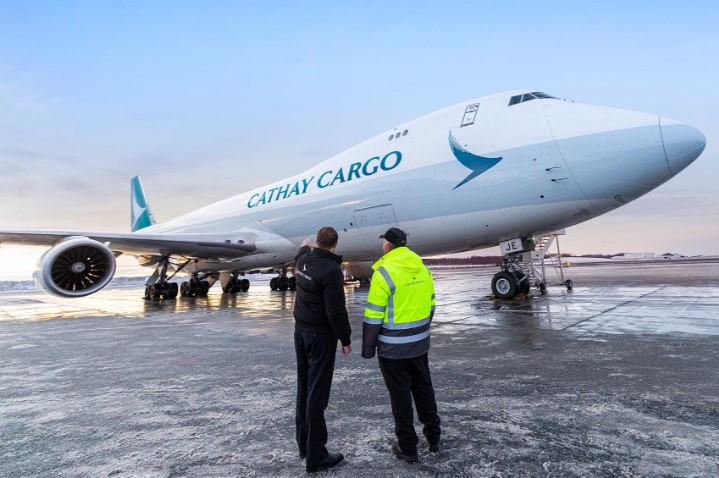
Reshaping the high-value logistics landscape across the Pearl River Delta, Cathay Cargo has formally integrated its specialized Cathay Fresh and Cathay Pharma solutions into a single, comprehensive cold chain platform.
The strategy capitalizes on Hong Kong International Airport’s (HKIA) structural transit network, which links regional hubs to half the world’s population within a five-hour flight radius, to capture high-margin cargo flows destined for the Greater Bay Area (GBA).
By utilizing specialized cross-border regulatory corridors and real-time asset monitoring, the carrier is addressing a key market bottleneck: maintaining strict temperature stability across multiple modes of transport.
The Multi-Tier Cold Chain Architecture: Perishables and Life Sciences
Cathay Cargo’s unified network addresses two high-exposure industrial sectors: food security/premium agribusiness and deep-tech life sciences. Each sector requires distinct handling protocols to prevent cargo spoilage during transit.
| Service Segment | Core Infrastructure Asset | Regulatory Framework | Core Asset Security Mechanic |
| Cathay Fresh | Air-Land Fresh Lane (ALFL) via the Hong Kong–Zhuhai–Macao Bridge. | IATA CEIV Fresh Certification. | Single Air Waybill; HK Customs Transshipment Certificates; GPS/e-locked chiller trucks. |
| Cathay Pharma | Dedicated Pharma Handling Centre at HKIA (Largest specialized facility). | IATA CEIV Pharma Standard. | Ultra Track near-real-time data loggers; 4 specific thermal zones (FRO, COL, CRT, ERT). |
Strategic Outlook: Eliminating the “Complexity Tax” at the Border
The integration occurs as the GBA’s 86 million consumers drive a massive surge in demand for traceable, premium imports, transforming the region into an economy valued at RMB 14.79 trillion (approx. US$2.09 trillion).
 [ Global Air Freight Origin ] ──(Cathay Cargo Flight)──► [ HKIA Hub Terminal ]
                                                                 │
                                                      (Cool Dollies Tarmac Transfer)
                                                                 │
                                                                 ▼
 [ Zhuhai Customs Facility ] ◄──(E-Lock & GPS Truck via Bridge)──┘
   (Fast-Tracked Entry via HK Transshipment Certificate)
         │
         ▼
 [ Unbroken GBA Retail & Logistics Delivery ]
- The Air-Land Intermodal Pipeline: Under the newly activated Air-Land Fresh Lane (ALFL), premium perishables migrate from air cargo hold to tarmac “Cool Dollies,” and then straight onto specialized temperature-controlled trucks under a single air waybill.
- Bypassing the Mainland Registration Barrier: Historically, moving fresh goods into the Chinese Mainland required complex re-registration and extensive bureaucratic filing. The ALFL bypasses this friction using a specialized Certificate for Transshipment Confirmation issued by Hong Kong Customs. This allows shipments to remain in an active “in-transit” status, routing them straight to a new temperature-controlled inspection facility in Zhuhai for fast-tracked border clearance.
- Biologics and Real-Time Visibility: For the pharmaceutical sector, where thermal variation can ruin delicate cell therapies and vaccines, Cathay Pharma has deployed its Ultra Track IoT framework. Operating across 70 qualified pharma stations globally, the system sends near-real-time temperature and location data to shippers, allowing ground crews to intervene before a temperature deviation violates clinical safety parameters.
Editor’s Take: The ROI of Frictionless Cross-Border Asset Corridors
For the Malaysian Business reader, Cathay Cargo’s cold chain expansion offers an important lesson in Policy Architecture. In our own logistics sector, as we work to scale the Perlis Inland Port infrastructure and connect the East Coast Rail Link (ECRL) corridors, Malaysian logistics providers frequently run into severe friction at regional borders. Uncoordinated customs inspections, siloed paperwork, and a lack of specialized cold storage facilities create a heavy “Complexity Tax” that hurts the final value of our exports.
Hong Kong’s Air-Land Fresh Lane shows a better way forward. By designing a unified regulatory pipeline backed by automated e-locks and cross-border customs certificates, they have turned a complex intermodal transit leg into a fast-tracked, single-invoice service.
This infrastructure-first approach acts as a powerful economic catalyst.
If Malaysia wants to capture high-value market share, whether exporting fresh durians to southern China or shipping sensitive medical devices from Penang’s manufacturing hubs, its planners must stop thinking of logistics as just moving trucks and planes. They need to build integrated, secure supply chains that treat data visibility and customs clearance as core parts of the transport network. Cathay’s model proves that in modern trade, speed and reliability are what create “Resilience Alpha” and protect operating margin.