

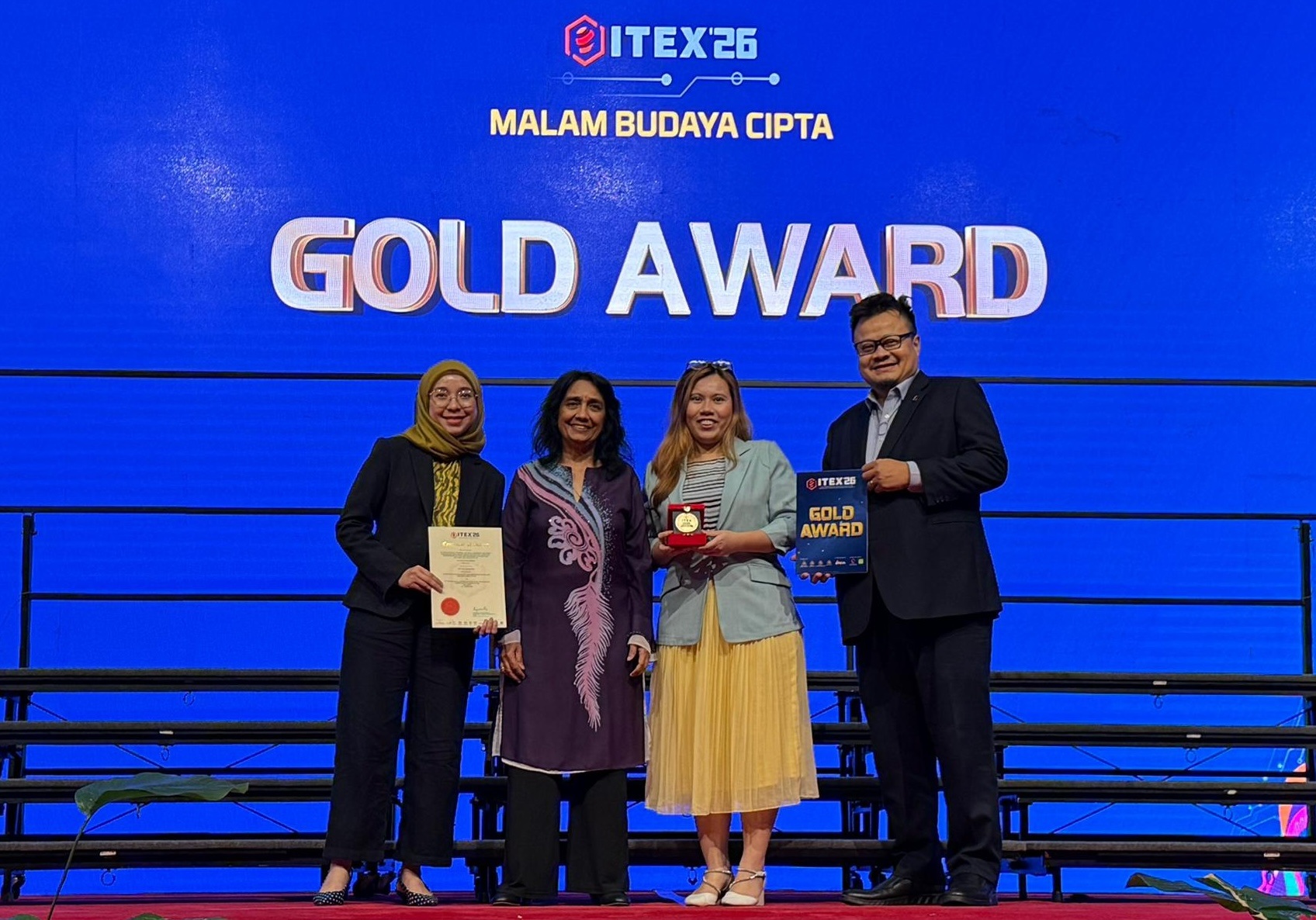
Shifting Malaysia’s deep-tech sector from theoretical research to market-driven execution, NanoMalaysia Berhad (NMB) has secured two major awards at the 37th International Invention, Innovation and Technology Exhibition (ITEX) 2026.
Operating under the Ministry of Science, Technology and Innovation (MOSTI), the agency utilized the national exhibition to debut two advanced nanotechnology solutions designed to protect domestic supply chains against climate disruptions: the SmartLeaf biomimetic precision agricultural sensor and a Tandem Indoor Green Hydrogen generation module.
The double recognition, with SmartLeaf capturing the Gold Award and the Tandem Solar-Hydrogen Cell securing the Silver Award, highlights the operational success of NMB’s Venture Builder investment model.
By acting as a co-investing commercialization partner rather than a passive grant-distribution body, NMB bridges the traditional “valley of death” that separates university research laboratories from active industrial deployment, directly supporting Malaysia’s transition toward an advanced, low-carbon economy.
| Nanotechnology Innovation | Core Technological Anchor | Active Readiness Level (TRL) | Stated Commercial Impact Metrics |
| SmartLeaf Sensors | Laser-Induced Graphene (LIG) on PDMS-coated biomimetic surfaces; real-time capacitive IoT moisture tracking. | TRL 7 (System Prototype Demonstrated in Operational Environment) | Yield improvement of 10% to 25%; water input savings up to 30%; crop input cost reduction up to 15%. |
| Tandem Hydrogen Module | Photoelectrochemical water-splitting cell paired with novel low-light indoor solar harvesting photocatalysts. | TRL 4–5 (Component and System Validation in Lab/Simulated Environment) | Self-powered, continuous off-grid green hydrogen generation from ambient and low-light indoor environments. |
Pillar 1: SmartLeaf and the Precision Mitigation of Crop Risk
Developed through an intense public-private collaboration alongside Regaltech (M) Sdn Bhd and Xiamen University Malaysia, the SmartLeaf system addresses a critical bottleneck in smart agriculture: currency and accuracy of micro-climate data.
Traditional agricultural sensors measure broad soil moisture or general ambient humidity, completely missing the micro-level moisture changes on the crop leaf where dangerous plant diseases incubate and spread.
SmartLeaf resolves this monitoring gap at Technology Readiness Level (TRL) 7 by mimicking the exact surface profile of a biological leaf. Using Laser-Induced Graphene (LIG) embedded onto a protective polydimethylsiloxane (PDMS) biomimetic coating, the sensor continuously monitors micro-droplet accumulation through high-sensitivity capacitance changes.
By transmitting real-time Internet of Things (IoT) data straight to automated irrigation pumps, the system eliminates blind fertilizer overuse and over-watering.
This highly targeted data approach allows commercial farms to expand aggregate crop yields by 10% to 25%, cut input overheads by up to 15%, and achieve a 30% reduction in water consumption while strictly maintaining crop quality.
Pillar 2: Low-Light Tandem Solar Cells and Decentralized Hydrogen Production
Addressing the clean energy segment, NMB debuted its Tandem Indoor Solar Cell with a Photoelectrochemical Cell for Hydrogen Production, co-developed alongside PhlexCell Sdn Bhd and Universiti Teknologi PETRONAS.
While mainstream green hydrogen infrastructure requires vast, capital-intensive arrays of outdoor megawatt-scale solar farms connected to heavy industrial electrolyzers, this modular innovation focuses entirely on localized, self-powered energy harvesting.
                  [ DISTRIBUTED INDUSTRIAL EMISSIONS / AMBIENT LIGHT ]
                                           ▼
        [ MODULE NARROW WAIST ]     (Tandem Photoelectrochemical Water-Splitting)
                                           ▲
[DECENTRALIZED HYDROGEN SITES] (TRL 4-5 Self-Powered Energy Storage & Off-Grid
                                                                          Kits)
Currently positioned at TRL 4–5, the system utilizes a breakthrough, highly stable photocatalyst layer capable of absorbing light across a wide spectrum. Crucially, the module continues to drive photoelectrochemical water splitting to generate green hydrogen not just under direct sunlight, but under low-light, indoor fluorescent, and ambient office conditions.
This continuous, self-powered generation capability makes the compact module highly valuable for future deployment in portable clean energy kits, off-grid industrial telemetry power backups, and zero-emission building automation networks.
Editor’s Take: Venture Building and the Practical Execution of Deep Tech
For the Malaysian Business reader, NanoMalaysia’s commercialization milestones deliver an essential lesson in Productivity Realism: in a volatile global trade landscape, long-term operational resilience belongs entirely to the organizations that control the molecular inputs of their industrial supply chains. For decades, local industry has paid a hidden “Complexity Tax”—importing expensive, foreign-built sensor hardware and proprietary clean-energy components that are difficult to adapt to tropical agricultural environments or local factory-floor specifications.
True market leadership requires structural Sovereignty Realism.
As our policy architects design economic funding pools under the 13th Malaysia Plan and deploy industrial targets under the New Industrial Master Plan (NIMP 2030), we must look past superficial technology adoption.
We need to build a self-sustaining ecosystem of locally owned, patented IP.
NMB Group CEO Dr. Rezal Khairi Ahmad’s Venture Builder approach provides the exact strategic blueprint our corporate sectors require. Whether tracking Alpro Group’s subscription networks driving primary care retention or evaluating Resorts World Genting’s vertical integration of luxury EV fleets to lower resort operating costs, the ultimate winners are always the operators that eliminate operational friction.
By taking equity stakes in domestic university spin-offs, anchoring advanced materials manufacturing locally, and securing third-party validation at platforms like ITEX, NanoMalaysia is proving that localized deep-tech innovation can successfully shield national food security, optimize corporate operating margins, and secure a lasting competitive advantage for Malaysia on the global stage.