

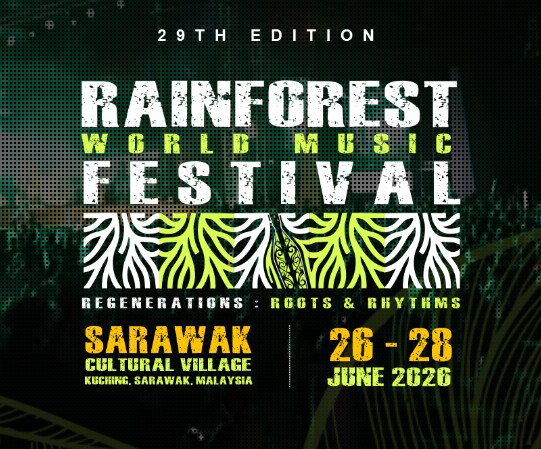
Standing firm against fluctuating international tourism markets and global trade uncertainties, the Sarawak Government has finalized a unified public-private partnership (PPP) ecosystem to anchor the upcoming 29th Rainforest World Music Festival (RWMF) 2026.
Speaking during the milestone RWMF Sponsors’ Appreciation Day at the Sheraton Hotel Kuching, Deputy Minister for Tourism Sarawak YB Datuk Sebastian Ting Chiew Yew, representing Minister YB Dato Sri Haji Abdul Karim Rahman Hamzah, unveiled a multi-tier corporate sponsorship ecosystem spanning the aviation, media, green technology, hospitality, and corporate infrastructure fields.
The collective backing, anchored by the Sarawak Tourism Board (STB) under the leadership of CEO Dr. Sharzede Datu Haji Salleh Askor, moves past traditional, passive corporate festival sponsorships.
Instead, the 2026 framework functions as a synchronized economic engine designed to insulate regional tourism returns, expand local retail spending, and cement Sarawak’s position as a premier global hub for responsible, culture-driven leisure commerce.
The Architecture of Integration: Multi-Tier Infrastructure Alliances
Operating an international, multi-day cultural asset inside a protected rainforest environment introduces serious logistical and operational challenges. Mainstream mass-entertainment events often generate a heavy “Complexity Tax” characterized by uncoordinated flight scheduling, massive plastic waste generation, and fragmented marketing reaches that bleed capital without benefiting the surrounding regional economy.
The RWMF 2026 network removes these pain points by embedding its corporate partners directly into the operational infrastructure of the festival grounds:
 [ TRADITIONAL TRUCKED FESTIVALS ] ──► Fragmented Sourcing & Heavy Carbon Footprints ──► High Input Leakage & Landfill Loads
                                                                                                  │
                                                                                                  ▼
                                                                                      Heavy "Complexity Tax"

 [ RWMF REGENERATIVE NETWORK ]     ──► Multi-Tier PPP Grids + Circular Operations    ──► Subsidized Aviation & Zero-Waste Outputs
                                                                                                  │
                                                                                                  ▼
                                                                                      Sovereign Resilience Alpha
1. The Aviation and Transit Lifelines (Diamond Tier)
To guarantee smooth regional access amid unpredictable flight pricing, Malaysia Aviation Group (MAG) serves as the Diamond Partner. By operating Malaysia Airlines and Firefly as the official carriers, the alliance coordinates direct flights into Kuching, shielding international travelers from unexpected transit delays and stabilizing tourist inflows.
2. Sovereign Media Monopolies (Diamond & Gold Tiers)
To maximize media value without expensive external marketing fees, the festival links directly with the Sarawak Media Group (TV Sarawak) as the official broadcaster and Astro Radio (Era FM Sarawak, Sinar FM, Mix FM, Lite FM) as official radio partners. This setup guarantees constant, multi-channel promotion across the ASEAN market, driving ticket sales directly through official distribution nodes like Ticketmelon.
3. Closed-Loop Circular Sustainability (Platinum & Gold Tiers)
Addressing environmental management, Cuckoo International and Solarvest Borneo operate as the festival’s Platinum and Gold Sustainable Partners alongside Trienekens (Sarawak) Sdn Bhd. Rather than greenwashing the event, these operators deploy concrete circular technologies:
- The Clean Energy Component: Solarvest Borneo sets up modular solar-lighting grids across the Sarawak Cultural Village to lower fossil-fuel consumption.
- The Waste Mitigation Grid: Cuckoo and Trienekens manage the Green Ruai and Green Warriors initiatives deploying automated water refill stations and structured waste segregation loops to eliminate single-use plastics across the entire operational footprint.
Strategic Network Architecture: Maximizing the Visitor Value Curve
Staged under the active 2026 theme “Regenerations: Roots & Rhythms,” the structural design of the festival has been overhauled to expand retail velocity. In a major operational update, STB has extended daily festival hours to run from 10:00 AM until 12:00 AM midnight, significantly lengthening the consumer spending window.
                           [ HIGH-SPENDING INTERNATIONAL LUXURY INFLOWS ]
                                                 ▼
                 [ EXPANDED TIME WINDOW ] (14-Hour Continuous On-Site Operations)
                                                 ▲
[ DIVERSIFIED INTERNATIONAL BOUNDS ] (Mongolia, Uzbekistan, Korea, US, UK, Nusantara Cores)
                                                 │
                                                 ▼
      [ ECOSYSTEM VALUE CAPTURE ] (Sarawakian Craft, Local F&B, Regional Resorts)
This extended 14-hour daily timeline allows the festival to feature a highly diverse lineup of over 200 performers from multiple continents including historic, debut appearances from cultural groups from Uzbekistan, Mongolia, and South Korea. These new performers join global headliners like Malaysia’s musical icon Dato’ M. Nasir, American funk legends The Commodores featuring Thomas McClary, and British acid-jazz pioneers Incognito.
By offering daytime artisan workshops, interactive culinary zones, and late-night concerts under a single 3-Day Pass structure, RWMF encourages visitors to remain on-site longer, maximizing the economic yield captured by local food, beverage, and craft vendors.
Editor’s Take: Ecosystem Synergy and the Reality of Regional Branding
For the Malaysian Business reader, the Rainforest World Music Festival’s structured corporate network delivers a definitive masterclass in Ecosystem Realism: in a fragmented global economy, the most resilient assets are those that transform simple consumer entertainment into a highly synchronized, multi-sector economic ecosystem. For decades, regional planners have treated cultural festivals as isolated cultural line-items funding them through arbitrary state grants while leaving local transport networks, energy suppliers, and hospitality assets to operate in uncoordinated silos. This separation limits the event’s potential, creating a heavy “Complexity Tax” that reduces the financial return of the entire tourism destination.
True market leadership requires building closed-loop regional networks.
By binding major airlines, green energy firms, and state media groups into a shared-value platform, Sarawak is not merely hosting a concert; they are running a highly efficient economic machine that converts international cultural interest directly into long-term commercial value for local industries.
This collaborative blueprint offers clear lessons for our wider industrial planning under the 13th Malaysia Plan (2026–2030). To shift Malaysia’s service and tourism sectors toward sustainable, high-yield growth, our business community must look past mass-volume, short-term models.
Sarawak’s integrated festival model proves that when public oversight and private capital align around tailored infrastructure, they can successfully protect regional operating margins, insulated local trade channels, and secure an unassailable competitive advantage on the global stage.