

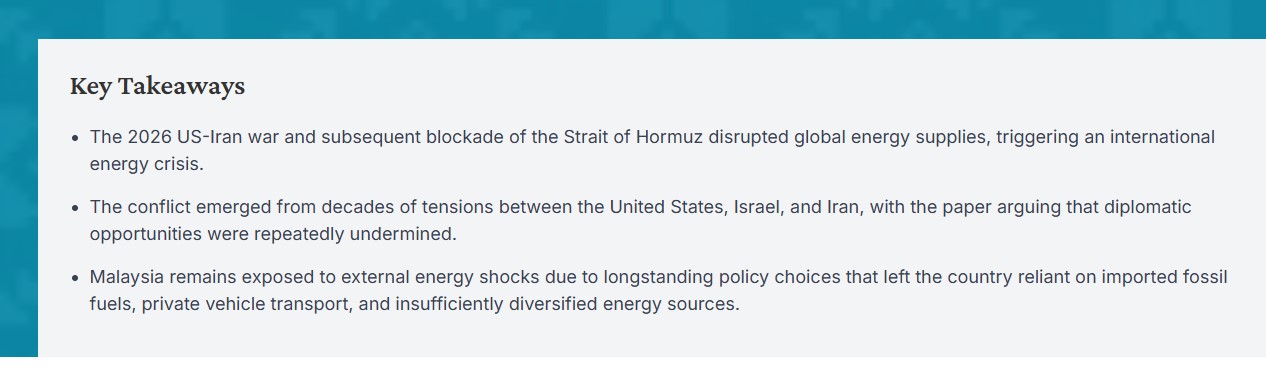
The dramatic escalation of the US-Iran conflict has rapidly transformed from a localized West Asian security failure into an acute supply-chain shock vibrating across Southeast Asian industrial corridors. A recent analytical brief by the Khazanah Research Institute (KRI) highlights a stark reality for regional corporate planners: despite Malaysia’s proud status as a net energy exporter, legacy policy frameworks have left the domestic economy profoundly exposed to external logistics and commodity disruptions. With the Strait of Hormuz heavily compromised, the structural vulnerabilities embedded within Malaysia’s domestic refining dependencies and private transportation frameworks are moving directly into the executive spotlight.
┌──────────────────────────────────────────────────────────────────┐
│                    STRATEGIC QUADRANT MATRIX                     │
├──────────────────────────────────────────────────────────────────┤
│                                 │                                │
│       HIGH IMPACT / LOW COMPX   │    HIGH IMPACT / HIGH COMPX    │
│       ───────────────────────   │    ────────────────────────    │
│       • National Fuel Subsidy   │     • Decentralised Utility    │
│         Restructuring           │       Grid Infrastructure      │
│                                 │                                │
├─────────────────────────────────┼────────────────────────────────┤
│                                 │                                │
│       LOW IMPACT / LOW COMPX    │    LOW IMPACT / HIGH COMPX     │
│       ──────────────────────    │    ───────────────────────     │
│       • Bilateral Maritime Port │     • Complete Upstream        │
│         Insurance Buffers       │       Sourcing Realignment     │
│                                 │                                │
└──────────────────────────────────────────────────────────────────┘
Dissecting the Core Architecture: Chokepoint Mechanics Meets Upstream Reality
- 1. The Upstream Refining Imbalance: While Malaysia maintains substantial domestic production of premium sweet crude, local downstream refining infrastructure remains structurally configured to process sour Middle Eastern variants. This technical reality mandates that the nation rely on the Persian Gulf for roughly 40% of its crude petroleum and condensate imports. When West Asian chokepoints freeze, the administrative lag in realigning feedstock supply chains immediately compresses the margins of domestic refining assets.
- 2. The Logistics & Transport Lock-in: On the demand side, Malaysia’s deep-seated reliance on private vehicle transport represents a significant fiscal and operational friction point during international energy shocks. Because domestic industrial transport networks and commuter choices are explicitly tied to liquid fossil fuels, price volatility in the crude markets leaks instantly into corporate operating costs, driving up general administrative drag across all localized supply chains.
The Geopolitical Shock Asset Integration Grid
| Vulnerability Vector | Legacy Exposure Structure | High-Velocity Mitigation Strategy |
| Upstream Sourcing | 40% reliance on Persian Gulf crude/condensates | Regional ASEAN supply-chain diversification |
| Downstream Transit | Strait of Hormuz maritime chokepoint exposure | Strategic stockpile scaling & alternative routes |
| Domestic Consumption | Private vehicle saturation & fossil fuel lock-in | Accelerated EV tech-stack deployment |
Editor’s Take: Managing Systemic Exposure Across ASEAN Supply Chains
The KRI brief offers an indispensable blueprint for regional corporate leaders as Southeast Asian industrial zones face an era of fragmented maritime security and volatile input costs. To protect long-term capital runways, forward-thinking enterprises cannot afford to view energy procurement as a secondary utility concern. Instead, leadership must actively design operational buffers that decrease reliance on single-corridor imports while accelerating the integration of localized, high-velocity automation and alternative energy assets to bypass global logistics bottlenecks.
This systemic transition toward insulation from external shocks is already visible across various segments of our tracked corporate ecosystem:
- Sime Darby Property Shifts Gear to Industrial, Logistics Segment, constructing specialized, energy-resilient manufacturing spaces that reduce physical distribution friction for global tenants.
- Gentari Drives Utility-Scale Renewable Rollouts to Anchor Green Foreign Direct Investment, scaling up localized commercial solar networks to insulate industrial clients from external fossil fuel price shocks.
- Green GSM Secures PHP 2 Billion Credit Line from PNB for Electric Fleet Expansion, actively deploying alternative transport infrastructure to systematically remove traditional petroleum dependencies from commercial logistics networks.
The ultimate takeaway for ASEAN enterprises is clear: true margin protection requires a deliberate pivot away from single-source infrastructure dependencies. By modernizing corporate asset networks and investing heavily in regional supply-chain flexibility, enterprises can successfully maintain capital velocity even as global geopolitical fault lines shift.