

Strategic Takeaways
- The Strategic Policy Shift: Drawing on Think City’s landmark report, From Roof to Resilience, urban planners are pivoting from simple physical building repairs to establishing robust, localized “social infrastructure.”
- The K2K Co-Management Protocol: The Kita-Untuk-Kita (K2K) framework shows that forming block-level resident councils with direct oversight of maintenance spending drastically reduces vandalism, improves security, and lifts rental recovery rates.
- The Digital Verification Mandate: To eliminate illegal subrentals and stabilize building occupancy, councils are preparing to deploy ground-floor biometric and encrypted MyKad access systems, matching building entry directly to registered municipal tenants.
Understanding Malaysia’s Public Housing Emergency
Prepared by Malaysian Business Editorial Desk
1. What exactly is the PPR system, and who is structurally responsible for it?
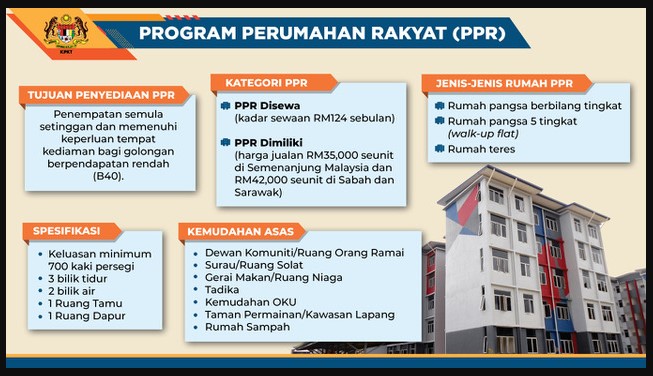
The Projek Perumahan Rakyat (PPR) is a federal social safety net framework initiated by the Ministry of Housing and Local Government (KPKT). It was engineered to clear urban squatter settlements and provide low-cost transit or rental housing for the Bottom 40% (B40) demographic.
The structural crisis of the PPR lies in its fragmented governance. While federal agencies fund and build the assets, ownership and daily maintenance are passed down to a patchwork of state housing boards (e.g., Lembaga Perumahan dan Hartanah Selangor) and municipal councils (e.g., DBKL). This multi-tiered bureaucracy creates severe accountability blindspots when structural components fail.
2. What happened to the millions allocated during the Najib administration?
During the Najib Razak era, significant funding was directed through specialized mechanisms like the Tabung Penyelenggaraan Perumahan Malaysia (TPPM) and the Perumahan Awam & Kos Rendah Maintenance Scheme (PMS). Millions of ringgit were poured into critical structural repairs.
However, these capital injections suffered from a fatal flaw: they were highly centralized and transactional. Funds were handed to third-party contractors for one-off projects, such as patching a roof or fixing an elevator, without building an on-site, self-sustaining financial framework. When political priorities shifted and the funding stopped, the lack of localized sinking funds caused these assets to slide right back into decay.
3. How does the “Subrental Arbitrage” shadow market operate?
Because municipal councils lack on-site enforcement teams, a thriving shadow economy has filled the gap. Original tenants rent their inner-city PPR units at the heavily subsidized rate of RM124 per month. They then move out to peripheral developments and illegally sublet the units to migrant laborers or undocumented workers for RM600 to RM800 per month.
This allows the original tenant to pocket a risk-free premium while causing severe over-occupancy. Squeezing multiple families or workers into a single 650 sq. ft. unit places excessive stress on plumbing, waste disposal, and elevators far beyond their original engineering design limits.
4. What was Think City’s core breakthrough in their recent policy report?
Think City’s report, From Roof to Resilience, highlights a critical shift: public housing is a dynamic social ecosystem, not just an engineering asset. Their fieldwork shows that physical fixes are short-lived unless paired with robust “social infrastructure.” Through the Kita-Untuk-Kita (K2K) initiative, Think City proved that empowering residents to form block-level co-management teams drives real change. When residents share stewardship of their buildings alongside local councils, vandalism drops, maintenance fees are recovered more effectively, and community safety improves.
From Roof to Ruin: Re-engineering Malaysia’s Crumbling Social Infrastructure
| Key Operational Dimension | The Legacy Top-Down Asset Model | The K2K Shared Stewardship Engine |
| Capital Allocation | Centralized Ad-Hoc Injections Transactional federal funds (e.g., TPPM) paid to external contractors for one-off fixes with zero local sinking funds. | Localized Co-Management Pools Ring-fenced maintenance budgets co-managed by block resident councils to sustain infrastructure. |
| Tenancy Governance | Unmonitored Shadow Arbitrage Unenforced subrentals turning an RM124 monthly subsidy into an RM800 cash play, causing intense over-occupancy. | Biometric Verification Networks Encrypted MyKad ground-floor access nodes matching building entry to registered municipal rosters. |
| Socioeconomic Transit | Intergenerational Stagnation Permanent low-cost tenancy traps that lack active income-linked exit tracks or wealth-building pathways. | Automated Means-Tested Graduation LHDN-linked rental tiering forcing an active, 24-month graduation track into PR1MA or affordable homeownership. |
For decades, Malaysia’s public housing architecture, the Projek Perumahan Rakyat (PPR), has stood as a visible symbol of the nation’s post-independence social contract. Designed to provide a secure, low-cost urban launchpad for the bottom 40% (B40) of the population, these high-density developments have instead evolved into islands of spatial isolation and financial insolvency. With billions of ringgit poured into overlapping bureaucracies, the infrastructure has hit a critical breaking point. To stave off systemic collapse, policymakers must look past short-term repairs and overhaul the system’s economic incentives.
The Failure of Centralized Capital Injections
To understand the depth of the current crisis, one must analyze the structural mechanics of past funding initiatives. Under the administration of former Prime Minister Najib Razak, federal funds were channeled through specialized programs such as the Tabung Penyelenggaraan Perumahan Malaysia (TPPM). These programs injected hundreds of millions of ringgit directly into low-cost developments to handle urgent mechanical and electrical failures.
Yet, walk into almost any major PPR complex today, and the reality is stark: out-of-service elevators, damaged fire suppression systems, and decaying stairwells. The systemic flaw was that these funds were administered through a highly centralized, ad-hoc procurement model. Federal allocations were granted to third-party contractors for one-off fixes, bypassing the community entirely. Because there was no localized asset management framework or dedicated sinking funds managed directly on-site, the properties fell back into disrepair the moment the contractors left. It was a transactional fix applied to a structural crisis.
The Shadow Economy: Arbitrage, Subrentals, and Over-Occupancy
Beyond capital starvation, the PPR ecosystem is undermined by a complete breakdown of tenancy enforcement. The state leases these apartments at a heavily subsidized rate of RM124 per month. However, a lucrative and illicit shadow market has filled the regulatory vacuum.
Original allotees frequently capitalize on their units, subletting them to undocumented workers or migrant laborers for RM600 to RM800 per month capturing a substantial risk-free premium. To split these costs, multiple families or workers often crowd into a single 650-square-foot, three-bedroom apartment. This extreme over-occupancy accelerates physical wear and tear on water pumps, sewage infrastructure, and elevators far beyond their original engineering specifications, leaving local municipal councils like DBKL stuck in an endless cycle of costly emergency repairs.
The Think City Paradigm Shift: Designing for Shared Stewardship
The urban think-tank Think City has deeply analyzed this dynamic. Their landmark report, From Roof to Resilience, reshapes the conversation by viewing public housing as a delicate social ecosystem rather than just a collection of concrete towers. Their field work across the Klang Valley reveals that physical improvements are short-lived unless they are paired with robust ‘social infrastructure.’
Through their Kita-Untuk-Kita (K2K) framework, Think City has championed a model of community-led co-management. By setting up block-level resident councils and giving them direct oversight of maintenance budgets, they tap into local social dynamics to reduce vandalism and ensure accountability. The solution relies on transitioning from top-down state dependency to a model of shared stewardship, where residents have a financial and social stake in their environment.
Global Benchmarks: How Singapore and Medellín Rewrote the Rules
Malaysia does not have to solve this in a vacuum. Successful global models offer clear blueprints for public housing management:
- Singapore’s HDB Model: The Housing & Development Board (HDB) avoids decay through strict enforcement and long-term financial planning. Maintenance fees are collected regularly, and properties undergo structured Town Council upgrades funded through the Central Provident Fund (CPF). Crucially, Singapore enforces demographic quotas via the Ethnic Integration Policy (EIP), preventing the formation of isolated enclaves and ensuring public housing remains integrated into the broader economy.
- Medellín’s Social Urbanism (Colombia): Faced with dense, cut-off urban pockets, Medellín did not just build standard housing units; they built high-end ‘Library Parks’ and integrated outdoor transport networks directly into their lowest-income areas. This connected marginalized communities to the urban economic center, demonstrating that transport and social infrastructure are just as vital as the housing units themselves.
The Policy Roadmap for Malaysian Reform
To pull the PPR network back from the brink, Malaysia’s economic and urban planners must deploy an aggressive, market-driven policy roadmap:
- Digital Identity & Access Controls: Eliminate the subrental market by installing biometric or encrypted MyKad turnstiles at ground-floor lobbies. This ensures building access is tied directly to registered tenants, cutting off illegal arbitrage networks.
- Automated, Tiered Means-Testing: Connect municipal tenancy registries with the Inland Revenue Board (LHDN) and the Employees Provident Fund (EPF). Households experiencing income growth should transition through a tiered rental scale, with a strict 24-month graduation horizon to move into affordable homeownership schemes (like PR1MA) once they cross into the M40 bracket.
- Monetizing Spaces via Corporate Partnerships: Implement commercial ad-models to fund social infrastructure. Multinational firms can receive municipal tax credits or assessment offsets in exchange for funding digital labs, free tuition centers, and career upskilling clinics on the ground floors of these developments. This turns corporate social responsibility into a sustainable funding mechanism.
The PPR system cannot survive on continuous emergency funding or political cycles. It requires real economic reform, strict rule of law, and modern asset management. Without these structural changes, these towers will continue to decline, turning a vital social safety net into a systemic crisis.