

Shamsher Singh Gill
Source Analysis: IBM & Ponemon Institute Cost of a Data Breach Report 2026
Executive Summary: The AI Tipping Point
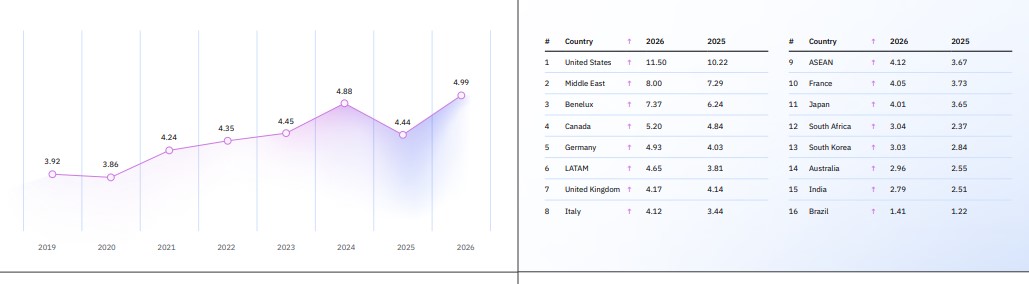
The cybersecurity landscape has crossed a critical threshold. As revealed in IBM’s annual Cost of a Data Breach Report 2026, which surveyed 602 breached organizations and over 3,500 security leaders, the global average cost of a data breach has spiked 12% in a single year to a record $4.99 million ($1,100 per hour). In the United States, that figure surged to an astonishing $11.5 million.
The primary catalyst? Weaponized artificial intelligence.
Attackers have abandoned human speed for machine speed. The report highlights how attackers leverage generative AI and frontier models, such as the model announced in April 2026 capable of unearthing thousands of zero-day vulnerabilities across operating systems, to collapse the timeline between discovery and exploitation. Defensive strategies built for a slower era are fracturing under the pressure.
1. AI-Driven Attacks Spike 56% and Add $1 Million to Breach Costs
More than 1 in 4 organizations (25%+) reported experiencing a malicious attack directly powered by AI – a 56% surge year-over-year.
- The Primary Drivers: Deepfake identity impersonation and AI-synthesized malware.
- The Cost Penalty: Breaches involving AI-driven attack vectors added an average of $1.0 million to the total breach cost compared to traditional attacks.
- Targeting Critical Infrastructure: 62% of all AI-driven breaches concentrated in critical sectors, led by Financial Services ($6.29M average breach cost) and Energy ($5.20M average breach cost).
2. Targeting the Model: Prompt Injection & Model Inversion
Attackers aren’t just using AI as a tool, they are actively attacking enterprise AI deployments. Among organizations reporting an AI-related incident, the financial toll was heavily concentrated in two specialized vectors:
- Model Inversion Attacks ($6.07M average cost): Reconstructing sensitive training data directly from model outputs.
- Prompt Injection Attacks ($5.89M average cost): Subverting model behavior and alignment to bypass security guardrails.
Crucially, 92% of organizations that suffered an AI-related breach lacked proper AI access controls, even though only 40% currently enforce access management on their models and datasets. The root cause of these incidents was rarely the underlying LLM itself, but rather structural governance failures: unpatched APIs, misconfigured cloud environments, and shadow AI integrations.
3. Extortion Evolves: Reputation Threats Surpass Technical Encryption
Ransomware tactics are shifting away from purely technical disruption toward multidimensional blackmail:
- Reputation Threat as Primary Tactic: 41% of ransomware victims reported that threat actors used public exposure and brand reputation damage as their main leverage point.
- Data Encryption: Pure encryption held at 23%, indicating attackers recognize that data exfiltration and public shaming yield faster payouts than file locking.
4. The Defender’s Dilemma: Asymmetric AI Adoption
While security teams are embracing AI, their deployment remains dangerously uneven:
- The Defender Advantage: Organizations with extensive Security AI and automation saved $1.93 million per breach and contained incidents 65 days faster.
- The Misalignment: 50% of organizations deploy AI agents in their Security Operations Center (SOC) for threat hunting and response. However, only 18% apply AI agents to vulnerability scanning and management the exact surface area targeted by frontier AI models.
In response to frontier AI threats, 85% of breached organizations plan to boost security investments, placing high priority on securing Non-Human Identities (NHIs), API security, and post-quantum cryptography.
“Cybersecurity is officially in an asymmetric arms race. Attackers are running AI agents at machine speed to exploit vulnerabilities in real-time, while defenders are still deploying AI primarily as a reactive safety net. Until security teams automate vulnerability detection and enforce strict identity governance over AI models and non-human identities, breach costs will continue their upward trajectory.”