

Strategic Takeaways
- The High-Capacity Fleet Fleet Base: The service utilizes specialized Airbus A350 twin-aisle wide-body aircraft. The inaugural flight, VN83, successfully carried nearly 300 passengers directly to Schiphol, while the return flight, VN82, immediately established a reliable schedule back to the capital.
- The Continental Footprint Expansion: The addition of Amsterdam expands Vietnam Airlines’ European footprint to 12 nonstop routes serving eight key gateways: Paris, London, Frankfurt, Munich, Milan, Copenhagen, Moscow, and Amsterdam.
- The Tactical Capacity Realignment: To meet shifting regional demand, the carrier has confirmed that starting July 1, 2026, it will increase its Hanoi–Moscow frequency from three to four round-trip flights per week, maximizing fleet use across its long-haul networks.
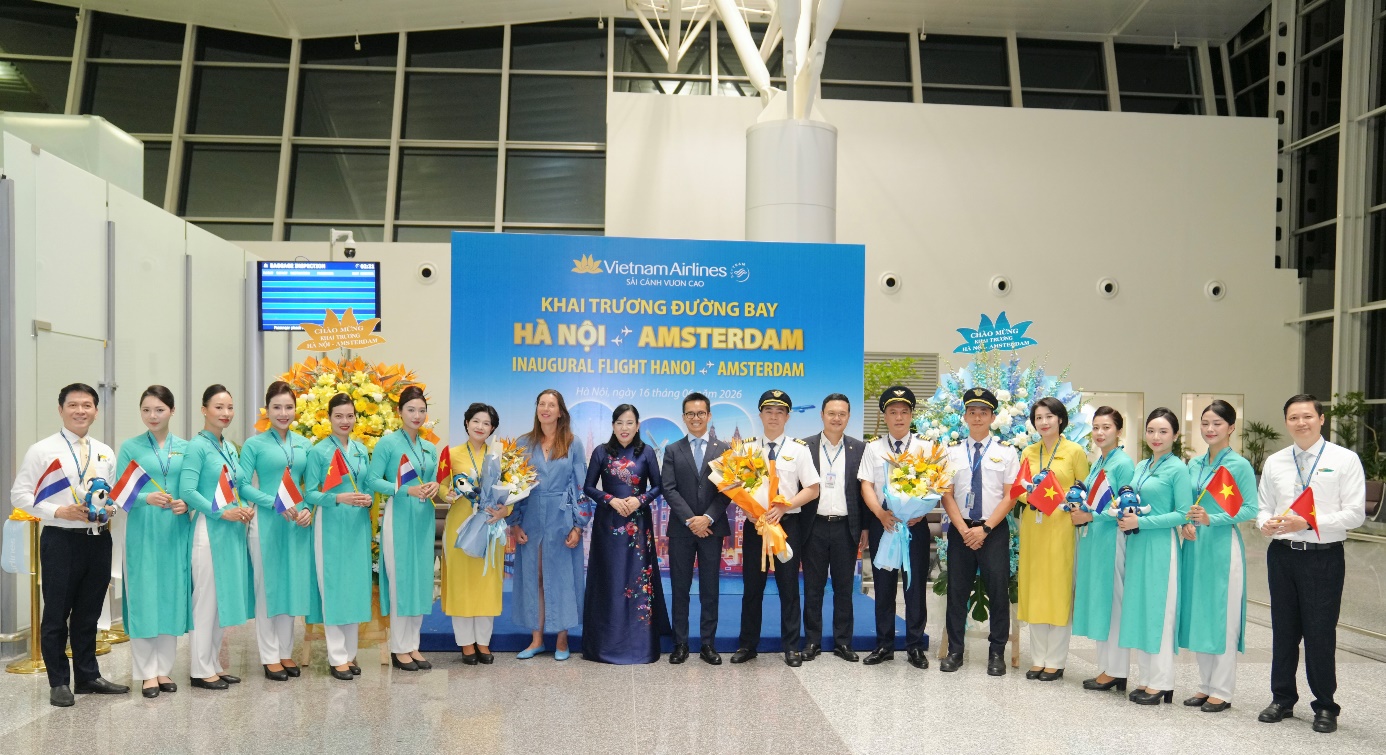
Reshaping the aviation landscape between Southeast Asia and Western Europe, national flag carrier Vietnam Airlines has officially launched its highly anticipated nonstop service linking Noi Bai International Airport (HAN) with Amsterdam Airport Schiphol (AMS).
The deployment, operated three times weekly on Tuesdays, Thursdays, and Saturdays, represents a strategic shift toward Productivity Realism within regional flag carrier networks.
By bypassing traditional Middle Eastern and Singaporean transit hubs, the route establishes a direct aerial corridor designed to capture high-yield corporate travel, urgent trade cargo, and the expanding European tourism segment.
The structural importance of the new route relies on a fundamental rule of international transport: real business expansion thrives when physical transit barriers are completely removed. Previously, trade and corporate travelers moving between Vietnam and the Netherlands had to connect through third-party hubs, adding severe time delays and logistics tracking risks.
By deploying its advanced wide-body Airbus A350 fleet, Vietnam Airlines eliminates this operational friction.
The strategy secures a direct, 12-hour transport line into one of Europe’s most vital financial, trade, and logistics centers, perfectly positioning the airline to absorb the accelerating bilateral commerce flowing between the two countries.
| Key Operational Dimension | Legacy Indirect Transit Loops | The Nonstop Capital-to-Capital Rail |
| Transit Efficiency | Mandatory Middle Eastern Hubbing Forced layovers in secondary hubs adding 4 to 8 hours of route latency per direction. | 12-Hour Direct Wide-Body Deployment Native nonstop connectivity cutting overall transit times down to the absolute physical baseline. |
| Capacity Management | Siloed Market Allocations Fragmented capacity across shared alliance segments, vulnerable to regional pricing shifts. | Dedicated Tri-Weekly Wide-Body Slots Reliable, scheduled capacity using advanced twin-aisle aircraft fleets deployed on fixed schedules. |
| Network Breadth | Point-to-Point Terminal Stagnation Isolated long-haul arrivals requiring separate ticketing and manually handled ground connections. | Integrated SkyTeam Hub Access Direct entry into Amsterdam Schiphol, instantly unlocking hundreds of European onward connection tracks. |
Dissecting the Trade Loop: Connecting European Markets with ASEAN Supply Lines
The new long-haul route moves past simple passenger transport, functioning as a high-speed logistical tool for international corporate supply chains:
1. Removing the Friction of International Transit: For corporate travel managers and tour operators, the direct flight removes the largest logistical hurdle to selling Vietnam as a key premium destination. The nonstop route saves critical hours of travel time per direction, protecting high-value business teams from unexpected flight cancellations and missed connections at secondary transit hubs.
2. Leveraging Favorable Trade and Policy Windows: The launch lines up perfectly with positive regional policy shifts. Dutch citizens currently enjoy 45-day visa-free entry to Vietnam for business and tourism under active government resolutions. This regulatory window, combined with direct air access, allows European firms to quickly coordinate site visits, inspect local factories, and expand operations without heavy bureaucratic delays.
Editor’s Take: Anchoring Long-Haul Margins via Productivity Realism
From the strict view of aviation economics and Productivity Realism, Vietnam Airlines’ strategic entry into Amsterdam Schiphol highlights an essential rule for global legacy carriers: long-term network survival and high-yield ticket margins belong entirely to operators that build direct capital-to-capital connections into dominant logistics hubs. For too long, secondary international lines have let third-party transit networks handle their long-haul passenger traffic, ignoring how multi-hop layovers, split baggage handling, and uncoordinated code-share agreements lower the travel experience, eat into cargo revenues, and leave local airlines vulnerable to aggressive pricing from mega-carriers.
True aviation leadership requires treating long-haul routes as high-speed trade pipelines.
By deploying advanced wide-body aircraft to connect major regional capitals directly, flag carriers show how to secure high-value corporate travel business without sacrificing cargo velocity or alliance network benefits.
This smart operational focus provides an excellent guide for regional executives as they restructure supply chain assets and corporate travel programs to thrive amidst expanding international competition.