

Key Takeaways
- The Graduation Cliff Edge: Nepal’s upcoming transition from Least Developed Country (LDC) status will strip away its long-held preferential trade tariffs, making structural productivity a survival imperative rather than a policy choice.
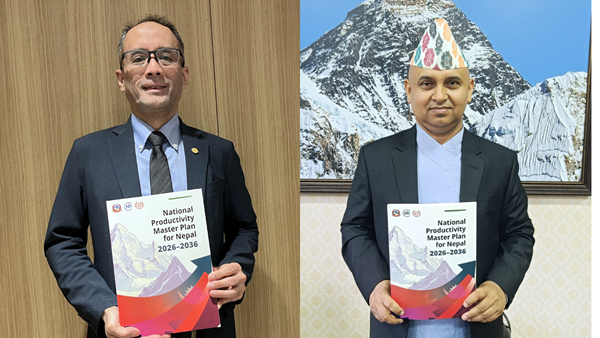
- A Decade of Structural Reform: Jointly engineered with the Asian Productivity Organization (APO), the 2026–2036 Master Plan targets deep-seated bottlenecks, focusing heavily on logistics, skill mismatches, and climate resilience.
- Shifting the Export Basket: The framework aims to radically boost Nepal’s “economic complexity” by shifting the national economic engine from basic agricultural survival and foreign remittances to high-value, specialised goods.
The Productivity Transformation Blueprint (2026–2036)
To move beyond high-level policy speak, the master plan addresses Nepal’s structural roadblocks with direct economic countermeasures over the next ten years.
| Core Constraint | Strategic Target | Practical Action | Expected Market Outcome |
| Logistical Inefficiencies | Infrastructure Modernisation | Strategic transport investments and cross-border customs streamlining. | Lowered cost of doing business, making local exports highly competitive in regional markets. |
| Skill Mismatches | Competitive Human Capital | Re-aligning educational curricula with private sector manufacturing demands. | Reduced reliance on unskilled labour export; creation of higher-wage domestic jobs. |
| Low Economic Complexity | Innovation-led Upgrades | Funding support for small enterprise technology adoption. | Shifting exports from raw agricultural crops to processed, high-margin finished goods. |
| Climate Vulnerabilities | Green Operational Resilience | Integrating climate-smart technology into agricultural supply chains. | Protection of national food security and insulation of supply chains from extreme weather shocks. |
The Graduation Crucible: Why Nepal Must Re-engineer its Economy
For years, Nepal has operated under the protective umbrella of Least Developed Country (LDC) status. This classification granted its businesses tax-free and quota-free access to some of the world’s wealthiest consumer markets. However, with graduation on the horizon, this safety net is about to be dismantled.
To prevent an economic shockwave, the Nepalese government’s Smooth Transition Strategy has placed productivity at the very centre of national development.
This is where the concept of “economic complexity” becomes crucial. In simple terms, economic complexity measures not just how much a country exports, but how unique and sophisticated those exports are. A country exporting raw timber has low complexity; a country exporting specialised wooden furniture holds high complexity.
By utilizing the APO’s new national productivity scorecard, Nepal intends to systematically measure and upgrade its industries. The goal is to move up the global value chain before the tariff hikes kick in, transforming local factories from simple assembly plants into hubs of genuine innovation.
Bridging the Execution Gap: From Federal Policy to Local Action
Unlike previous state papers that often ended up archived, the 2026–2036 Master Plan is designed as an active execution roadmap. The National Productivity and Economic Development Centre (NPEDC), alongside the Ministry of Industry, Commerce and Supplies, will oversee the roll-out.
The execution model avoids a “one-size-fits-all” trap by sequencing reforms through a phased approach:
- Foundational Phase (Years 1–3): Establishing institutional frameworks, harmonising trade policies, and setting up the national productivity scorecard.
- Scaling Phase (Years 4–7): Launching pilot technology integration programs in manufacturing and agribusiness across selected provinces.
- Mainstreaming Phase (Years 8–10): Embedding successful productivity measures directly into provincial and local government budgeting systems.
This phased sequencing ensures that local governments, often disconnected from federal policy in Kathmandu, are actively funded and equipped to drive productivity improvements on the ground.
Editor’s Take
For ASEAN corporate leaders and Malaysian policymakers, Nepal’s bold ten-year master plan is a trend worth watching closely. Historically, Malaysia and Nepal have shared a deep, asymmetrical relationship built around labour corridors. Tens of thousands of Nepalese workers form the backbone of Malaysia’s security, manufacturing, and construction sectors.
If Nepal successfully pulls off this decade-long productivity leap, those traditional labour dynamics will shift dramatically. As high-value, domestic manufacturing jobs open up in Nepal, the supply of outward-bound industrial labour will contract. This will inevitably force Malaysian business owners to accelerate their own automation and digital adoption plans. Furthermore, a more productive, middle-income Nepal opens up a fresh, untapped consumer market in South Asia for ASEAN brands. Nepal’s transition is a powerful case study in structural survival proving that in the modern global economy, raw labour is a depreciating asset, and systemic productivity is the only true currency.