

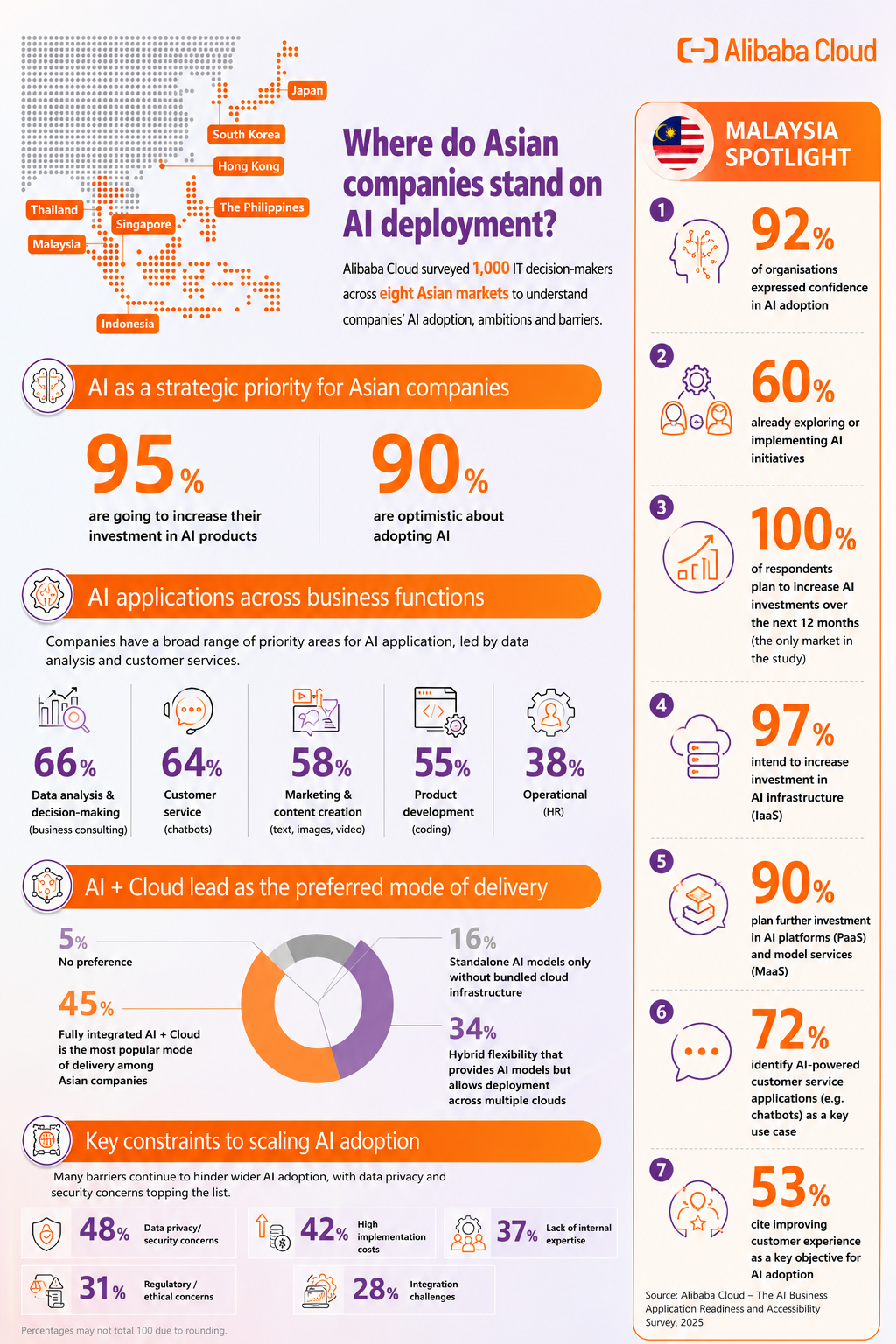
- Unanimous Capital Expansion: Malaysia stands out as the only market in Asia where 100% of surveyed organisations plan to increase AI spending, with 97% boosting investments in Infrastructure-as-a-Service (IaaS) and over 90% expanding Platform-as-a-Service (PaaS) and Model-as-a-Service (MaaS) budgets.
- Transition to Production & Outcomes: Moving beyond pilot experiments, 75% of Asian companies now consider AI indispensable to operations, shifting focus from raw token generation to actionable agentic workflows, customer experience (cited by 72% in Malaysia), and data-driven decision-making.
- The Integrated Stack Imperative: 45% of enterprises prefer fully integrated AI and cloud architectures to centralise data governance, address data privacy and security concerns (the top barrier at 48%), and reduce implementation costs (42%).
Asian enterprises are shifting rapidly from AI experimentation to full operational integration. According to Alibaba Cloud’s AI Business Application Readiness and Accessibility Survey, near-universal enthusiasm is sweeping the region, with 92% of Malaysian organisations expressing confidence in AI adoption and 60% actively implementing or exploring initiatives.
To support this surge, Alibaba Group has committed over RMB380 billion (USD53 billion) over three years into cloud and AI infrastructure. As the market enters the agentic AI era, business leaders are seeking secure, end-to-end stacks that integrate foundation models, such as Alibaba Cloud’s multilingual Qwen family, directly into scalable cloud runtimes to ensure strict data privacy, regulatory compliance, and seamless operational orchestration.
| Adoption Parameter | Regional Benchmark (Asia) | Malaysia Specific Benchmark | Strategic Enterprise Focus |
| Investment Intent | 99% prioritizing AI | 100% increasing budget | Capital allocation across IaaS (97%), PaaS & MaaS (>90%) |
| Operational Integration | 75% consider AI indispensable | 60% implementing / exploring | Customer service tools (72%), analytics & decision-making (66%) |
| Primary Deployment Goal | Driving innovation (64%) | Improving customer experience (53%) | Unlocking revenue potential (48%) & competitive edge (45%) |
| Preferred Stack Architecture | 45% fully integrated AI + Cloud | High demand for integrated stack | Centralised governance, standardized data, and cost control |
| Top Adoption Friction | Data privacy & security (48%) | High implementation costs (42%) | Internal skills gap (37%) & regulatory compliance (31%) |
What it means for Malaysia
- Strategic Pivot to High-Value Service Automation: With 72% of Malaysian firms prioritizing AI customer service applications and 53% focusing on customer experience, local corporate adoption is directly targeting operational throughput in banking, telecommunications, and retail. This aligns with national digitalization goals by freeing human capital for complex problem-solving while automating multi-lingual consumer touchpoints.
- Accelerated Infrastructure and Cloud Demand: Malaysia’s unanimous 100% investment intention places immense demand on domestic data center capacity and cloud ecosystems. As local enterprises deploy PaaS and MaaS frameworks, national cloud adoption strategies supported by agencies like MDEC and MOSTI will need to ensure robust cybersecurity frameworks, data residency compliance, and localized technical upskilling programs.
What it means for ASEAN
- Unlocking Multilingual Sub-Regional Trade: The scarcity of localized language models has historically hindered AI adoption across Southeast Asia. Open, multilingual models, such as Qwen supporting Bahasa Melayu alongside regional dialects, allow cross-border enterprises across Malaysia, Indonesia, and Thailand to deploy unified agentic tools that break down linguistic barriers in regional trade and customer support.
- Establishing Regional Agentic Standards: As ASEAN member states navigate fragmented data privacy and sovereignty regulations, the shift toward integrated “AI + Cloud” architectures offers a standardized framework for regional conglomerates. By centralizing model governance within secure cloud environments, firms operating across ASEAN can maintain compliance with varying national data sovereignty laws without siloing their digital operations.
Editor’s Take
The conversation around enterprise AI has permanently shifted from basic model capabilities to architectural control. Malaysia’s 100% investment commitment proves that local corporate leaders recognize the necessity of AI, but raw enthusiasm will quickly run into operational friction if security and system integration are treated as afterthoughts. Enterprise leaders must avoid fragmenting their tech stack across disconnected point solutions. The winning strategy lies in deploying integrated, multilingual “AI + Cloud” platforms that solve local data privacy concerns while enabling autonomous agentic workflows capable of driving real-world business outcomes.