

Source Data: IMF Country Focus, March 2026
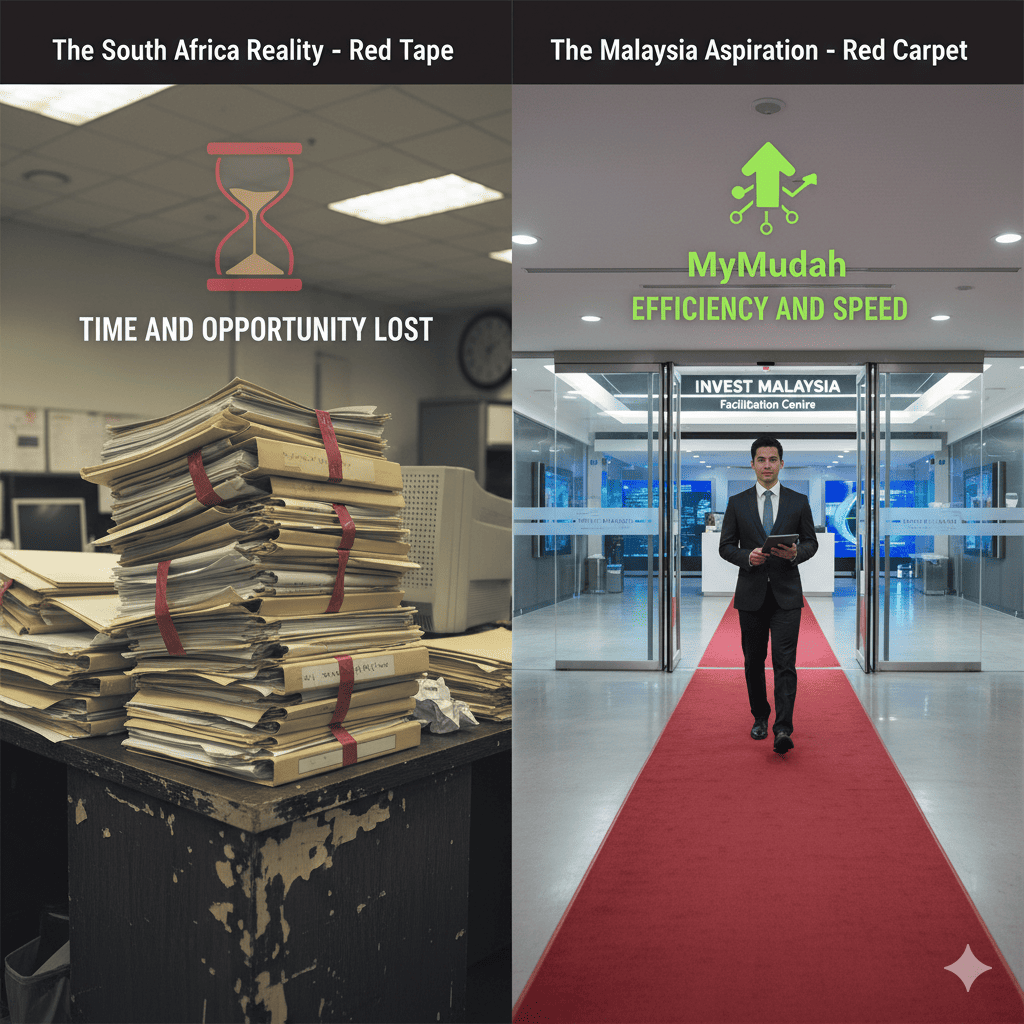
As Malaysia charts its course through the first year of the 13th Malaysia Plan, a recent IMF report on South Africa serves as a stark warning: Regulatory friction is a silent killer of job growth. The IMF’s 11 March 2026 report reveals that in South Africa, a mere 1% increase in the time managers spend dealing with government regulations correlates directly with a 1% reduction in job growth. For small firms (under 20 employees), the impact on productivity is nearly double.
The Paralysis of SMEs
South Africa’s “Business Licensing Bill of 2025” is currently attempting to fix a broken, decentralised system defined by inconsistent fees and duplicative permits. For Malaysian SMEs, this resonates deeply. While Malaysia has made strides through digital initiatives like MyMudah, the South African experience highlights that “centralisation” without “digital integration” leads to stagnation.
The “Risk-Based” Solution
The IMF advocates for a shift that Malaysian policymakers should watch closely: Risk-Based Licensing. Instead of a “one-size-fits-all” permit system, low-risk businesses (such as retail) should operate with minimal oversight, allowing enforcement agencies to focus on high-risk sectors (like food production or chemicals).
| Feature | Malaysia: MyMudah (MPC) | South Africa: Business Licensing Bill 2025 |
| Status | Operational (Phase 2.0) – Embedded in the 13th Malaysia Plan (13MP). | Legislative Proposal – Currently facing public and business opposition. |
| Primary Goal | Reducing “Unnecessary Regulatory Burden” (URB) to lower compliance costs. | Replacing the 1991 Businesses Act with a uniform, national licensing system. |
| Institutional Hook | #MyMudah Units established in every Ministry and State Government agency. | Minister of Small Business Development to designate activities requiring a license. |
| Digital Integration | MPC MyMudah System – A direct feedback portal for businesses to report “red tape” issues. | Single Digital Platform – Proposed by IMF to centralise municipal/provincial applications. |
| Focus on SMEs | Targeted deregulation via MyMudah units in industry associations. | Aimed at Formalisation – Seeking to bring informal traders and micro-firms into the tax net. |
| Enforcement Model | Consultative – Uses Behavioral Insights (BI) to nudge agencies towards better regulatory practice. | Punitive – Grants officers wide powers to inspect, confiscate goods, and issue fines (up to ZAR 10,000). |
| Major Challenge | Inter-agency silos and ensuring 100% adherence at the Municipal (PBT) level. | High Fragmentation – Difficulty in harmonising provincial laws and municipal by-laws. |
The Bottom Line
If South Africa closes just half the gap with emerging-market best practices, its output could rise by 9%. For Malaysia, the message is clear: To hit our RM1 trillion export goals, we must ensure our “red carpets” for investors aren’t tangled in “red tape.”
Why it matters to Malaysia:
Malaysia and South Africa often compete for the same pool of “Emerging Market” capital. If South Africa successfully implements these reforms, they could become a more formidable competitor for FDI. Conversely, by studying their failures, Malaysia can refine its New Incentive Framework (NIF) to be the most “frictionless” destination in the Global South.