

Malaysia is currently pursuing a dual-track strategy: insulating the domestic economy through community-led resilience programs while aggressively expanding its high-value halal footprint in the Asia Pacific and beyond.
RM68.52 Billion in Halal Exports
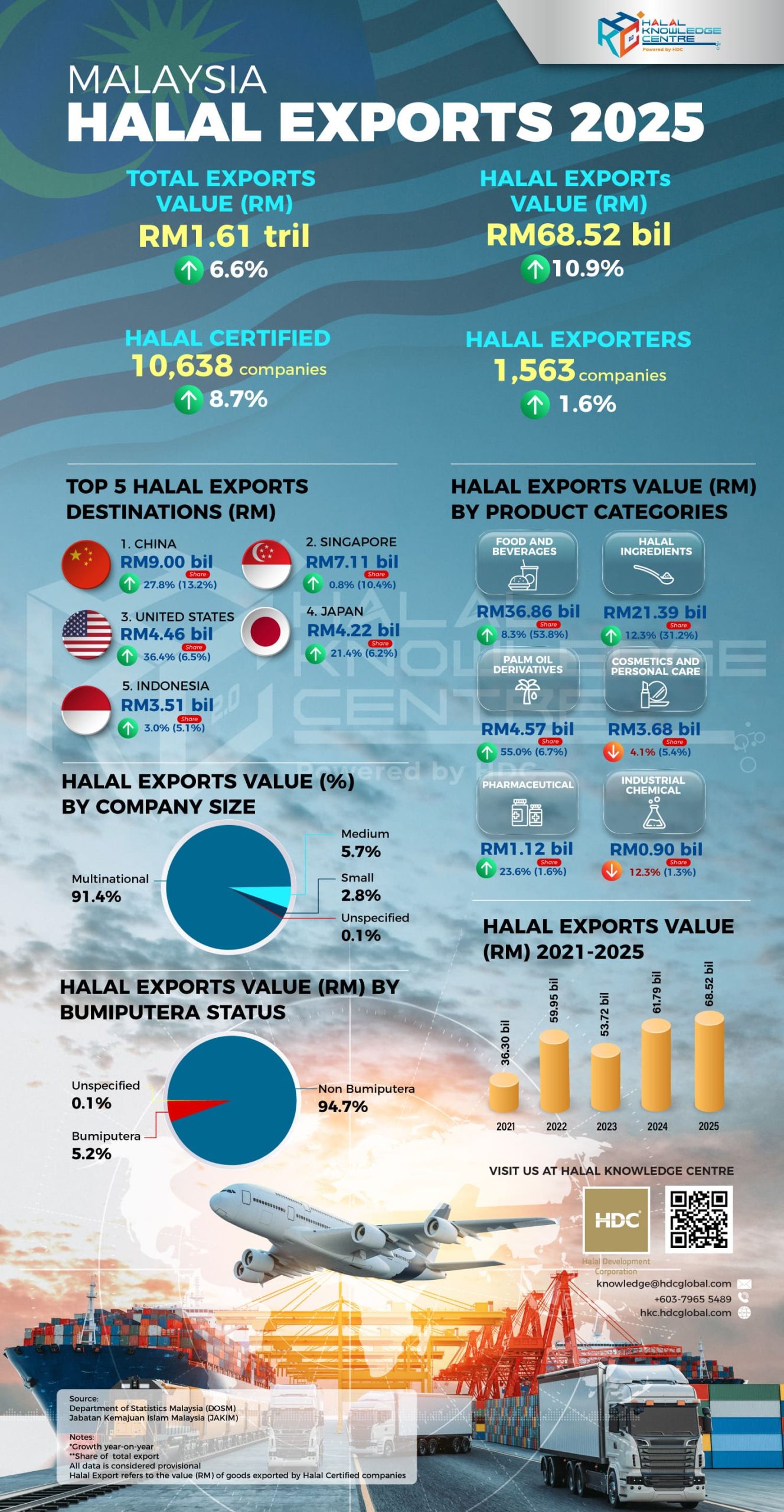
The Halal Development Corporation Berhad (HDC) announced that Malaysia’s halal industry achieved a 10.9% year-on-year increase in 2025, reaching a total export value of RM68.52 billion.
- Core Drivers: The Food and Beverages (F&B) segment remains the anchor, contributing RM36.86 billion (53.8%), followed by Halal ingredients at RM21.39 billion.
- Significant Growth: Palm oil and derivatives saw a massive 55% surge, valued at RM4.57 billion.
- Market Diversification: China remains the top destination (RM9 billion), but significant gains were noted in Singapore, the United States, Japan, and Indonesia.
The Google Semarak Malaysia Fund
To support long-term regional growth, Google has introduced the Semarak Malaysia Fund: Selangor, managed by ChangeX. This initiative targets the state’s “long-term resilience” by funding projects that address workforce skilling and sustainability.
| Fund Feature | Details & Key Dates | Strategic Priorities |
| Max Funding | Up to RM30,000 per project. | AI and digital training for career readiness. |
| Deadline | Applications close on June 9. | Supporting small businesses to thrive. |
| Eligibility | Non-profits and schools in Selangor. | Water resilience and energy footprint reduction. |
Global Headwinds: The IMF’s 3.1% Warning
This local and sectoral momentum occurs against a backdrop of global economic cooling. The IMF has officially cut its global growth forecast to 3.1% for 2026.
- Risk Multiplier: The IMF warns that growth could drop further if the war in the Middle East is prolonged.
- Supply Chain Pressure: HDC Interim CEO Hanisofian Alias noted that these geopolitical developments may pose indirect challenges through supply chain disruptions and cost pressures.
Editor’s Take: Leveraging Integrity for Market Share
HDC’s report proves that Malaysia’s “Certification Credibility” is its most valuable export asset. While the global growth forecast of 3.1% is a reason for caution, the 10.9% growth in halal exports suggests that Malaysia is successfully capturing a “Resilience Premium” in global trade. Moving forward, the focus must shift toward high-value segments like pharmaceuticals and digital traceability to buffer against the supply chain risks highlighted by the ongoing conflict.