

What ASEAN Human Capital Leaders Must Extract from the Deloitte Global 2026 Gen Z & Millennial Survey
For years, a pervasive and deeply flawed narrative has circulated within the executive suites of Kuala Lumpur, Singapore, and Jakarta: that the younger tranches of the workforce have simply abandoned corporate ambition. Middle managers complain of a lack of drive, while traditionalists mistake a refusal to accept structural burnout for an institutional rejection of growth.
The release of the Deloitte Global 2026 Gen Z and Millennial Survey which evaluated 22,595 respondents across 44 countries extinguishes this lazy caricature. What emerges from this comprehensive data print is not a deficit of desire, but a sharp rise in Productivity Realism. The future workforce is completely prepared to grow, expand, and upskill; however, their corporate engagement is now highly conditional. They are systematically weighing the structural costs of leadership and flatly rejecting organizational models that require personal and physiological degradation as the entry price for advancement.
The Structural Evolution: From High-Velocity to Durable Careers
The defining operational insight of the 2026 data is a massive generational pivot away from high-velocity corporate ladders toward long-term, durable career architectures. Only 25% of Gen Z and 21% of Millennial professionals state a preference for fast-paced advancement marked by rapid, aggressive promotion cycles. Instead, the overwhelming majority actively favor gradual, sustainable growth, with significant volumes expressing a clear willingness to make lateral moves or even step backward to secure foundational multi-disciplinary skills.
| Operational Vector | Legacy Corporate Blueprint | The 2026 Reality Blueprint |
| Career Velocity | High-Speed Churn: Rapid title changes, vertical promotion pressure, and high operational attrition. | Sustainable Architecture: Gradual, steady progress, skill diversification, and lateral mastery. |
| Leadership Pipeline | Unconditional Sacrifice: Management roles paired with burnout, constant availability, and high friction. | Conditional Ambition: Clear boundaries, shared team accountability, and structural well-being. |
| Technology Adoption | Top-Down Automation: Rigid software implementation designed to cut immediate corporate heads. | Autonomous AI Co-Piloting: Skill development, productivity gains, and stress management tools. |
This structural change in expectations places an immediate operational burden on chief people officers across Southeast Asia. If your organizational retention strategy relies entirely on dangling a slightly flashier title or a minor, high-pressure promotion every twelve months, your leadership pipelines are built on sand. The incoming workforce is actively assessing the health trade-offs of management tiers, and if the view from the top looks like chronic exhaustion, they will deliberately choose to remain at the individual contributor level.
De-Risking the Leadership Bottleneck
The survey exposes an acute vulnerability for corporate succession planning: merely 6% of Gen Z and Millennial workers identify securing a traditional leadership role as their primary near-term professional objective. When pressed on the specific institutional forces keeping them from pursuing management paths, their concerns are highly operational:
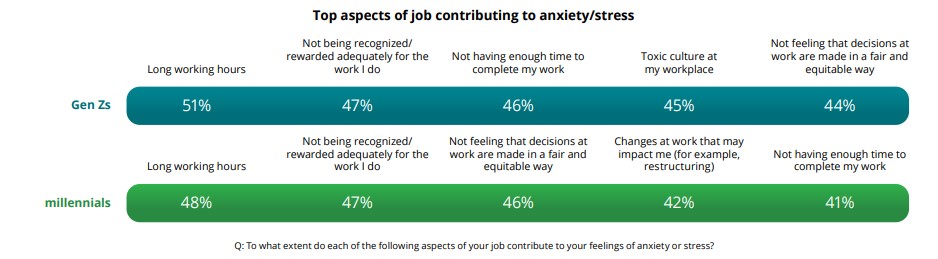
- Stress & Burnout: 50% of Gen Z and 49% of Millennials identify systemic exhaustion as their absolute barrier to pursuing leadership.
- Excessive Responsibility: 50% of Gen Z and 48% of Millennials cite unmitigated, individual corporate burdens.
- Work-Life Imbalance: 41% of Gen Z and 46% of Millennials flatly refuse to sacrifice their personal lives for a management tier.
For ASEAN enterprises scaling operations under the New Industrial Master Plan (NIMP 2030), these data points point to a critical bottleneck. As corporations digitize and build highly automated operations, the need for agile, empathetic managers to lead complex human-AI teams is at an all-time high. Yet, our current management frameworks are operating as a deterrent. To secure succession pools, HR chiefs must completely redesign the leadership role itself transitioning from isolated, individual accountability models to distributed team structures that actively guarantee psychological safety and manageable workloads.
The Macro Financial Reality and the Housing Anchor
A major driver behind this career caution is persistent, long-term financial pressure. For the fifth consecutive year, the cost of living ranks as the absolute leading concern for both generations, far outstripping all other social or institutional variables. More than half of all respondents (55% of Gen Z and 52% of Millennials) confirm they are actively delaying major life milestones, including starting a family, furthering their education, or launching independent business ventures, simply to build basic personal financial safety.
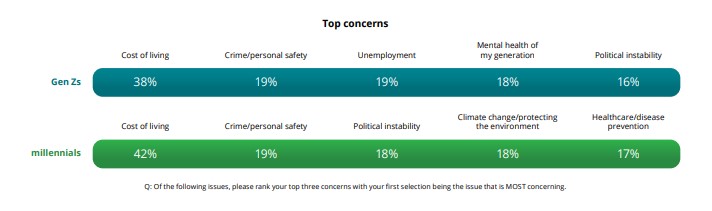
Critically, the 2026 data shows that the availability and affordability of housing now directly dictates career decisions and talent mobility. Younger professionals are no longer willing to relocate to premium urban corporate hubs if the local real estate market consumes their disposable income. For companies in high-density areas like the Klang Valley or Singapore, talent acquisition is now closely tied to local living costs. Forward-thinking HR teams are responding by moving past rigid salary bands to deploy flexible work locations, targeted housing stipends, and localized satellite workspaces that eliminate lengthy, expensive daily commutes.
The AI Readiness Disconnect
While executive boards debate AI governance policies at a slow pace, the workforce has already integrated these systems into their daily operations. AI adoption has achieved massive scale, with 74% of Gen Z and Millennial employees utilizing AI tools in their day-to-day work shows a substantial jump from the mid-50% levels recorded just twelve months ago.
Interestingly, the data shows that younger entry-level employees are not treating AI as a threat to their job security; rather, they are aggressively using it as an autonomous career coach and productivity driver:
- 79% use AI to identify critical skill gaps and learning opportunities.
- 72% of Gen Z and 69% of Millennials utilize it to seek objective career guidance.
- 67% of Gen Z lean on it to automate repetitive tasks and manage daily workplace stress.
However, this rapid grass-roots adoption has exposed a serious organizational readiness gap: more than 30% of employees state that their corporate leadership is utterly unprepared for the technical realities of AI transformation. This creates an immediate risk for talent retention: if high-performing digital natives discover that their employers are using legacy systems and blocking AI tools rather than supporting them, they will take their skills elsewhere.
Editor’s Take: Sourcing Realism to Combat Capital Attrition
For the Malaysian Business reader, the implications of the 2026 Deloitte print demand absolute corporate realism. We can no longer treat talent retention as an isolated HR task managed through standard annual reviews. In an era where human capital velocity directly dictates corporate performance, failing to adapt to these generational changes imposes heavy capital attrition on your operations.
Companies that force outdated, high-pressure management structures onto a workforce that openly values career sustainability will face rising recruitment overheads and weakening leadership pipelines.
True structural resilience requires corporate boards to treat workplace well-being, flexible housing strategies, and AI integration not as soft benefits, but as core infrastructure requirements to protect long-term capital efficiency and secure a lasting competitive advantage on the regional stage.