

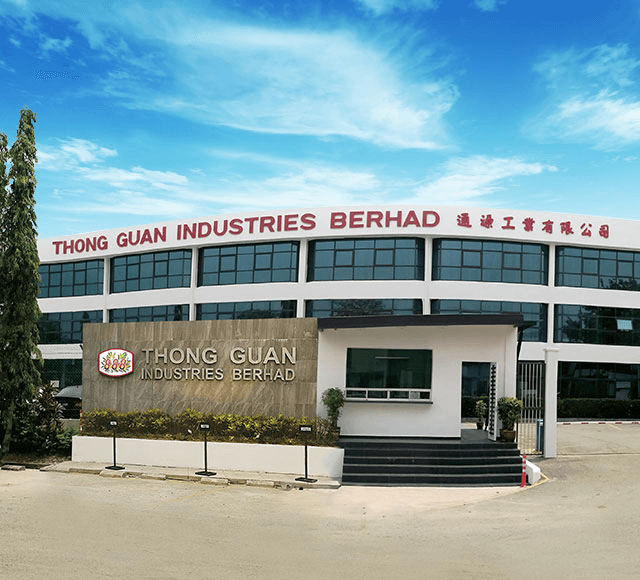
On May 29, 2026, I sat down with Dato’ Ang Poon Chuan, the scion driving Thong Guan Industries Berhad, the Bursa Malaysia-listed powerhouse, famed for its ubiquitous “888” beverage logo.
Our conversation traced a remarkable trajectory: a corporate empire that began in 1942 amidst the volatility of World War II, funded by a humble RM50 loan. Those initial funds were deployed to trade chests of tea imported from India. Today, that small trading outfit has evolved into a global multinational.
This interview marks the next chapter in our Three-Generation Businesses series, focusing squarely on a critical pillar: Direction.
The Twin Anchors: Demand and Timing
Dato’ Ang reminisced about the 1960s, a pivotal era when the company transitioned from roasted coffee powder into PE plastic bags in 1962—back when oil was a mere USD 3 a barrel and local packaging relied on rustic hemp and banana skin paper bags (kiam chiao). Today, Thong Guan exports to over 70 countries.
Over the past 80 years, the group’s strategic compass has been dictated by two distinct forces: Demand and Timing.
All commercial entities exist to fulfill market demand. However, sustainable demand is actively engineered through research and development—either by pioneering new applications or solving operational pain points. A prime example is Thong Guan’s innovation in doubling the number of pallets that can be shrink-wrapped using the exact same volume of material.
Conversely, timing often involves macro-environmental events entirely beyond an enterprise’s control. In their recent book The Game of the Impossible, Tan Sri Idris Jala and P. Gunasegaram note that 70% of variables are external. Whether one attributes the remaining variance to fate, luck, or divine intervention, Idris believes leaders can court corporate favor by adhering to three distinct operational ethics:
- Humanity: Cultivate reciprocal corporate goodwill (Karma).
- Integrity: Remain strictly on the right side of conscience and law.
- Reflection: Commit to systematic deep reflection and self-renewal.
Navigating Industrial Shifts
Thong Guan’s history highlights two critical macro-timings. First, in the 1980s, Tun Dr. Lim Chong Eu industrialised Penang by pivoting toward electrical and electronics (E&E). This industrial boom catalyzed an insatiable local demand for industrial plastics, wrapping media, and carrier bags.
Second, the opening of China’s economy in the 1990s created a domestic labor crunch in Malaysia. Responding proactively, Thong Guan established its China facility in 1994, moving operations in by 1996. When the Asian Financial Crisis struck in 1997, the company leveraged the headwinds to secure a Second Board listing, later graduating to the Main Market in 2001.
During this same period, the company captured 90% of the Japanese garbage bag export market; today, it commands a 12% market share in Japan.
By 1997, Thong Guan also scaled its stretch film division, which now contributes 55% of consolidated revenue. According to an Applied Market Information Ltd. research report, the group is officially ranked among the top 10 largest pallet stretch film producers globally. Notably, the entire product portfolio is Halal-certified.
Strategic Priorities for the Modern Era
“As we move into FY 2026, several strategic priorities will guide our direction,” Dato’ Ang emphasized, echoing the mandates outlined in Thong Guan’s Annual Report 2025:
- Market Diversification: Deepening global customer partnerships.
- Supply Chain Resilience: Enhancing operational flexibility.
- Circular Packaging: Advancing sustainable materials and green technology.
- Operational Efficiency: Optimizing energy management across plant floors.
- Technical Expertise: Expanding technical services and load stability solutions.
- Digitalization: Leveraging advanced digital platforms for customer management.
- Human Capital: Developing internal sustainability competencies.
Thong Guan’s directional commitment remains uncompromising. Dato’ Ang focuses squarely on internal execution rather than competitor maneuvers, preferring to build deep alliances with long-established, multi-generational global peers—example working with a 150-year-old German family enterprise.
This family-run giant aligns brothers, sons, and extended family members toward a single corporate vision. Crucially, the board of directors includes former senior managers who share the same operational drive as the founder’s grandson.
The Legacy Modelling Framework
In our 3 Essentials to Legacy Modelling, once organizational philosophy is institutionalized, establishing a unified sense of direction and purpose at the highest enterprise level becomes paramount.
If an organization sets an aggressive target—such as achieving RM2 billion in revenue—it must deploy dedicated tactical teams tasked with pushing the envelope, regardless of external economic friction.
While demand and timing are critical, passive compliance breeds complacency. Leaders cannot simply wait for market shifts; they must actively architect the conditions for their strategic direction to manifest.
This philosophy is perfectly encapsulated by the classical Chinese idiom: 天时,地利,人和 (tiān shí, dì lì, rén hé) — the alignment of the Right Time, Right Place, and Right People.
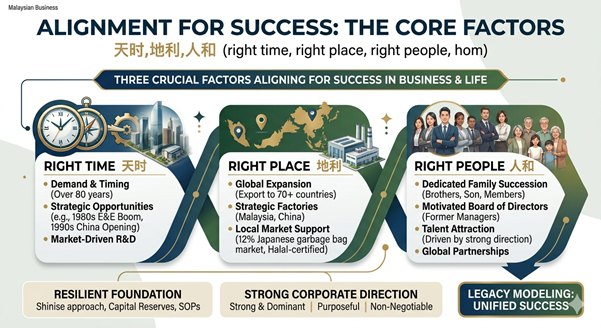
To lead an enterprise to battle, commanders must marshal internal and external resources under a corporate direction that is:
- Strong and Dominant: High-caliber talent gravities naturally toward commanding leadership.
- Purposeful: Clear mandates eliminate bureaucratic noise and flowery rhetoric, accelerating time-to-action.
- Important: If a strategic direction lacks intrinsic material value, it should not be pursued.
- Non-Negotiable: True leadership requires accountability. While tactics can adapt, the core direction cannot be compromised by corporate whims.
- Logical: The path must remain viable. Ordering an army into a barren desert without a pre-engineered water supply network is a failure of leadership, not a test of resolve.
Capital Preservation and Governance
Under the Shinise (long-established enterprise) approach to Legacy Modelling, resilient corporations systematically stress-test for a minimum of two years of operational failure. This means maintaining sufficient capital reserves, liquidity, and inventory to survive an extended macroeconomic emergency.
This resilience is achieved via disciplined financial planning, a cultural philosophy of lean expenditure, and a strict capital allocation policy of investing in best-in-class machinery to reduce manpower costs, optimize cycle times, and preserve market share.
Ultimately, high-level corporate directions must be systematically translated from the strategic to the tactical and operational tiers via robust standard operating procedures (SOPs). Without this granular documentation, executive mandates remain merely aspirational.
The author can be reached at Gray@samarata.com.my for feedback and comments.