

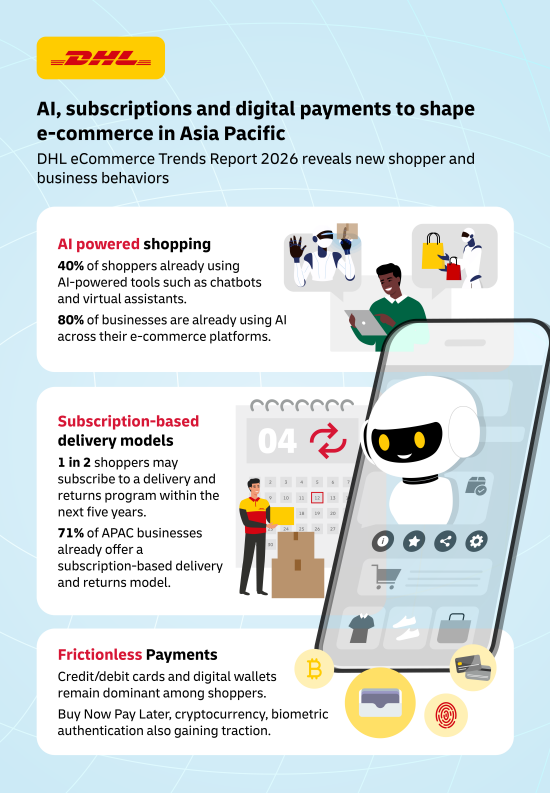
- The Trust-Usage Chasm: While 80% of Asia Pacific (APAC) businesses deploy AI, and 40% of shoppers use virtual assistants, over 62% of consumers cite privacy concerns as a major barrier to delegating full buying power to AI agents.
- The Subscription Pivot: Consumer retention is shifting from transactional loyalty to structural lock-in, with 71% of APAC businesses offering subscription-based delivery and returns models to match soaring shopper demand.
- The Instant Rail Advantage: Supported by mobile-first demographics and rapid interoperability across real-time payment rails like DuitNow, APAC is uniquely positioned to leapfrog Western card-first economies in automated commerce.
A profound paradigm shift is sweeping through the Asia Pacific digital marketplace. According to the latest DHL eCommerce Trends Report 2026 and Deloitte’s landmark study on Agentic Shopping, APAC is no longer just participating in global e-commerce development actively dictating its future architecture. Over the next five years, this hyper-connected region, home to over 4.3 billion shoppers and a rapidly expanding middle class, is projected to drive nearly two-thirds of the world’s new retail sales.
This growth is being propelled by three converging forces: the evolution of artificial intelligence into “agentic” systems, the rise of logistics-linked subscriptions, and the maturation of cross-border digital payment networks.
The Infrastructure Matrix: APAC vs. Western E-Commerce
To understand why the region is moving so quickly, we must look at how the fundamental digital infrastructure in APAC compares to traditional Western markets:
| Strategic Pillar | Asia Pacific (APAC) Landscape | Western (US/Europe) Landscape | Strategic Implications for Brands |
| AI Adoption & Strategy | High; 29% of businesses already run agentic AI; expected to hit 76% by 2028. | Moderate; primarily focused on back-end search optimization rather than autonomous agents. | Brands must prepare for “Agent-to-Agent” (A2A) negotiations where bots buy from bots. |
| Payment Rails | Account-to-account (A2A) instant rails (e.g., DuitNow, PayNow, PromptPay) with cross-border linkages. | Heavily reliant on legacy credit/debit card networks with higher transaction friction. | Lower transaction costs and frictionless checkout are the baseline requirements to reduce cart abandonment. |
| Delivery Models | High penetration of subscription-based logistics and out-of-home (OOH) lockers. | Home delivery remains standard, but is increasingly challenged by rising courier costs. | Logistics is now a core customer retention tool, rather than a mere backend cost center. |
The AI Paradox: From Assistance to Autonomous Action
While 40% of APAC shoppers already use basic AI tools (such as customer service chatbots), and a further 37% are eager to adopt them, there remains a massive trust gap. Approximately 62% of consumers express deep reservations about data privacy, and 50% worry about the accuracy of autonomous purchasing decisions.
However, the technology is moving faster than consumer anxiety. We are rapidly moving past “predictive AI” (which suggests what you might like) and entering the era of agentic commerce.
Agentic Commerce: A paradigm where highly specialized AI agents act on behalf of consumers and businesses—actively researching, comparing specs, negotiating custom deals, and executing transactions based on preset user rules.
Deloitte indicates that while only 29% of APAC consumer businesses currently deploy agentic systems, this will skyrocket to 76% within the next two years. As these systems mature, they will drastically collapse the traditional, multi-step online search and checkout journey into a single, unified action.
Locked-In Loyalty: The Rise of Logistics Subscriptions
Customer acquisition costs have skyrocketed, making transactional relationships highly inefficient. In response, the subscription economy is expanding from digital software and curated product boxes into the physical supply chain.
Across the region, consumers are demanding structural predictability. In Malaysia, 47% of shoppers already subscribe to at least one delivery and returns program, while 52% of consumers in India and 61% in Australia do the same. This demand is met by a highly proactive corporate landscape: 71% of APAC businesses already offer structured delivery and return subscriptions, using preferential pricing and priority services to secure long-term loyalty.
Frictionless Checkout: The Instant Rail Advantage
E-commerce success is ultimately decided at the checkout counter. The DHL data highlights a glaring industry blind spot: globally, 62% of shoppers will instantly abandon their cart if their preferred payment method is unavailable, yet only 45% of online businesses actually recognize this as a top driver of cart abandonment.
In Southeast Asia, this friction is being systematically erased. Driven by a highly mobile-first demographic, markets like Malaysia, Thailand, and China are rapidly scaling interoperable QR payment networks and digital wallets. These local payment methods are far easier to integrate into automated AI agent frameworks than traditional Western credit card credentials, giving the region a distinct advantage as autonomous shopping ecosystems scale.
Editor’s Take: The Strategic “Why”
The convergence of agentic AI, subscription logistics, and real-time payment rails is fundamentally rewriting the economics of retail. The old e-commerce playbook relied on heavy spending on search engine optimization (SEO) and digital advertising to capture human eyeballs is becoming obsolete.
In a world where up to 25% of global e-commerce sales could be influenced or fully executed by autonomous AI agents by 2030, your target consumer is no longer just a human. Your new consumer is an algorithm.
For policymakers and corporate leaders in Malaysia and the wider ASEAN region, this presents both a massive opportunity and an urgent mandate. To capture value in this new landscape, businesses must stop viewing AI as a glorified customer-service chatbot. They need to build clean, structured, and machine-readable data foundations that allow external AI agents to easily discover and verify their products in milliseconds.
Furthermore, governments must continue to prioritize regional payment interoperability. Initiatives that link Malaysia’s DuitNow with Singapore’s PayNow and Thailand’s PromptPay are not just convenient for tourists, they are the very rails upon which the automated, cross-border agentic economy of tomorrow will run.