

Key Takeaways
- Direct Cross-Border Highway: The 50-kilometre Nongsa Changi Cable (NCC) connects Batam’s Nongsa Digital Park directly to Singapore’s Changi telecom hub, establishing a high-capacity, sub-2-millisecond latency digital bridge across the Singapore Strait.
- Regional Infrastructure Synergy: Jointly developed by TelkomGroup’s Telin, BW Digital, and Nongsa Digital Park, the project forms a core component of the Indonesia Cable Express (ICE) ecosystem alongside BW Digital’s 144MW data centre campus.
- ASEAN Digital Economy Catalyst: Delivering over 1.6 Petabits per second in data transmission capacity, the subsea corridor provides critical bandwidth for artificial intelligence (AI), cloud platforms, and cross-border trade ahead of the ASEAN Digital Economy Framework Agreement (DEFA).
Anchoring Southeast Asia’s Digital Gateway
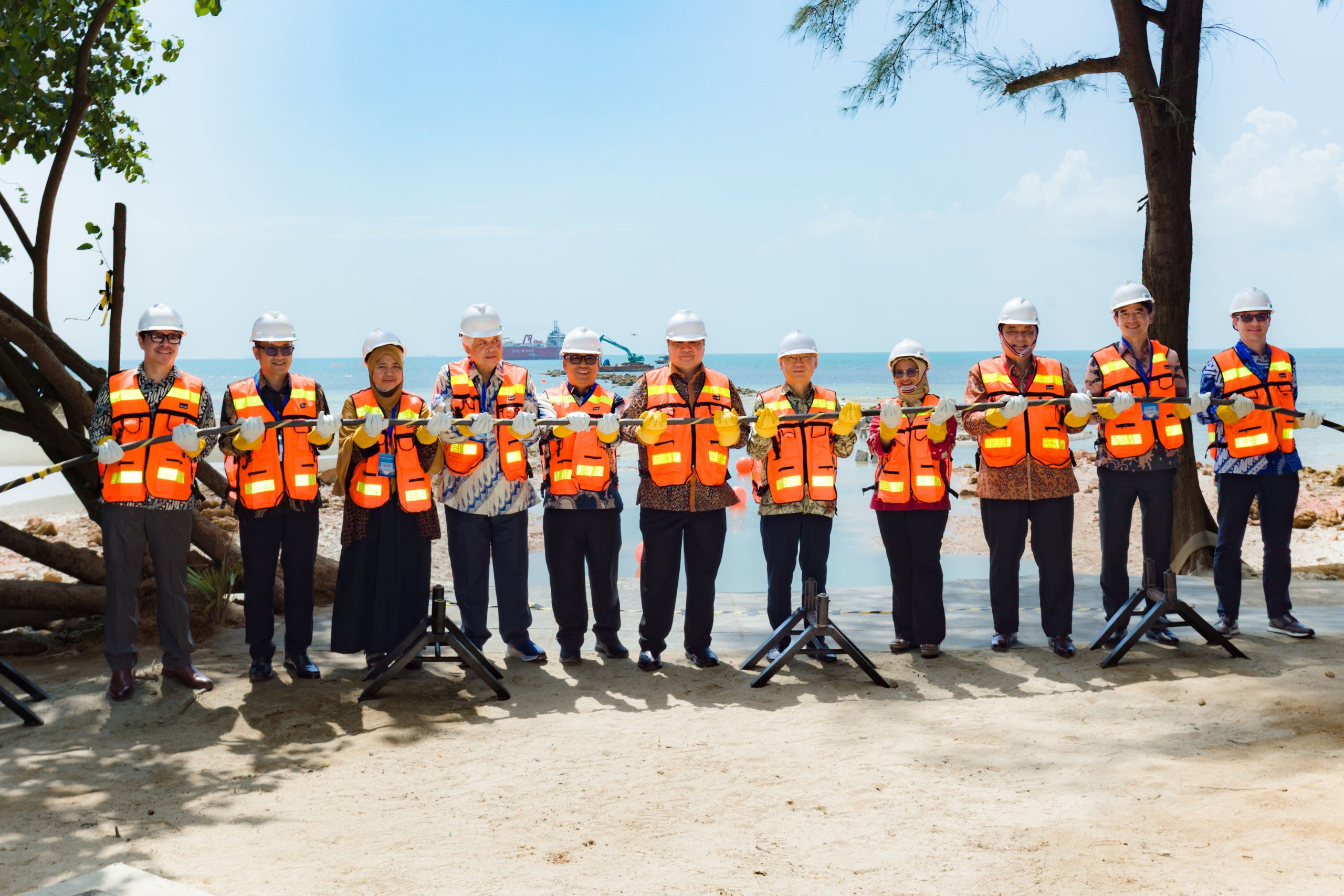
The successful cable landing of the Nongsa Changi Cable (NCC) at Nongsa Digital Park (NDP) in Batam marks a major structural leap for digital infrastructure across the Singapore Strait. Attended by Indonesia’s Coordinating Minister for Economic Affairs Airlangga Hartarto and Singapore’s Deputy Prime Minister Gan Kim Yong, the milestone formalises a high-speed physical link between two of Southeast Asia’s most vital commercial nodes.
As cross-border digital services, artificial intelligence models, and cloud computing workloads expand exponentially, physical network capacity has become as critical to regional trade as maritime shipping lanes. The NCC serves as an essential physical corridor, cementing Batam’s transformation from an industrial manufacturing zone into a primary digital entry point for Indonesia while extending Singapore’s reach as a global data clearinghouse.
Infrastructure Parameters & Market Impact
The project combines strategic subsea deployment with localized land-based infrastructure, establishing direct connectivity between data processing facilities and international transmission networks:
| Structural Dimension | Technical Specification | Strategic & Economic Value |
| Physical Route | Spans ~50 km directly across the Singapore Strait from Changi to Nongsa. | Minimises physical distance to achieve ultra-low latency (<2 ms) between hubs. |
| Transmission Capacity | 24 fibre pairs delivering >1.6 Petabits per second total throughput. | Provides high-volume data pipes to handle massive AI training workloads and cloud traffic. |
| Network Framework | Core segment of TelkomGroup’s Indonesia Cable Express (ICE) program. | Introduces crucial route diversity, eliminating single-point failure risks in subsea traffic. |
| Ecosystem Integration | Directly feeds BW Digital’s 144MW NDP1 data centre and terrestrial fibre links. | Unifies subsea landing, land fibre, and hyper-scale data hosting within a single industrial campus. |
| Bilateral Alignment | Supported by BP Batam, Singapore EDB, and national ministries. | Prepares digital trading rails ahead of the region-wide ASEAN Digital Economy Framework Agreement. |
Capitalising on Complementary Economic Strengths
The emergence of the Batam-Singapore digital twin model leverages the distinct competitive advantages of both jurisdictions. Singapore provides a mature, trusted legal and financial environment alongside extensive global submarine network connections. Conversely, Batam offers scalable land, expanding industrial power availability, including emerging renewable energy projects, and lower operational cost structures for energy-intensive data storage and AI compute clusters.
By establishing direct subsea cable touchpoints at Nongsa Digital Park, cloud providers and hyperscalers can run compute workloads in Batam while maintaining near-instantaneous synchronization with operations in Singapore. This structural alignment supports Indonesia’s national digital sovereignty ambitions while bolstering resilience across regional supply chains.
Editor’s Take
The Strategic Why: Digital hubs cannot function on server capacity alone; they require physical, low-latency connectivity to move data without friction. The Nongsa Changi Cable provides the crucial missing link that transforms Batam from a secondary hosting location into an integrated co-hub alongside Singapore. As land and power constraints in tier-one Asian cities force data infrastructure to decentralise, public-private subsea corridors like the NCC offer a clear blueprint for how neighboring ASEAN economies can share resources to capture hyper-scale AI investment.