

AI screening, remote care and ageing solutions take centre stage, with the Philippines representing Southeast Asia
From a 30-second kidney disease screening test and AI-powered medical imaging to remote health monitoring, dementia safety technology and smart rehabilitation, health innovation is increasingly moving beyond hospitals and into everyday life.
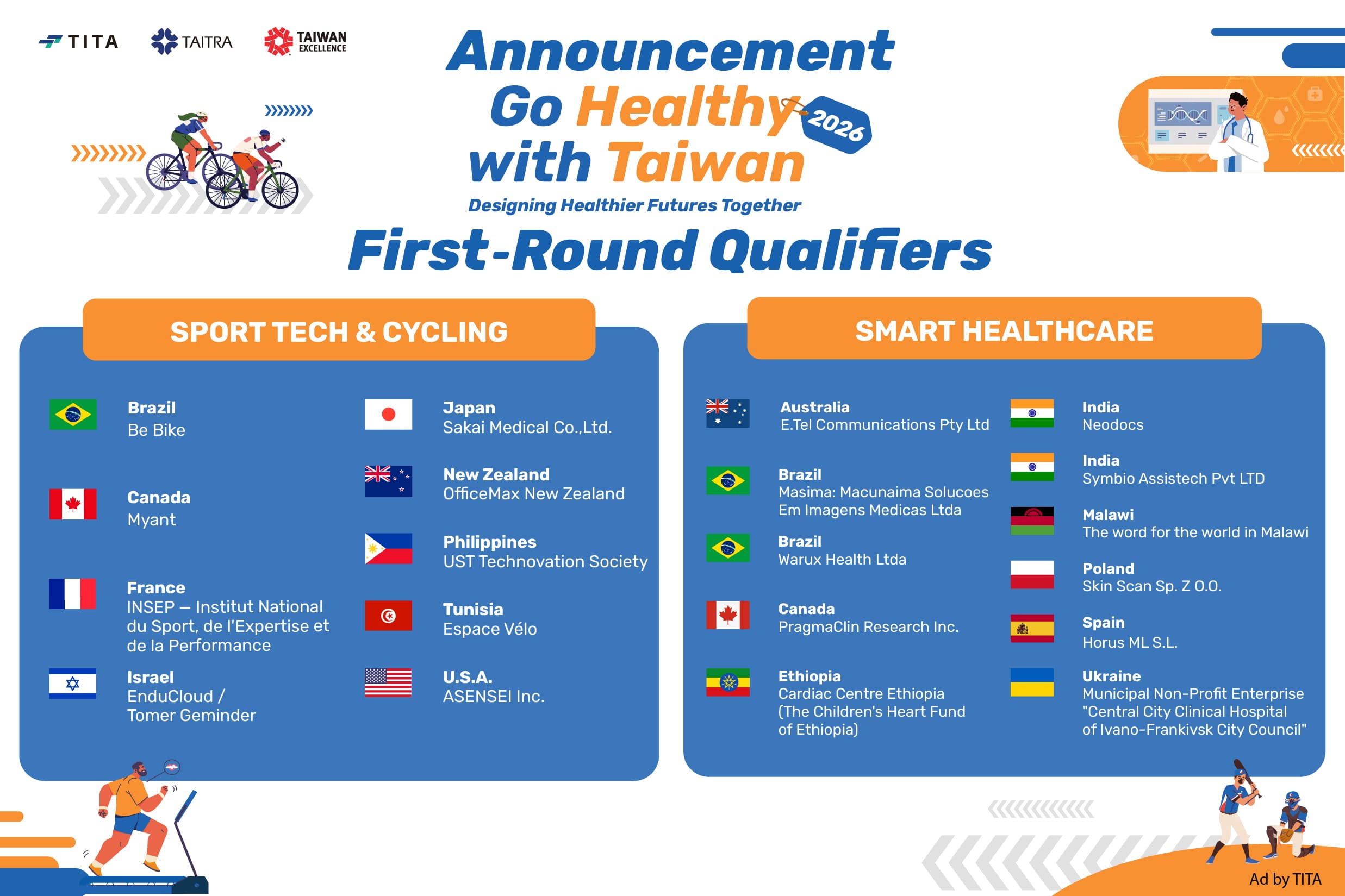
These practical applications are among the key trends emerging from the Top 20 semi-finalists of Go Healthy with Taiwan 2026, reflecting growing global efforts to make healthcare more preventive, accessible and integrated into daily living.
Organised by the International Trade Administration (TITA), Ministry of Economic Affairs, Taiwan, and implemented by the Taiwan External Trade Development Council (TAITRA), the global campaign attracted 832 proposals from 62 countries this year — a 30% increase from 638 submissions in the previous edition.
The newly announced Top 20 represent 16 countries, with solutions spanning Smart Healthcare, Sport Tech and Cycling. Their proposals address real-world needs ranging from earlier disease detection and wider access to healthcare to active ageing, rehabilitation and safer mobility.
Southeast Asia is also represented among this year’s semi-finalists. The UST Technovation Society from the Philippines has proposed a smart e-bike and trainer system with biometric monitoring to support exercise and rehabilitation for people with cardiac and chronic conditions.
Health Tech Tackles Everyday Healthcare Challenges
Of the 20 semi-finalists, 11 are in Smart Healthcare and 9 are in Sport Tech & Cycling. Across the shortlisted proposals, four areas stand out as health technology becomes increasingly focused on practical, everyday applications.
In early detection and screening, an Indian team uses a smartphone to read a urine test strip and screen for kidney disease in just 30 seconds. A Spanish team applies AI to heart disease risk screening, while a Brazilian team combines AI with Taiwanese digital health platforms for quantitative brain CT and MRI analysis.
For remote and community healthcare, a Brazilian team integrates Taiwanese contactless vital-sign AI into WhatsApp-based care services, while a Canadian solution uses 3D cameras and AI to assess Parkinson’s symptoms, extending assessment capabilities to patients in rural communities.
Healthy ageing and independent living are other major focuses. An Australian team is developing wandering detection technology for people with dementia; a Japanese team incorporates Taiwanese equipment to help older adults maintain independence; and an Israeli solution provides personalised exercise prescriptions for seniors.
Innovation is also reshaping sports, rehabilitation and mobility. Teams from the United States and France are working on real-time movement analysis and injury prevention, while a New Zealand proposal combines smart mobility, green commuting and employee wellness for corporate environments.
Connecting Global Ideas with Taiwan’s Technology Ecosystem
Importantly, many of the shortlisted concepts are already moving beyond the idea stage. 70% of the semi-finalists are companies with products already on the market, alongside SMEs, NGOs and academic institutions — highlighting the strong potential for real-world adoption.
Go Healthy with Taiwan encourages innovators worldwide to combine Taiwanese products, technologies, services or business models with solutions tailored to health needs in different markets.
The Top 20 will now receive one-on-one mentorship from industry experts to further develop their proposals. Six finalists are expected to be announced in early November and will be invited to Taiwan to pitch their ideas in person.
Three eventual winners will each receive US$30,000 to help turn their proposals into real-world applications.
By bringing together international market needs and Taiwan’s health technology capabilities, Go Healthy with Taiwan offers markets including Malaysia and Southeast Asia a window into emerging applications across smart healthcare, healthy ageing, rehabilitation and sports technology — while opening possibilities for future cross-border collaboration and market adoption.
For the full list of Top 20 semi-finalists and details of their proposals, please visit the official Go Healthy with Taiwan website: https://gohealthy.taiwanexcellence.org/semi-finals-announcement-2026.html