

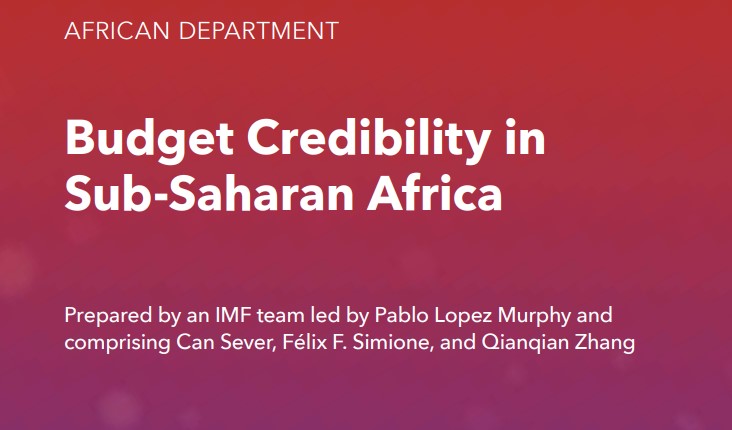
A major departmental paper released by the International Monetary Fund (IMF) has issued a stark warning to emerging markets: chronic budget slippages are no longer just accounting anomalies but they are active structural impediments to long-term economic development.
The report, titled “Budget Credibility as an Anchor for Better Economic Outcomes for Sub-Saharan Africa,” evaluates a fresh dataset of 39 nations between 2021 and 2024. The authors (Pablo Lopez Murphy, Can Sever, Félix F. Simione, and Qianqian Zhang) conclude that persistent deviations from fiscal promises have eroded policy effectiveness, triggering a damaging Negative Multiplier Effect across the Global South.
The Mechanics of Deviation: Optimism vs. Execution
The IMF research moves beyond documenting whether budgets are missed, systematically detailing why they fail. The paper exposes a recurring, systemic cycle: governments begin fiscal years with overly ambitious revenue projections and unrealistic assumptions regarding foreign grants.
When the true revenue shortfall materialises mid-year, governments face tighter financing conditions and find it politically untenable to cut primary current expenditures (such as public wages or social transfers). Consequently, capital investment is treated as the residual adjustment tool.
| Budget Component | Programmed Behavior | Actual Operational Outcome | Real-Economy Impact |
| Revenue Projections | Aggressive, optimistic forecasting models. | Frequent underperformance; systemic shortfalls. | Unplanned financing gaps discovered mid-year. |
| Current Expenditure | Stated commitment to fiscal prudence. | Consistently overspent; procyclical expansion during windfalls. | Higher deficits, unexpected borrowing, and arrears. |
| Capital Investment | Ambitious infrastructure roadmaps (roads, schools). | Systematic under-execution; deferred or cancelled. | Stifled long-term development; crumbling utilities. |
| Interest Payments | Regularly underestimated in initial drafts. | Exceeds targets due to tighter global financing. | Crowds out fiscal room for critical public services. |
The Economic Critique: Shifting the Narrative on “Shocks”
For development economists, the IMF’s findings challenge a long-standing political narrative. Regional policymakers have traditionally attributed budget deficits to isolated forecasting errors, climate-related disasters, or external commodity price volatility.
The data reveals that while external shocks are frequent, the primary drivers of budget failure are deep structural weaknesses and weak expenditure controls. This institutional failure carries a severe “Complexity Tax.” By repeatedly failing to execute capital projects, states lock themselves into perpetual crisis management.
Every dollar of promised capital development that is diverted to cover current expenditure overruns acts as an Inverse Multiplier. It does not merely represent lost infrastructure; it suppresses future capital velocity, weakens the social contract, and drives away high-value institutional investors who require predictable fiscal anchors.
Editor’s Take: Lessons in Fiscal Discipline for ASEAN’s “Rising Stars”
For the Malaysian Business reader, the IMF’s African analysis functions as an instructive mirror. While Malaysia sits on a more secure fiscal foundation, backed by a RM32.6 billion remittance-buoyed ecosystem and a RM426.7 billion pipeline of approved investments, the core institutional lessons remain entirely relevant.
As Malaysia transitions toward the 13th Malaysia Plan and navigates large-scale infrastructure transformations like the Perlis Inland Port (PIP) and regional data centre energy configurations, budget realism must remain our primary anchor.
The IMF notes that countries with independent fiscal councils, rules-based frameworks, and binding top-down expenditure ceilings consistently achieve superior macroeconomic stability.
We must resist the temptation of “the math of optimism.” When a state or nation treats capital expenditure as a flexible luxury to be trimmed whenever revenue targets falter, it is effectively borrowing against its future innovation to subsidise today’s operational overhead. For any emerging market aspiring to achieve high-income status by 2030, architectural simplicity and ironclad budget credibility are not technical preferences, they are mechanical necessities for survival.