

In a milestone disclosure that redraws the boundaries of sustainable finance in the Asia-Pacific region, the Centre for Impact Investing and Practices (CIIP), in collaboration with Temasek, Invesco, and ImpactSF, has released a comprehensive regional strategy brief titled “Climate Adaptation and Resilience in Asia: Pricing Risk, Sizing Opportunities, Financing Solutions.”
Unveiled on the eve of Ecosperity Week’s Impact Investing Roundtable 2026, the study synthesizes over US$100 billion in historical financing flows between 2021 and 2025 to map a first-of-its-kind structural architecture for climate adaptation. It identifies 250+ priority solutions designed to mitigate what has become a defining structural bottleneck for the Global South.
For a C-suite audience navigating the RM426.7 billion regional investment pipeline, the report exposes an acute macro disconnect: by 2030, Asia will account for 75% of the global climate adaptation financing gap, forcing local enterprise to absorb a staggering US$336 billion (approx. RM1.5 trillion) in annual climate overheads.
The Commerciality Tier Matrix: Sorting Hype from Scalability
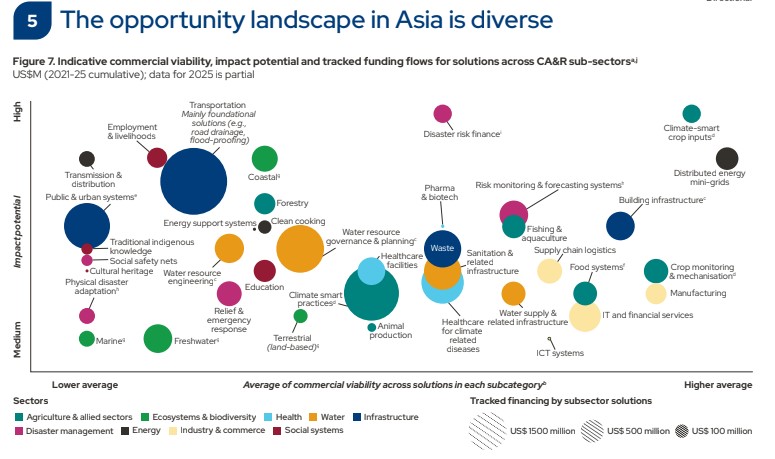
The CIIP framework dismantles the traditional, fragmented approach to climate risk by categorizing 252 localized Asian adaptation solutions across three distinct tiers of commercial viability. This provides clear, de-risked entry points for public, private, and philanthropic capital:
| Commerciality Tier | Solution Count | Core Characteristics | Strategic Allocation Target |
| Tier 1: Proven Commerciality | 65 Solutions | Clear track record; market-rate returns; ready for immediate commercial scale. | Private Equity, Sovereign Wealth, Institutional Asset Managers. |
| Tier 2: Emerging Opportunities | 93 Solutions | Technologically viable but require catalytic, blended finance to absorb early risk. | Development Finance Institutions (DFIs), Corporate Venture Capital. |
| Tier 3: Foundational Resilience | 94 Solutions | Low/no immediate commercial viability; vital for cross-border ecosystem safety. | Sovereign Grants, Concessional Public Capital, Philanthropy. |
The Agri-Food Intersection: Shifting the Smallholder Multiplier
A key sectoral deep-dive, Building a Climate-Adapted and Resilient Agri-Food System in Southeast Asia, targets the structural core of ASEAN’s rural economy. While agriculture accounts for 9.8% of Southeast Asia’s aggregate GDP, climate stress threatens to reduce critical crop yields by up to 41%.
This looming compression directly impacts the region’s 100 million smallholder farmers, many of whom operate on razor-thin margins. Under current conditions, the average annual production growth of regional food staples has languished below 1.3% over the past decade.
Dr. Godefroy Grosjean, Co-Lead at the CGIAR Hub for Sustainable Finance (ImpactSF), noted that ignoring these local vulnerabilities directly impacts corporate financial bottom lines. ImpactSF is deploying AI-driven, science-backed data models to price these hyper-local risks, shifting climate adaptation from a defensive, compliance-driven expense into an active generator of “Resilience Alpha.”
The Structural Barriers: Budget Realism and Pipeline Deficits
Promisingly, institutional funder interest is reaching a critical inflection point. A survey of 165 Asian funders managing over US$1 trillion in combined Assets Under Management (AUM) revealed that Climate Adaptation and Resilience (CA&R) has emerged as their leading impact theme. Nearly 49% are already actively deploying capital, with an additional 28% exploring immediate market entry.
However, a severe “Complexity Tax” prevents this wave of liquidity from reaching the ground. The current annual funding flow in Asia stands at just US$19 billion, a fraction of the US$200 billion+ required annually to insulate regional supply chains. Both active and inactive funders cite pipeline challenges and structural deal-structuring limitations as their primary operational bottlenecks. For inactive institutional capital, rigid investment mandates and localized knowledge gaps continue to stall allocation.
Editor’s Take: Overcoming the “Complexity Tax” of Fragmented Capital
For the Malaysian Business reader, the CIIP-Temasek blueprint confirms a thesis we have advanced across multiple industrial cycles: budget realism and architectural simplicity are non-negotiable for sovereign survival. As we track massive cross-border asset transformations, ranging from Johor Plantations’ midstream circular iSPOC complex to the RM1 billion NexQuantum AI Digital Park infrastructure in Perak we see that physical assets are highly vulnerable to localized climate shocks.
Historically, corporate boards treated climate adaptation as a philanthropic afterthought. In 2026, it is a core line item on the corporate balance sheet. The fact that current financing flows meet less than 10% of Asia’s actual resilience requirements represents a systemic threat to regional capital velocity.
To close this US$181 billion annual gap, regional captains must look to the report’s focus on Resilience Valuation. We must stop evaluating capital expenditure purely through short-term accounting metrics. If a logistics hub like the Perlis Inland Port or an enterprise provider like CelcomDigi does not embed avoided-loss calculations into its long-term policy architecture, it is effectively overstating its future equity value.
By leveraging the newly launched fund flow dashboards and case libraries, ASEAN’s “Rising Stars” have a rare opportunity to pioneer blended-finance frameworks. Securing “Resilience Alpha” today ensures that our infrastructure can withstand the volatile, climate-strained macro environment of the next decade.