

Strategic Takeaways
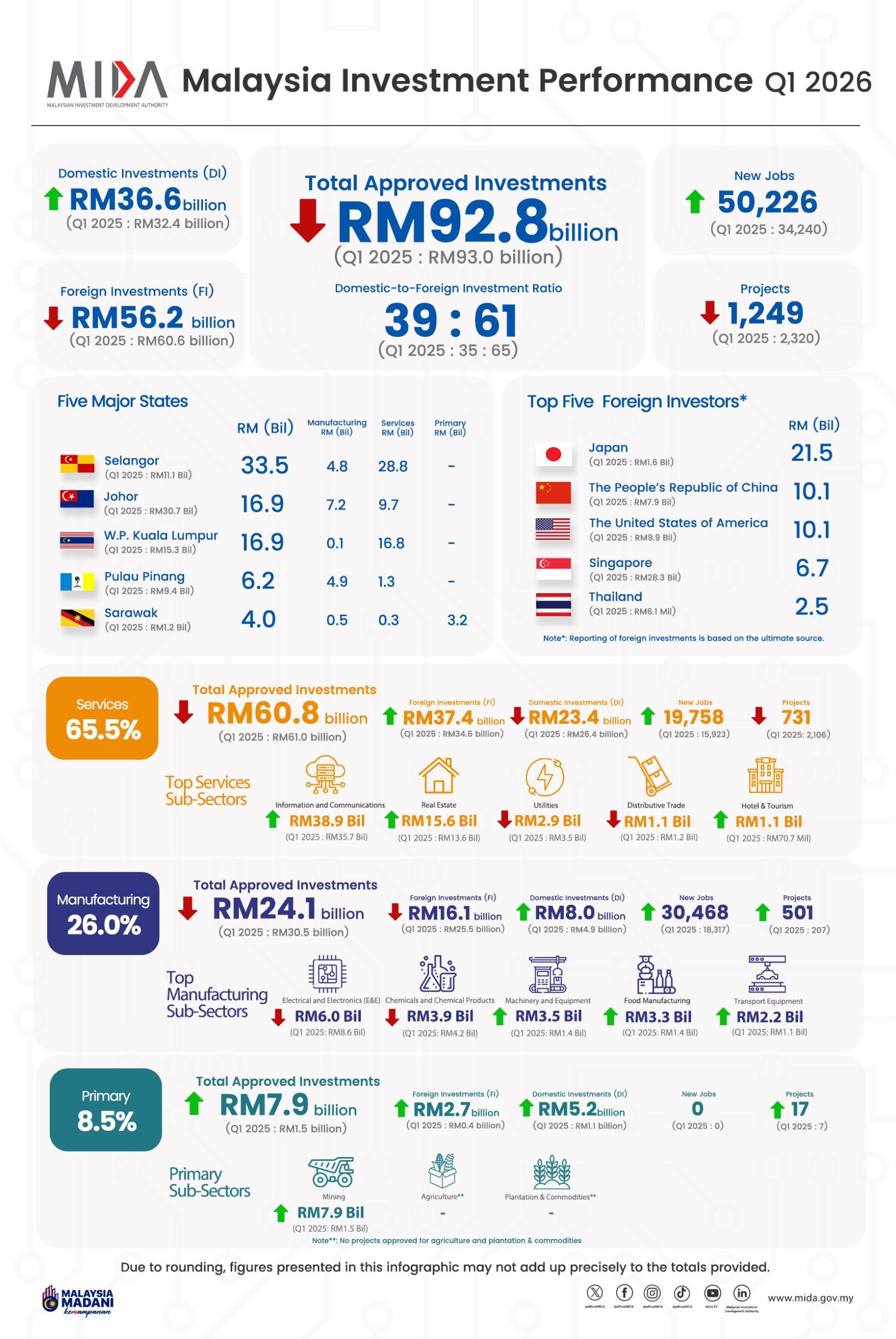
- The Sovereign Capital Distribution: The services sector led the quarter by securing RM60.8 billion (65.5% of total approvals), while advanced manufacturing captured RM24.1 billion (26.0%), and the primary sector grew to RM7.9 billion (8.5%), driven by offshore oil and gas developments in Sarawak.
- The Japanese High-Tech Influx: Japan emerged as the leading foreign investor with a RM21.5 billion injection (a 13.8x year-on-year expansion). Notably, 93.6% of this capital is allocated to digital transformation, front-end compound semiconductor manufacturing, and advanced electronic systems.
- The Regional Hub Concentration: Selangor solidified its lead by attracting RM33.5 billion (a 3x year-on-year surge), followed by Johor and W.P. Kuala Lumpur at RM16.9 billion each. Together, these locations anchor the country’s expanding data center networks, which accounted for RM34.6 billion across 33 projects.
Moving past passive investment attraction and toward strict, tech-driven resource curation, the Malaysian Investment Development Authority (MIDA) has announced that the nation secured RM92.8 billion in approved investments for the first quarter of 2026 (Q1 2026).
The quarterly data highlights an economy adapting well to shifting global circumstances.
While total investment value adjusted by a marginal 0.2% year-on-year against Q1 2025, the pipeline shifted toward high-impact projects.
This structural movement is expected to create 50,226 new jobs representing a substantial 46.7% year-on-year surge in employment generation.
The investment data reveals a strategic shift driven by MIDA’s New Incentive Framework launched on March 1, 2026.
Faced with global fragmentation and changing energy dynamics, Malaysia has turned away from low-margin, labor-heavy manufacturing and refocused its efforts on front-end semiconductor engineering, advanced biopharmaceuticals, and green energy arrays.
This selective approach is clearest in the digital infrastructure layer.
Instead of welcoming any data center operator, MIDA’s specialized taskforces are prioritizing speed-to-market and strict sustainability metrics.
This disciplined review process helped the Information and Communications subsector secure a dominant RM38.9 billion share of the services industry.
Dissecting the Core Architecture: Local Sourcing Meets Advanced Materials
- 1. The Localized Supply Chain Protocol (#InvestLokal): Directed by MIDA Chairman YM Tengku Datuk Seri Utama Zafrul Tengku Abdul Aziz, the New Incentive Framework balances foreign investment with deep local integration. Domestic investments expanded by 13.0% year-on-year to RM36.6 billion (39.5% of total approvals), proving that local businesses are actively expanding to support global tech giants.
- 2. Front-End High-Velocity Manufacturing: Managed by MIDA CEO Datuk Sikh Shamsul Ibrahim Sikh Abdul Majid, project execution remains high, with over 85% of manufacturing applications approved since 2021 reaching active implementation stages. Notable front-end wins during the quarter include:
- Aixtron Malaysia (Germany): Investing RM200.0 million into a Global Centre of Excellence for MOCVD technology, introducing Malaysia’s first front-end deposition segment for next-generation materials like GaN and SiC.
- WaferWise Semiconductor (China): Allocating RM700.0 million to build a 12-inch wafer-level chip-scale packaging facility optimized for automotive CMOS image sensors.
- Halo Laser Technologies (US): A Stanford University spin-out investing RM329.8 million into proprietary laser-based manufacturing for silicon carbide wafers used in AI data centers.
Editor’s Take: Anchoring Regional Value Through Productivity Realism
From the strict view of macroeconomic policy and Productivity Realism, MIDA’s Q1 2026 data contains a clear lesson for the ASEAN business landscape: sustainable enterprise value and national competitive edge belong to hubs that systematically convert investment approvals into running, automated operations. For too long, regional markets have celebrated large investment announcements without monitoring project completion rates, leaving their local supply chains exposed to sudden resource delays and empty industrial sites.
True economic leadership requires ensuring high project execution rates.
By utilizing unified facilitation platforms like the Invest Malaysia Facilitation Centre (IMFC), local authorities are demonstrating how to move complex manufacturing projects from paper to production within 18 to 24 months.
This clear focus on execution is vital as global electronics and energy networks reorganize to minimize logistical friction.