

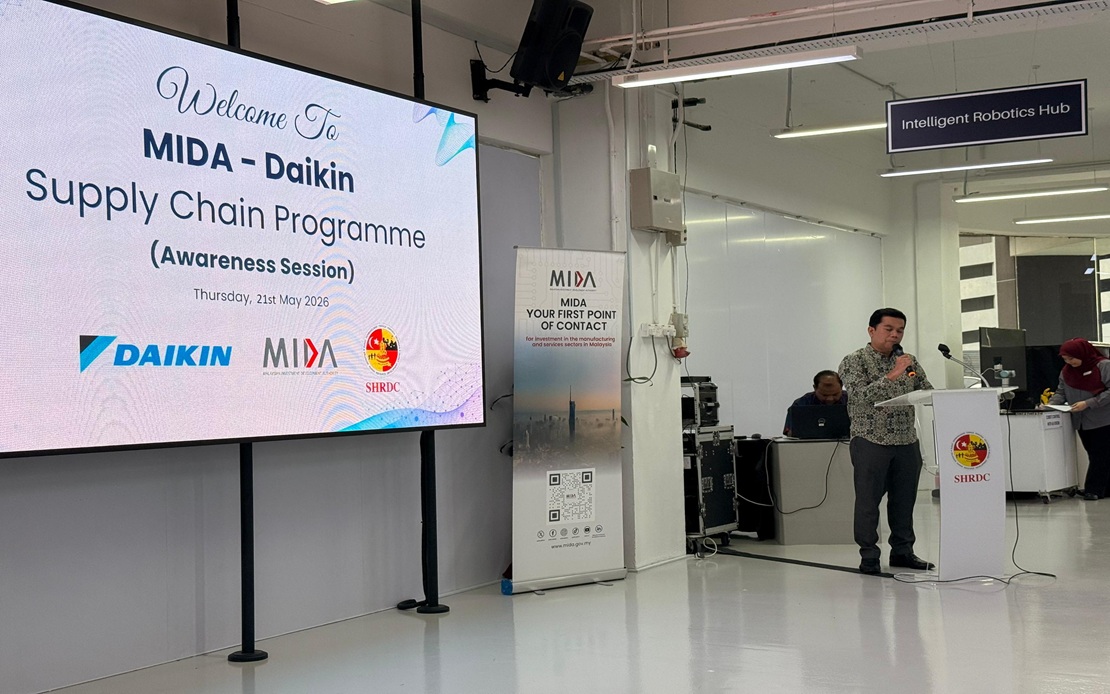
Strengthening Malaysia’s tier-two and tier-three industrial networks to match global procurement standards, the Malaysian Investment Development Authority (MIDA) has finalized a tripartite supplier capability development framework.
Staged before an audience of over 100 domestic manufacturing executives, component vendors, and banking institutions at the Selangor Human Resource Development Centre (SHRDC), the launch debuts the MIDA – Daikin Supply Chain Programme.
The joint initiative brings together federal policy architects, multinational corporation (MNC) supply chains, and technical human capital hubs under a unified platform.
The commercial objective moves past traditional, hands-off supplier development seminars. Instead, the initiative addresses a clear structural goal within the New Industrial Master Plan (NIMP 2030): protecting domestic manufacturing margins by moving local small and medium enterprises (SMEs) directly into high-value multinational supply chains.
By converting loose manufacturing practices into advanced, data-driven smart factory setups, the framework aims to shield local manufacturers from unexpected global trade shifts, optimize operating efficiencies, and anchor Malaysia as a premier manufacturing center.
The Architecture of Integration: Overcoming the SME Complexity Tax
Historically, local manufacturing vendors attempting to secure long-term component supply contracts with top-tier MNCs like Daikin Malaysia and Daikin Electronics Devices Malaysia have run into a hidden “Complexity Tax.” This systemic friction stems from a combination of old, manual machine configurations, a lack of standardized quality data, and an inability to meet the automated tracking requirements demanded by modern international buyers. These gaps frequently push multinational procurers to source their core components from external regional hubs.
The MIDA-Daikin-SHRDC program resolves these technical barriers by connecting manufacturing technology with target business pipelines:
- The SINERGI Integration Model: Spearheaded by SHRDC Executive Director Ms. Teh Sook Ling, the SINERGI platform coordinates technical training, state policy updates, smart machinery, and corporate buyers into a single operational channel. Rather than forcing local firms to deploy automation tools in isolation, the framework allows vendors to run synchronized upgrades that match Daikin’s explicit procurement criteria.
- On-Floor Technical Exposure: To show these upgrades in practice, the program incorporates direct tours of SHRDC’s advanced Shah Alam facility. This experience gives local business owners direct access to real-world Industry 4.0 applications focusing on machine-to-machine communications, cloud-based performance tracking, and automated sorting cells.
- Streamlined Regulatory Navigation: Led by MIDA senior executives, including Executive Director of Investment Promotion Mr. Faizal Jalaludin and Domestic Investment Director Mr. Sukri Abu Bakar, the platform provides direct support for local firms navigating state regulations. This includes hands-on assistance for companies applying for modern Manufacturing Licences and moving through compliance checks.
Financial Engineering: Funding Digital Transformation via Alliance Bank
Recognizing that upgrading equipment requires reliable access to capital, the alliance has integrated commercial lenders like Alliance Bank straight into its operational framework. Mainstream bank loans often require heavy physical collateral that small engineering firms cannot provide, slowing down technology adoption.
                     [ DOMESTIC TIER-2 AND TIER-3 MANUFACTURERS ]
                                          ▼
               [ CAPITAL MEDIATION WAIST ] (Alliance Bank Targeted Digital Loans)
                                          ▲
               [ SECURED MULTI-YEAR CONTRACTS ] (Daikin Global Value Chain Nodes)
By connecting targeted commercial loans directly with verified supply chain development milestones, the partnership allows local vendors to secure flexible financing to fund their automation software, robotic arms, and quality tracking tools.
This financial support allows engineering firms to comfortably upgrade their factory floors without taking on unstable out-of-pocket liabilities.
When local components consistently meet Daikin’s low defect standards, it reduces the need for expensive imported parts, lowering overall logistics overheads and building a highly resilient domestic supply ecosystem.
Editor’s Take: Ecosystem Realism and the Industrial Talent Imperative
For the Malaysian Business reader, the MIDA-Daikin-SHRDC supply chain program delivers a critical lesson in Productivity Realism: in a fragmented global trade arena, long-term market dominance belongs entirely to the industrial networks that proactively cultivate their local tier-two supply bases. For decades, the domestic industrial sector has paid a high “Complexity Tax” relying heavily on low-cost labor and cheap imported inputs while underinvesting in the technical training and automation upgrades required to climb into premium global manufacturing tiers.
True market leadership requires building secure, high-skill ecosystems.
As MIDA CEO Datuk Sikh Shamsul Ibrahim Sikh Abdul Majid rightly highlights, integrating local firms into global value chains is a critical requirement to protect national competitiveness, lower corporate health overheads, and unlock high-paying technical jobs for the local workforce.
This collaborative approach provides an exact strategic blueprint for our business community as we deploy assets under the 13th Malaysia Plan (2026–2030). To capture maximum yield from advanced manufacturing, our corporate leaders must look past standalone operations.
Whether tracking Gentari’s 150MWp LSS5 solar development driving clean utility base loads to lure tech FDI, evaluating Berjaya Air’s vertical integration using the world’s first all-business ATR HighLine fleet to capture premium luxury transit, or monitoring Alpro Group’s subscription networks streamline care delivery, the core priority remains identical: eliminate operational friction.
By actively leveraging the SINERGI training platform, installing smart tracking tools, and connecting with multinational supply chains, Malaysian manufacturers can successfully bulletproof their operations, lower their production overheads, and build a lasting competitive advantage on the global industrial stage.